Since I have to go pick up The Wench at the airport today, and since I'm running late already, without any further commentary here's an interesting article about WoTC's new strategy for D&D.
RPGPundit
Currently Smoking: Mastro de Paja bent apple + Dunhill 965
Monday, 3 February 2014

Sunday, 2 February 2014
Golden Age Non-Update: The Mystery Man who Ran a Country
Last night's game was cancelled on account of both rain and birthday party, thus we didn't get a chance to play an adventure with the Mystery Men. So instead I'll mention that in the interim between last adventure and the next, there was an important conference that took place among Allied leaders in Canada. The Mystery Men were not present, though the important powers each brought their own heroes as bodyguards: Churchill brought the Shining Knight; The U.S. brought The Patriot; and Canada's Prime Minister had The Canadian Shield to guard him.
But maybe that last one shouldn't have bothered, since in fact, in secret (until after his death, that is), Prime Minister William Lyon Mackenzie King was a "mystery man" in his own right. Mackenzie King was Canada's longest-serving Prime Minister and guided that country through several important stages in its history, not least the Second World War. The whole time, however, he also had a secret identity: from an early age, he'd developed the superpower of being able to speak with the spirits of the dead. Mackenzie King was a Medium.
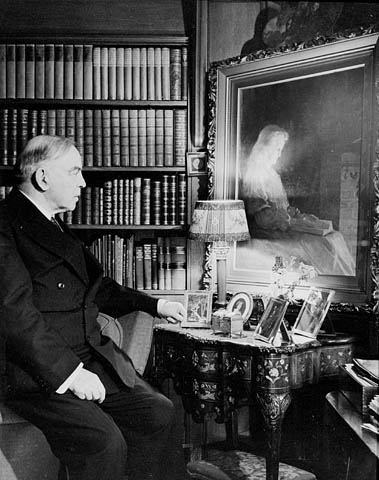
There's a picture of our heroic Prime Minister, engaged in channeling his dead mother for advice on important affairs. Mackenzie King consulted his deceased mother's spirit more than anyone else in his seances (performed via crystal ball and ouija board), seeking her advice on all sorts of vital matters. Of course, in affairs of state he did not only refer to mommy; he also relied on more serious advisers, like his dead mentor, the late Prime Minister Wilfred Laurier. And of course, his deceased dogs, all of whom were named "Pat". This team of dead housewives, 19th century politicians and various Irish Terriers worked to secretly insure Mackenzie King's success in life and politics.
In case you're not Canadian (If you are, all of this should be old hat to you, and if isn't shame on you!), yes, this is all true. Canada's WWII-era Prime Minister, its longest serving and one of its most popular (who's face is on the Canadian $50 bill), was also its weirdest.
...Or then again, maybe not. I mean, was WLMK any weirder than a Prime Minister who is an active and engaged member of something called the "Christian and Missionary Alliance Church", who hold as literal truth that the world is only 6000 years old, that evolution is a lie, and that climate change is a Satanic conspiracy? I mean, at least Mackenzie King's ghost-terriers didn't seem to have given him any really terrible advice; as far as we know "Pat III" never suggested that his master should forge a secret alliance with Hitler, or something... on the other hand, Prime Minister Stephen Harper has most definitely been drawn to serious politics by his own communications with ghosts (the Holy Ghost, in this case), to turn his back on every commitment Canada had ever made to the environment, to appoint Creationists as his Science Minister, and to write a blank-check declaration of absolute loyalty to Israel because he thinks its important for a prophetic apocalypse-timeline.
So maybe Mackenzie King's woo-woo ideas weren't the problematic ones after all.
RPGPundit
Currently Smoking: Stanwell compact + Image Latakia
But maybe that last one shouldn't have bothered, since in fact, in secret (until after his death, that is), Prime Minister William Lyon Mackenzie King was a "mystery man" in his own right. Mackenzie King was Canada's longest-serving Prime Minister and guided that country through several important stages in its history, not least the Second World War. The whole time, however, he also had a secret identity: from an early age, he'd developed the superpower of being able to speak with the spirits of the dead. Mackenzie King was a Medium.
There's a picture of our heroic Prime Minister, engaged in channeling his dead mother for advice on important affairs. Mackenzie King consulted his deceased mother's spirit more than anyone else in his seances (performed via crystal ball and ouija board), seeking her advice on all sorts of vital matters. Of course, in affairs of state he did not only refer to mommy; he also relied on more serious advisers, like his dead mentor, the late Prime Minister Wilfred Laurier. And of course, his deceased dogs, all of whom were named "Pat". This team of dead housewives, 19th century politicians and various Irish Terriers worked to secretly insure Mackenzie King's success in life and politics.
In case you're not Canadian (If you are, all of this should be old hat to you, and if isn't shame on you!), yes, this is all true. Canada's WWII-era Prime Minister, its longest serving and one of its most popular (who's face is on the Canadian $50 bill), was also its weirdest.
...Or then again, maybe not. I mean, was WLMK any weirder than a Prime Minister who is an active and engaged member of something called the "Christian and Missionary Alliance Church", who hold as literal truth that the world is only 6000 years old, that evolution is a lie, and that climate change is a Satanic conspiracy? I mean, at least Mackenzie King's ghost-terriers didn't seem to have given him any really terrible advice; as far as we know "Pat III" never suggested that his master should forge a secret alliance with Hitler, or something... on the other hand, Prime Minister Stephen Harper has most definitely been drawn to serious politics by his own communications with ghosts (the Holy Ghost, in this case), to turn his back on every commitment Canada had ever made to the environment, to appoint Creationists as his Science Minister, and to write a blank-check declaration of absolute loyalty to Israel because he thinks its important for a prophetic apocalypse-timeline.
So maybe Mackenzie King's woo-woo ideas weren't the problematic ones after all.
RPGPundit
Currently Smoking: Stanwell compact + Image Latakia
Saturday, 1 February 2014
If You're a Female Asian Highschooler in the U.S., You Might Be In For a Tough Year...
Consider me on record as being against "Zero Tolerance" policies; pretty much in general, but especially in schools. The very notion of zero tolerance is an idiotic concept, it restricts authorities from being able to use their own judgment in determining individual cases. Its led to idiocy like teenagers being suspended for consensual hugging, 7 year old boys being suspended for pretending their fish stick was a gun, or honors students being expelled for bringing as dangerous a weapon as nail-clippers to school with them.
It has been proven to do nothing to prevent violence in schools. It almost certainly does nothing to improve behavior, and it doesn't even manage to prevent a statistically credible problem involving school administrators potentially being more harsh with discipline against students of certain race or gender and more lenient to others; before 'zero tolerance', there may well have been cases of a prejudiced administrator giving a white kid in school less of a punishment for the same misbehavior than a black kid; after 'zero tolerance', the same corrupt administrator would just end up suspending/expelling the black kid and letting the white kid off scot-free.
The problem, you see, is with poor administrators. Thus, it isn't something that can be solved with regulation if you don't fix the regulators. But of course, with teacher's unions on the one hand and a general public hungry for quick-fixes that seem to be 'doing something' on the other, it just seems much easier to introduce what seems like a tough-on-crime policy than actually reforming the fundamental system.
So now it seems that the Obama administration has decided they don't like Zero Tolerance either. Great! Only as you might expect from the left wing, they think that the solution is to replace one set of idiotic regulations with another.
The Department of Education together with the Justice Department has now issued new regulations to schools throughout the country urging them to drop zero-tolerance in favor of a new policy that seeks to correct above all what they call "disparate impact". This in brief is the phenomenon I already hinted about above: that statistically, children of certain minority groups (African Americans, Latinos) are considerably more likely to be suspended from school than white students. The DoE/DoJ paper suggests that from now on American schools should above all strive to make sure that their numbers demonstrate 'equality': schools that end up suspending more black kids, hispanic kids, or special-ed kids than other kids will be considered "suspect".
These new school rules will consider demographics over discipline, but it ignores a very real problem: the simple fact is that while there are undoubtedly cases of racial prejudice or other biases on the parts of teachers and administrators that could lead to unfair disciplining, there's also realistically social problems that have nothing to do with race in and of itself but that occur along racial lines (as well as other demographic details, like gender) which means that kids of certain demographics are not just more likely to be unfairly disciplined, they're also more likely to have discipline problems that MUST be dealt with in order to prevent absolute chaos in the schools.
Inner-city schools are likely to have a higher proportion of minority students than schools in the suburbs; they're also much more likely to have discipline problems for all kinds of reasons (poverty, crime in the local environment, gangs, drugs, and underfunded or neglected schools themselves, for that matter). The reality is that in these schools you're more likely to have kids with discipline problems, and those kids are more likely to be of certain minorities.
So with this new policy, what options are left to schools? Only two: the first would be that in order to avoid becoming "suspect" in the government's eyes, teachers and administrators find themselves forced to NOT discipline students of certain racial background that commit violence or crime in schools. Of course, this first option just isn't violence, schools in this situation would fall to pieces as criminal delinquents would be able to get away with destroying the school environment with impunity.
So I have to assume even liberal school administrators wouldn't be that crazy. The only other option, however, is to try to keep up "quotas", and the only way to do this is by punishing children that don't fit those particular minority demographics MORE harshly, applying more strict rules to try to "balance things out". If you suspend a Hispanic kid for drug-dealing, and you can't find any drug-dealing white kid in your school to suspend, then you're just going to have to suspend a white kid for throwing an eraser in class. If a black kid beats another student up in school and you have to expel him, you'll have to find an Asian to expel for speaking too loudly in the school hallway.
Which brings up another issue: this isn't just black vs. white. The same statistical survey that demonstrated that black students are (proportionally) three times more likely to be expelled from school than white students also showed that Asian students are even less likely to be expelled than either group. Is this because there is a dastardly pro-Asian agenda in our schools? Or could it be that for reasons of economics, culture, and upbringing Asian kids are just much less likely to get in trouble in school?
While we're at it, in general boys any race are VASTLY more likely to be suspended or expelled than girls. I can't believe that this is entirely due to a pernicious feminist "war on boys"; I think most likely its that both cultural and biological elements related to gender make girls, on the whole, less likely to commit the types of delinquency that lead to suspensions or expulsions.
But if we are to avoid "disparate impact" it means schools will have to be increasingly more vehement in their disciplining of girls than boys, of Asians than caucasians, in order to make sure they aren't "suspect" of discrimination for choosing to suspend people based on what they actually DO.
Shit, if you're an Asian schoolgirl in America, you're about to have a very rough year...
RPGPundit
Currently Smoking: Stanwell deluxe + Image Perique
It has been proven to do nothing to prevent violence in schools. It almost certainly does nothing to improve behavior, and it doesn't even manage to prevent a statistically credible problem involving school administrators potentially being more harsh with discipline against students of certain race or gender and more lenient to others; before 'zero tolerance', there may well have been cases of a prejudiced administrator giving a white kid in school less of a punishment for the same misbehavior than a black kid; after 'zero tolerance', the same corrupt administrator would just end up suspending/expelling the black kid and letting the white kid off scot-free.
The problem, you see, is with poor administrators. Thus, it isn't something that can be solved with regulation if you don't fix the regulators. But of course, with teacher's unions on the one hand and a general public hungry for quick-fixes that seem to be 'doing something' on the other, it just seems much easier to introduce what seems like a tough-on-crime policy than actually reforming the fundamental system.
So now it seems that the Obama administration has decided they don't like Zero Tolerance either. Great! Only as you might expect from the left wing, they think that the solution is to replace one set of idiotic regulations with another.
The Department of Education together with the Justice Department has now issued new regulations to schools throughout the country urging them to drop zero-tolerance in favor of a new policy that seeks to correct above all what they call "disparate impact". This in brief is the phenomenon I already hinted about above: that statistically, children of certain minority groups (African Americans, Latinos) are considerably more likely to be suspended from school than white students. The DoE/DoJ paper suggests that from now on American schools should above all strive to make sure that their numbers demonstrate 'equality': schools that end up suspending more black kids, hispanic kids, or special-ed kids than other kids will be considered "suspect".
These new school rules will consider demographics over discipline, but it ignores a very real problem: the simple fact is that while there are undoubtedly cases of racial prejudice or other biases on the parts of teachers and administrators that could lead to unfair disciplining, there's also realistically social problems that have nothing to do with race in and of itself but that occur along racial lines (as well as other demographic details, like gender) which means that kids of certain demographics are not just more likely to be unfairly disciplined, they're also more likely to have discipline problems that MUST be dealt with in order to prevent absolute chaos in the schools.
Inner-city schools are likely to have a higher proportion of minority students than schools in the suburbs; they're also much more likely to have discipline problems for all kinds of reasons (poverty, crime in the local environment, gangs, drugs, and underfunded or neglected schools themselves, for that matter). The reality is that in these schools you're more likely to have kids with discipline problems, and those kids are more likely to be of certain minorities.
So with this new policy, what options are left to schools? Only two: the first would be that in order to avoid becoming "suspect" in the government's eyes, teachers and administrators find themselves forced to NOT discipline students of certain racial background that commit violence or crime in schools. Of course, this first option just isn't violence, schools in this situation would fall to pieces as criminal delinquents would be able to get away with destroying the school environment with impunity.
So I have to assume even liberal school administrators wouldn't be that crazy. The only other option, however, is to try to keep up "quotas", and the only way to do this is by punishing children that don't fit those particular minority demographics MORE harshly, applying more strict rules to try to "balance things out". If you suspend a Hispanic kid for drug-dealing, and you can't find any drug-dealing white kid in your school to suspend, then you're just going to have to suspend a white kid for throwing an eraser in class. If a black kid beats another student up in school and you have to expel him, you'll have to find an Asian to expel for speaking too loudly in the school hallway.
Which brings up another issue: this isn't just black vs. white. The same statistical survey that demonstrated that black students are (proportionally) three times more likely to be expelled from school than white students also showed that Asian students are even less likely to be expelled than either group. Is this because there is a dastardly pro-Asian agenda in our schools? Or could it be that for reasons of economics, culture, and upbringing Asian kids are just much less likely to get in trouble in school?
While we're at it, in general boys any race are VASTLY more likely to be suspended or expelled than girls. I can't believe that this is entirely due to a pernicious feminist "war on boys"; I think most likely its that both cultural and biological elements related to gender make girls, on the whole, less likely to commit the types of delinquency that lead to suspensions or expulsions.
But if we are to avoid "disparate impact" it means schools will have to be increasingly more vehement in their disciplining of girls than boys, of Asians than caucasians, in order to make sure they aren't "suspect" of discrimination for choosing to suspend people based on what they actually DO.
Shit, if you're an Asian schoolgirl in America, you're about to have a very rough year...
RPGPundit
Currently Smoking: Stanwell deluxe + Image Perique
Friday, 31 January 2014
Did 'Game of Thrones' Start as a GURPS campaign?
Gentlemen, I present you the evidence: first of all, we know for an absolute fact that George R.R. Martin is a gamer, and that his favorite game in the world is GURPS. We know that some of his other novels began as direct inspiration/play-report from one of his campaigns.
Now, I haven't actually seen any direct confirmation from Martin (or a reliable source of some kind) that "A Game of Thrones" started out as a GURPS campaign. One person I discussed the matter with recently decried the notion that GoT might have started as an RPG game as "wishful thinking".
We do know for a fact that Martin was influenced by the War of the Roses. And we know you can make the War of the Roses into an RPG setting: I've done it, with my "Dark Albion" campaign/ free setting. But its true that it might be too much to hope for that one of the most popular franchises of recent years has direct RPG-roots.
Maybe so, but at the same time as an historian I'm trained to study text for historical clues. And I think I've discovered something everyone else has missed.
First, presume that IF Martin had started Game of Thrones as a campaign, it would have been with GURPS. Second, we know that characters created with different systems sometimes have a different look. In GURPS' case, it is heavily affected by its being a point-buy system for people that love radical "character optimization". Random-roll old-school it ain't.
With those two points in mind, something fascinating reveals itself: pretty much with every character in Thrones you can see them as GURPS Fantasy guys complete with having seriously minmaxed on their disadvantages. Consider:
"I want to be the best fucking swordsman in the world.. shit.. better take 'incestuous relationship with sister' and 'murdered the last king'"
"I want to be even better at swordplay than that other guy! Damn.. i better take "excessively tall", "social disadvantage: female", and "flaw: falls in love with idiots""
"I want to be crazy smart and really socially competent... ah well, 'midget' here I come"
"I want my character to be King! Damn.. I'll have to take the 'complete asshole' disadvantage"
"I want to have 'contender for the throne' and be the only player who didn't pay it off with 'complete moron'. Yeah, I know I'll need to pay it off somehow.. how about 'sold his soul to a religious cult'?"
"I'm the badass strong mean knight.. fuck, well, "facial burns" and 'phobia: fire' it is.."
"I want dragons!! You're saying I'll have to take what?? And that's still not enough? I'd also need to.. shit. Oh.. well.. ok!"
"I want to be the most awesome character in this or any other campaign ever. I'll have to take 'little girl'?? But I did that exact same thing already in the 'Kick-Ass Supers' campaign! Well, whatever..."
...And then the guy playing Littlefinger doesn't char-op at all and ends up running circles around everyone else anyways by sheer Roleplay, because he's used to playing Amber instead of GURPS. Which is why the char-opers all despise him.
RPGPundit
Currently Smoking: Ben Wade Canadian + Image Latakia
Now, I haven't actually seen any direct confirmation from Martin (or a reliable source of some kind) that "A Game of Thrones" started out as a GURPS campaign. One person I discussed the matter with recently decried the notion that GoT might have started as an RPG game as "wishful thinking".
We do know for a fact that Martin was influenced by the War of the Roses. And we know you can make the War of the Roses into an RPG setting: I've done it, with my "Dark Albion" campaign/ free setting. But its true that it might be too much to hope for that one of the most popular franchises of recent years has direct RPG-roots.
Maybe so, but at the same time as an historian I'm trained to study text for historical clues. And I think I've discovered something everyone else has missed.
First, presume that IF Martin had started Game of Thrones as a campaign, it would have been with GURPS. Second, we know that characters created with different systems sometimes have a different look. In GURPS' case, it is heavily affected by its being a point-buy system for people that love radical "character optimization". Random-roll old-school it ain't.
With those two points in mind, something fascinating reveals itself: pretty much with every character in Thrones you can see them as GURPS Fantasy guys complete with having seriously minmaxed on their disadvantages. Consider:
"I want to be the best fucking swordsman in the world.. shit.. better take 'incestuous relationship with sister' and 'murdered the last king'"
"I want to be even better at swordplay than that other guy! Damn.. i better take "excessively tall", "social disadvantage: female", and "flaw: falls in love with idiots""
"I want to be crazy smart and really socially competent... ah well, 'midget' here I come"
"I want my character to be King! Damn.. I'll have to take the 'complete asshole' disadvantage"
"I want to have 'contender for the throne' and be the only player who didn't pay it off with 'complete moron'. Yeah, I know I'll need to pay it off somehow.. how about 'sold his soul to a religious cult'?"
"I'm the badass strong mean knight.. fuck, well, "facial burns" and 'phobia: fire' it is.."
"I want dragons!! You're saying I'll have to take what?? And that's still not enough? I'd also need to.. shit. Oh.. well.. ok!"
"I want to be the most awesome character in this or any other campaign ever. I'll have to take 'little girl'?? But I did that exact same thing already in the 'Kick-Ass Supers' campaign! Well, whatever..."
...And then the guy playing Littlefinger doesn't char-op at all and ends up running circles around everyone else anyways by sheer Roleplay, because he's used to playing Amber instead of GURPS. Which is why the char-opers all despise him.
RPGPundit
Currently Smoking: Ben Wade Canadian + Image Latakia
Thursday, 30 January 2014
RPGPundit Reviews: Sixcess Core
This is a review of the "Sixcess Core" RPG; written (mainly) by Ben Rogers, published by Harshrealities. It is a review of the print edition, softcover, about 290 pages long. Its in gorgeous mostly-full-colour with quite good production values and art.
You might not have heard of Sixcess Core. On the other hand, if you've been to certain conventions, you might have found a large number of gaming tables dedicated to this game. Likewise, if you've been on certain rpg forums, you might have found quite a few enthusiastic threads posted on the subject of this game, as well as banner advertising (including on theRPGsite). I found that a bit of a mystery, since it certainly did seem to come out of nowhere. But as it turns out, there's a reason for that, only I was not sure it has much to do with the game itself as with other reasons its promoters have for being so, well, evangelizing.
In this case, I use that last word literally. I had the suspicion that Sixcess Core is produced by quite a large team of people, that I suspected of belonging all to the same church. As it turns out, I happened to speak recently with Ben Rogers, the main author, when we were both guest panelists in the "All-Star" #rpgnet-chat interview of RPG celebrities. When I questioned him on this, he assured me that my suspicion was unfounded, that only he and a couple of friends involved were religious, and did not attend any church. He assured me, in fact, that the promotion of Sixcess to the extent of making a huge investment in Con presence, advertising, and even producing a Calendar with schedules of Con Events and other details about the game, were purely a part of a large-scale marketing plan. I have no reason to imagine he'd be dishonest about it (after all, if he really was evangelizing with his book, you'd think he'd be very eager to say so!), but in fact that only makes me think he's crazy in a whole different way. To me at least, it would be more understandable if he was producing Sixcess and promoting it eagerly at a level of financial investment far beyond what he could reasonably expect would be profitable in this current RPG industry, because he was doing it for a higher cause he held dear; rather than just doing it because he has an idea that Sixcess could really be such an astounding success that he will make a huge enough return on his expenditures to make it all worthwhile.
In any case, my reasons for initially thinking Sixcess was an evangelizing project is not something I've just pulled out of nowhere. If you look at the book's credits, they give "special thanks" to "God the Father, Jesus the Christ, and the Holy Spirit" (one would almost expect that it ought to have been 'Holy the Spirit', but I guess there's no accounting for poetic meter). Right after their preface, they provide "a word from the writers" where they comment that "the writers of this game system are Christians who believe in Biblical truth. We are presenting a worldview based on these beliefs". They do make a point of claiming that it is not that they are seeking to convert people or make others change their ways, only to "proclaim truth to every creature", which is the "one specific task" that "all Believers were given".
Their argument is that the RPG world is "rife with various forms of heathen, pagan, agnostic, and atheistic worldviews" and that "no one makes apologies for presenting what they believe in a game system, nor shall we". I can, I suppose, understand their perspective if you presume that the mere absence of strong Christian advocacy in most RPGs amounts to a direct promotion of these other worldviews; except I'm quite sure that most RPG writers are not actually "presenting what they believe". I certainly don't honestly believe that Gnomes really exist and are out to kill us all, nor do I believe in the literal existence of Indra or other Indian gods as the kind of mythological beings seen in the ancient Vedas, or in my Arrows of Indra RPG.
I know that Tracey Hickman is a Mormon, and not a believer in the pagan pantheon of Dragonlance, M.A.R. Barker was a Muslim and not a believer in the weirdo-gods of Tekumel, and Gary Gygax was a fairly devout Christian in real life rather than a follower of Pelor. I guess its possible, maybe even probable, that some of the WoD authors were new-agers or pagans or Wiccans, but I suspect the vast majority of them didn't believe that Vampires or Faeries were real. So certainly the argument that other RPGs are not expressly presenting a Christian worldview does not equivocate to meaning that they are expressly meant to present what the authors do in fact believe (and that this is an anti-christian worldview).
There's something about this kind of work that tends to remind me of a statement by the cartoon character Hank Hill regarding "Christian Rock": "this doesn't make Christianity better, it just makes rock worse". The real question is just how heavy-handed a treatment Sixcess will be.
Before taking a careful look at that, I ought to address the question of why this subject matters in the first place, from the reviewer's point of view. There are two reasons: in the first place, there is the aforementioned question of just how much the actual "christian worldview" ends up affecting the game itself. That will be examined later. But even aside from that, even if we should assume that it does not have a major impact on the game itself, this would then beg the question of why they chose to bring it up in the first place? The second point is that there are going to be people, potential readers, who will (for whatever reasons) not like the game just because of this statement. So in that sense, I think its very fair that I bring it up; its not about what I think of their religion, but that it would be disingenuous of me NOT to mention it in a review that could potentially lead people to purchase the game. If someone bought the game and I had not mentioned this, they could (reasonably) expect I misled them. I'll note that when I spoke with him in the "All-stars" panel, Ben also stated that this was the very same reason why he was so explicit about his Christianity in the introduction of the book; he didn't want anyone accusing him of using "stealth tactics".
So I'm not judging their Christianity, but I am saying that it is clearly relevant, to them and to potential purchasers, that they have made the choice of starting the very book itself by emphasizing their belief system. I don't think a game-designer's religion matters at all if it does not explicitly manifest in an RPG manual in such a way that their belief system is being promoted; but here they are clearly promoting their religion in the product. Some people might find that a bold statement like theirs is admirable, some might share the same beliefs and appreciate the game for that reason, others might not care one way or the other if the game is playable. And of course, some might find the game distasteful on the same basis.
There is of course another question, which is whether Sixcess Core is a good game outside of the question of the Christianity of its authors. We'll be exploring that too.
So at its core (pardon the pun), Sixcess Core is a generic RPG, one of those that says (in its back-cover blurb) "there are no limits" in terms of what you can do with it. I have to say that I'm not very partial to generic universal RPGs these days; usually, even the ones that can do "anything" can't actually do most of those things better than a specific gamed aimed at emulating a specific genre.
On top of that, Sixecess' system is a dice pool, which is also generally not one of my favorite type of systems. Within that, its a dicepool that uses D6s (as you might have guessed from the name) and uses both variable difficulty ("TN") numbers AND counting successes, which makes it pretty much the type of dice-pool system I'm most biased against.
There's nothing radically innovative about the basic system. You roll pools of attribute + skill, have to count numbers of successes at or above the TN number, and rolls of 6 explode to allow for extra potential successes. 1s optionally take away successes. Rolling all 1s is a fumble, while rolling a number of successes equal to the TN number is a critical. If your skill rating alone is higher than the TN number you can choose to just take an "automatic success" (which counts as if you'd rolled a single success on the attempt). There are some other variable details too, like that you can choose to sacrifice one or more dice from your pool to lower the TN by 1 for each die sacrificed; plus there are rules for opposed or resisted tests (combat are typically the latter, where you have to get more successes than the person resisting), cumulative tests where successes are tallied over multiple rolls, and focus or reaction tests which are used for specific circumstances (the former for maintaining concentration, the latter for judging charisma effects).
So on the whole, the basic system is less complicated than Shadowrun, probably more complicated than Savage Worlds. It doesn't really have anything that makes me look in amazement, its all pretty average.
Characters have a set of standard attributes (charisma, intellect, perception, fitness, reflexes and willpower). Willpower can be used as a kind of pool of its own to assist in checks. Derived attributes 'drive' and 'visage' govern initiative and reaction checks.
Then there are also the special attributes: "Powers" is used to govern all special powers that function as substitutes for skill, be it superpowers, kung-fu special abilities, psionics, spells, etc.
"Sorcery" and "Faith" can serve as particular kinds of powers; and here we get back to the "Christian worldview" of the game. We are told that ALL supernatural forces but one, that is "any other entity besides the one, true and only God of the universe" (yes, that is a quote) is powered by Sorcery, including "false gods, masquerading demons, seducing spirits", etc.; and that "by its very nature Sorcery is evil, selfish, self-serving and destructive". So again, in this setting, if you are relying on any spiritual power other than God, be it Zeus, Krishna, Allah, Buddha, or Pelor, you are "lost, a plaything for evil powers that lie, cheat and steal... through a slow, steady corrupting influence". That's right, every other divine source is a DEMON.
But wait, what about Faith? Maybe the game implies that actually if you're a good person but happen to worship a god with a different name you are still using Faith? Maybe it's like C. S. Lewis implied and people who worship all those demonic other deities but are good people are actually worshiping Jesus without realizing it? I mean, that would still suck ass, but would be marginally better than what the above paragraph sounds like, right?
Wrong. In the entry on Faith we are told EXPLICITLY that "FTH is not simply 'believing in something'... this is specifically faith in the one true and only God of the universe. Regardless of the gameworld, there is only one God - YHVH".
This is also the only RPG I've run into that actually uses Scripture to justify a game mechanic! We are told that Faith costs character points to acquire specifically because "Jesus said in Luke 14:27-28 'And whosoever doth not bear his cross, and come after me, cannot be my disciple. For which of you, intending to build a tower, sitteth not down first, and counteth the cost, whether he have sufficient to finish it?' There is a cost to Faith".
We are also told that a character can of course abandon his faith, and that if he does turn his back to God and follow another path he may NOT regain Faith later, because "God declares that to be the only unforgiveable sin" (apparently, the parable of the prodigal son did not sink in with these folks; I, at least, interpret the "Sin against the Holy Spirit" to be something quite different than what they claim here).
You can boost Faith by "time spent focused on the Lord" and "avoiding physical pleasures". Spending time "in fellowship and Praise" also provides a "small boost" to Faith.
Anyways, moving right along. The combat system is relatively thorough, with a lot of details on conditions, modifiers for all sorts of things, rules on things like fatigue, social combat, morale, vehicles, and more than a few optional rules to simulate different types of genre.
Character creation is only presented after all this, which I find an interesting choice, in the sense of being somewhat counter-intuitive, but that might work for others. PCs start being created by determining priorities, ordering Powers, Order (social class), Wealth (resources), Essence (how good his attributes are) and Readiness (how good his skills are) on a scale. I seem to recall something similar to this in certain editions of Shadowrun, which the rules system in general seems reminiscent of (without being a purely blatant copy).
I will say that this is at least vastly preferable to the notion of "here's 400 points, go nuts". This way at least the structure immediately reduces possibilities for min-maxing, and thus character creation. By the looks of things, making a character (a normal, viable character) would still be very far from the five-minute process that most OSR-fans enjoy.
Unfortunately, this does also have some negative side-effects. In my Dark Albion houseruled D&D game, for example, I have social class as a randomly-rolled quality. This is separate from attribute rolls; so you can have a high noble who has great stats, a high noble with lousy stats, a serf with very poor stats, or a serf with great stats. In Sixcess core, the priority system means that there are already certain things you can't have: all Nobles, for example (which are generated by making 'order' your primary selection) will never ever be the ones with the very best power ranks, or the highest number of points in attributes. In fact, because wealth is yet another separate category, you can't even have a noble who is also the wealthiest man in the kingdom!
There are some optional, very general professions which only offer guidelines for the creation of more "archetypal" characters.
You also get some "edges" (boons for the character), "flaws", and "qualities" (which are quirks that act as both boon and flaw). We're also provided with templates for two-dozen or so races, which work as a kind of package of attribute modifiers, edges, and flaws. There's also backgrounds, which can only be taken during character creation, and have variable cost depending on whether they're minor or major backgrounds.
There's 11 backgrounds, about 150 edges, and about 100 flaws. Only 1 sample quality is given ("Dangerous beauty", which gains all the benefits of the "beautiful" edge but can also draw unwelcome attention due to their beauty), with the argument that qualities must somehow be based on the gameworld. This seems fairly odd to me, since it seems to me that many of the edges and flaws would also depend on the game world! In fact, the only possible argument in favor of having a gigantic smorgasbord of edges and flaws is to try to fit the "universal generic" model of system design.
The argument against this, of course, is that it threatens to slow character creation to a halt as players try to navigate their way through immense shopping lists of stuff; worse still if you have very 'min/max' type players who will try to pick apart these edges and flaws for characters that are as mechanically ideal as possible. Of course, I despise open lists of edges/flaws for those very reasons. You can kind of argue it is a necessary evil for generic systems, but really there are other better ways.
Then to compound the problem, you have well over 100 skills. These run the gamut of variety, and tends toward specialization, so that somehow acrobatics, climb, dodge, juggle, leap and run are all different skills; implying that an acrobat would be no better than any other human at climbing, leaping, or dodging. He does have the option of choosing a "skill style", which costs one extra point (keep in mind that if his skills had been 3rd of 5 in priority he'd only have 14 skill points to distribute!); so for an extra point he could be extra good at balance, though still suck at leaping or climbing. Anyways, I would think, in case the author wants some advice for a future edition, that it might be better if there could be groupings of similar skill types; a player could points into a type, which would then default to different levels in ALL skills related to that type. But whatever, what I really think is that skills should be assigned by class, randomly rolled or omitted altogether to save time (but that's just me).
Now, here's one odd little detail, for which first I must clarify that the author does not cite Christianity or quote scripture on every page. Far from it. When you skip past the section on "Faith" and "Sorcery", for a good long while, this book looks to all purposes like a typical RPG book. But then SUDDENLY, out of nowhere, direct scriptural quotation appears in the skills section; only not in ALL of the skills, no. In fact, scripture is NOT quoted at all in the section on "powers", on "magic" or even on "Prayer"! Instead, the bible gets quoted suddenly, unexpectedly, and exclusively in the section related to Social Skills. For some reason, the author didn't feel like he needed to quote holy verse for the "artillery" skill, or for the "healing" skill, or the "astrology" skill, but for Social Skills, he suddenly had to quote the book of Psalms four times. But that's not all, he immediately precedes those quotes (Ps. 65:2-3, Ps. 52:2, Ps. 57:4, and Ps. 116:11; and then Rev. 21:8 in the next page under "detect lies") with a quote from INXS!
I fucking kid you not. That's the moment my mind just went "pop". I can get it, I can get wanting to share your holy book. But seriously?! You share what I can only assume you feel is the sacred and infallible word of god from THE MOST IMPORTANT BOOK IN THE WORLD, with a quote from a second-rate band of the 1980s??
I myself have lots of holy books, and yet I would still consider it minor-rate blasphemy to do that. Seriously, what were you thinking?! It just seems so sophomoric. I can, even as a game designer, excuse the not-particularly-innovative system, the point buy, the dice pools, the variable TNs AND counting-of-successes, all of that I can still let pass; but as a religious historian I just can't find mixing the songs of David with the songs side-by-side with the songs of Michael Hutchence.
Anyways, after that the scripture-quoting stops as suddenly and inexplicably as it started. And after the skills, we move on to Items. This chapter starts with an interesting description of some unusual materials, things like cold steel, mithril, stone molding, tritanium, shadesilk, wraithstone, and other unusual substances to make objects out of. These are quite cool, but after four pages of this, we switch over to a very standard very conventional list of items with their (generic) cost. There's a very big list of ancient and modern items, weapons, armor, etc.
The "Powers" section gives some more information on how to handle special powers. Its notable that in this section, in spite of Sixcess being designed to be a generic game, the only powers that are explicitly designed are set up to act as "magic" powers for a fantasy game. Psionics and Superpowers only get a sidebar explaining how you could use the same list of magic powers to work for superpowers, which I find a less than satisfactory method. I presume the plan is that future sourcebooks will cover stuff like superpowers in way more detail. I should note that later on in the book there are rules for how a GM can generate his own powers, so the enterprising GM could go ahead and do that.
Contrary to what the whole "Sorcery/faith" thing suggested earlier in the book, in this section it clarifies that there are actually three kinds of fantasy powers: (evil) Sorcery, Miracles (faith, explicitly faith in the Judeo-Christian God), and Magic. Of the third, we are told Magic is "neutral", neither good nor evil, and it is based on natural life-energy, rather than on consorting with demons or faith in God. This at least gives non-Christians who want to play this game as-is some wiggle room, though it still means that if you want to play a spellcaster who's magic comes from Thoth or the Wiccan Goddess then you have to either create a character who uses Sorcery and is being tricked by demons, or who is using Magic and has simply deluded themselves as to the source of their power. In Sixcess, every god that isn't the Christian God is either really a demon, or doesn't exist at all.
There's a decent list of about thirty powers in the book. Not bad, and may be enough to handle a fantasy game, but hardly all-encompassing.
Next we get a list of nine sample characters, complete and ready to play; each gets a full-page statblock and a very well-drawn colour illustration. Nothing wrong with that. We also get a list of 34 NPC "Contacts", some quite interesting, all with a small but complete statblock entry and a b&w mugshot, also well drawn. I'll mention again that the art is very well done in the book, and they make a good use of both colour and B&W, for effect.
The bestiary provides some simple guidelines (but not really any kind of complete system) for creating monsters, and presents a list of about 48 creatures (plus some sub-headings). Most of these are pretty much fantasy-standard, you've got your undead, lycanthropes, common dangerous animals, centaurs, kraken, etc. Plus a few amusing entries, like the Jackalope, or the Were-claus (a monstrous lycanthropic version of Santa). You get entries on "spiritual beings" too, like Demons and Angels; these include some biblical/religious references, but really given that this is where the archetypes come from, that's not a bad thing in this particular case.
Finally, you also get statblocks for very standard generic "villains": mooks, thugs, henchmen, minions, bosses, plus things like "psycho killers", "killer robots", "galactic overlord soldiers" (with an accompanying drawing that very clearly shows they mean "stormtroopers"), and the local castle (or apartment complex) "knut". There's an entry for Cthulhu too, but its been redacted.
The section on "Game Mastering" is largely pretty standard, explaining some potential styles of GMing and types of players, and basic suggestions on scenario-design; the sort of thing that can be useful to beginners and worthless for very experienced gamers.
There is one point I found very amusing: it has a section on "role-player vs. Roll-player", more to try to describe the difference between the two (alleged) types rather than condemn one style. So that's pretty funny but what's funnier still is the part where the author suggests that its "roll-players" who are more likely to enjoy random tables and random character generation because they are more concerned with dice rolls and rules. No, dude, its precisely because we like Roleplaying more that we like randomness in character generation: the guys who want to "character optimize" in a randomless minutiae-obssessed point-buy system where they're in total control of everything to create the most effective character for what they already envision wanting to be able to do are far less "roleplayers" than the guys who want to end up rolling a Dex4 Halfling with a randomly-generated cursed chicken and then have to figure out how to make that viable and interesting!
The GM section does offer a few "optional" rules to modify the core game system, including a one-paragraph option of skipping the edges, flaws, and backgrounds; though unfortunately it offers no concrete guidelines about how to do this and maintain balance (or even make the "priorities" system of character generation work!). So its kind of a throwaway line. The author even reminds you that "some relish the idea of poring over pages and picking the exact suite of edges, flaws, backgrounds and details to make their character". Yeah, those guys are totally way more "roleplayers" than the guys who don't like poring over rules...
The experience points system is detailed here, and it too is fairly standard for this type of game. You get 8-10 points (recommended) per session and spend these points to advance in attributes, powers, skills, etc. One interesting detail is that you get xp for group objectives achieved, and also individual xp for creativity, pushing the game along, humour, roleplaying.. and "the Blessings of Y'shua". That's "Jesus" if you didn't already guess. Yes, you get 1 extra xp point per adventure if your character doesn't kill, steal, lie, cheat, or commit "sexual impurity" and has a "focus on sharing the truth with everyone they encounter".
This section also has rules on creating powers, the guidelines in this case are very detailed and complex; but I think that's the kind of thing someone who would like Sixcess' system would enjoy, so its probably a good choice. These rules certainly look complete enough that they would at least go a long way to providing more of that promise of universality.
A couple of helpful appendices round out the book; one with a detailed example of character creation; another with a big reference table of skills, edges and flaws. Finally, there's an index and a character sheet.
So to reach some conclusions: Sixcess Core is not a terrible RPG. Its just not an exceptional one in any meaningful way; other than the fact that it includes some explicit Christian themes (in the system itself, not just setting). Its dice pool system is workable if you like that kind of thing, but offers nothing radically new. Its not quite as detailed or truly universal as GURPS, not as fast and smooth as other games. If you don't like point-buy dice-pool games, you obviously wouldn't like Sixcess. If you do like those games, you probably already have a favorite and there's a good chance you'll like that favorite more than Sixcess.
I think that if you are very interested in playing a game that clearly operates from a Christian (protestant, basically) viewpoint, then Sixcess might be good for you. I'll note at the same time that if you aren't that way, unless you're one of these people who really dislikes anything Christian on pure principle, you also won't have a huge problem with the Christian elements as they can be excised fairly easily via houseruling. Even so, that still leaves the problem of this game not really, at this point at least, having that much to offer. I say 'at this point' because I don't doubt that Ben Rogers has very big plans, and we'll have to see where those plans lead. If this system had a really amazing setting or two, it might make it viable. Until then, there's not much reason to get on board yet.
Conclusion: the system is acceptable but nothing great. The Christianity is forgivable. The INXS isn't.
RPGPundit
Currently Smoking: Lorenzetti Oversize + H&H's Beverwyck
Wednesday, 29 January 2014
On "Fake Nerd Girls"
You may or may not have heard that some controversy has been making the rounds lately, of certain people claiming that there’s a subset of girls in the nerd scene that are “fake”, that are only in it… what, because nerd stuff is cool now? To find themselves a man? I don’t know.
Look, this is the most asinine thing I’ve heard nerds say in a long time.
Its very simple, if you’re at a geek event (be it a gaming night, a con, the local gaming store, or whatever), and you see a girl there and you don’t know if she’s a “fake nerd girl” or not, ask yourself these two simple questions, genius:
1. Is she being paid to be there?
2. Has she been clearly reluctantly dragged there by a soon-to-be-ex-boyfriend even though she clearly has no interest in the proceedings?
If its not either of the above, then she’s a real nerd girl, you morons.
No really, I understand, you spent your entire life thinking “I can’t get a girlfriend because I’m a nerd and girls don’t think we’re cool”, and now nerd-everything IS cool, and yet you still don’t have a girlfriend. Well guess what, its not because the girls are just “pretending” to like superheroes or RPGs or Star Wars or LoTR or board games, or any of the other stuff you like, its not that “if only she was a REAL nerd girl then she’d like me”; its just YOU.
There were plenty of us who were able to have and keep girlfriends back when nerd stuff wasn’t cool, and likewise, those of you who are odious enough not to be capable or deserving of either Attempted Reproduction or Human Companionship are not going to be any less odious to a girl because she thinks Legolas is dreamy. Its legolas she likes, not you.
The good book said it best, I think, when it sayeth (AL 2:57) “He that is righteous shall be righteous still; he that is filthy shall be filthy still”.
In this case, filthy is pretty much literal.
So get over it, dudes, the Nerd Girls are real, its your excuse for why you didn’t have a girlfriend that turned out to be fake.
RPGPundit
Currently Smoking: Castello Fiammata + Image Perique
(originally posted December 8, 2013, on the old blog)
Tuesday, 28 January 2014
Famous Pipe Smokers
Today's entry is on a guy who was mainly known as a pipe smoker, but also as a major plot hook for at least two or three different RPG genres:

Yes, I'm talking Admiral Richard Byrd. Aside from being quite a decent pipe smoker, he also:
-Claimed to have been the first man to fly over the North Pole (pulp?)
-May have faked that claim (true crime? Hollow Earth? Two-fisted Tales?)
-Later tried to make the first non-stop trans-atlantic flight, but was beaten by Lindbergh ("In Harm's Way: Aces in Spades?")
-Flew over the South Pole, then also spent five months in an antarctic station alone, where he almost died. (some kind of occult thriller?)
-Led the largest american expedition (4000 men) to the Antarctic just after the end of world war two, in a military project called Operation High Jump. Rumours abounded that this mission somehow involved looking for secret nazi survival bases in the south pole. (Two Fisted Tales?)
-The mission was very abruptly terminated, six months early, and the official reason has remained top secret to this day (Cthulhu?)
RPGPundit
Currently Smoking: Stanwell Compact + Image Latakia
Yes, I'm talking Admiral Richard Byrd. Aside from being quite a decent pipe smoker, he also:
-Claimed to have been the first man to fly over the North Pole (pulp?)
-May have faked that claim (true crime? Hollow Earth? Two-fisted Tales?)
-Later tried to make the first non-stop trans-atlantic flight, but was beaten by Lindbergh ("In Harm's Way: Aces in Spades?")
-Flew over the South Pole, then also spent five months in an antarctic station alone, where he almost died. (some kind of occult thriller?)
-Led the largest american expedition (4000 men) to the Antarctic just after the end of world war two, in a military project called Operation High Jump. Rumours abounded that this mission somehow involved looking for secret nazi survival bases in the south pole. (Two Fisted Tales?)
-The mission was very abruptly terminated, six months early, and the official reason has remained top secret to this day (Cthulhu?)
RPGPundit
Currently Smoking: Stanwell Compact + Image Latakia
Subscribe to:
Posts (Atom)