The new and improved defender of RPGs!

Sunday, 10 May 2015

10th Anniversary Rant: Amber: The 23-dagger Solution to The Swine (or "That Time the Pundit Vampire-LARPed")

There's a thread going on right now on RPG.net about the Amber Diceless RPG. In it, a number of whiny bitches are misleading some poor guy (a certain AJFixer) who asked what was great about the RPG. They are responding by talking all kinds of shit about the game, MY game, probably the best RPG of all time.

There is a word for these people: Swine.
But there is also another word, and that word is "Losers". Not in the general sense, but in the very specific sense that I figure most of those writing on that thread are people who have LOST at the game of Amber, which is different than most RPGs in the sense that there are very clear winners and losers, and that the players compete to win and lose.

This is one of the brilliant things about that RPG, it creates a competitive atmosphere of paranoia that, well, puts a game like Paranoia to shame. It creates epic combat that makes Exalted seem like the cheap Dragon Ball Z knockoff that it is. It deals with archetypal themes and epic myth without having even a drop of pretentiousness (unlike say Nobilis, which attempts to do the same and instead ends up with something closer to a Dawson's Creek fan club than Mount Olympus).

And finally, it does scheming and plotting in a way that makes Vampire look like a kid's game.

Ah yes. This fact hit home to me a year ago, when I actually participated in a Vampire LARP. Yes, me, in a vampire LARP. I did it mostly because some friends of mine were doing it, and I was only in it for a few months.
In any case, I hadn't played Vampire in years; and here I went in, and in my first session with hardly a drop of effort I had engineered a plot where I ended up (through a series of double-feints) taking the position of Seneschal, without ever having publicly postulated for it. Within a couple of months, I had overthrown the prince, and even though my plot was found out I was untouchable because of the contacts I'd carefully established with the elders. All this in a game I am well known to despise and without really giving a shit; in other words, without even really trying.

So basically I, of all people, pwned about 30 vampire players at playing Vampire.

How did I do this? Simple. Years of playing Amber. These guys' plots were infantile compared to what the Elder Amberites (or any PC Amberite worth his salt) do on a regular basis in any decent Amber campaign. Manipulating them all was unbelievably easy, when one was used to trying to manipulate generally far smarter Amber players.

And that's what pisses the Losers off more than anything. I would wager that most of them came from a few (or a great many) campaigns of Vampire: The Masquerade, where they pranced about in full pretentiousness and engaged in very "clever" conspiracies to replace the Prince's blood with beet juice or to make the Toreador have a slightly embarrassing incident at the art gallery. They came into Amber convinced that they would have no problem with the scheming, plotting, manipulating nature of the game.

The problem is, sending vampies into an Amber game is a bit like taking people who've been trained in scheming through the inter-office politics of their Ladies' Club, and putting them into the court of the Borgias in the Italian city states. They might think they're hot shit, but they're actually children, and the Borgia will eat them alive.
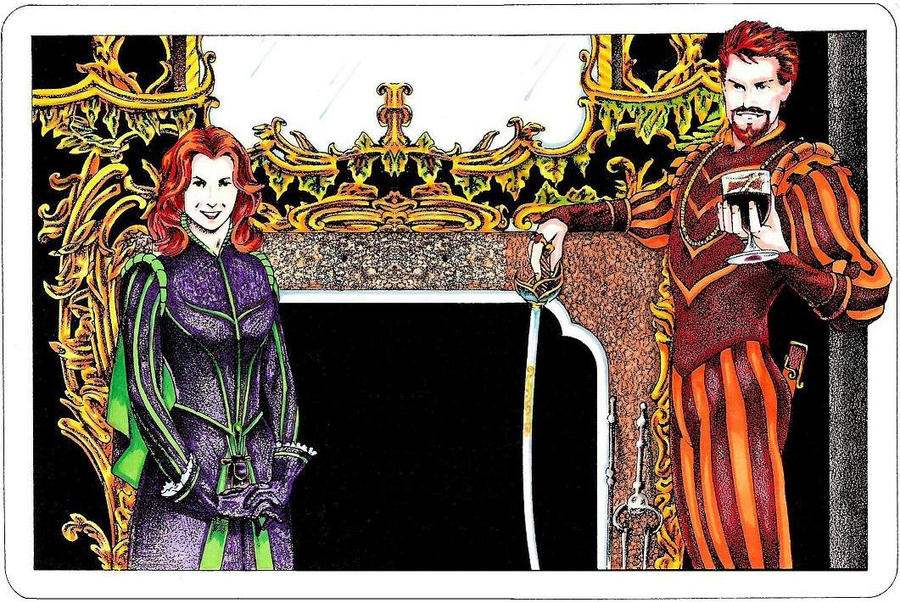

(These two?  They make any Vampire ever seem about as Machiavellian or threatening as Linus from Peanuts by comparison)


So all these stupid "dark" motherfuckers think they're going to play a gracious and oh-so witty game of showing up their fellow Amberites, and in the first five minutes of the game they end up with 23 stab wounds in their back and groin and find themselves being thrown into the "inescapable" abyss while being courteously told that all the people they've ever cared about will be systematically assassinated one at a time by a strange faceless rubbery demon. (this is a fairly survivable and rectifiable situation in Amber, in case you didn't know)

(and quick, kiddies, just from my description, guess which elder Amberite I was thinking of as the mastermind of that plot?)

So of course, the vampire-swine who thought he would be king of the castle ends up getting his pseudo-intellectual ass handed to him on a platter, and notices that there's very little preening in amber, and hardly any prancing or flouncing (except maybe for Julian, when no one is looking), and decide that Amber must be a "bad game".
Right... its the game that's at fault.
Not your inability to actually play it well.
You stupid gang of shitheads.

"wahh waahh the ranks are bad, first place always wins". Wrong again, shithead. I've beaten more first ranks (and seen more first-ranks beaten) than I could shake a stick at. In my Amber campaigns there have been countless occasions where the guy who was 1st in warfare, or strength, or psyche, got his testicles caved in by PCs who didn't have a single 1st place rank, even by PCs who were drastically underpowered.
The point is, Amber forces you to actually think and work out environmental or conditional differences that take away the first-ranked player's advantage.

"wahh waahhh its all DM-fiat"
What? Don't you lily-livered narrativists LIKE DM-fiat? Aren't you always playing "experimental" Forge games that are all about the "narrative" and containing much flimsier excuses for systems than Amber's system, which is actually complete and well defined?
Oh, I see. You like that, IN THEORY.
Like communism works, IN THEORY.
The problem is in your theory, the DM fiat was made so that you in particular would get to show off your own special snowflake rainbow-wonderfulness, not so that you would get your spleen chopped into little bits by the much smarter Amber player to your left.

In reality, the DM has no more "fiat" in Amber than in any other game. Often, I've found he has less. Amber is like Chess. There's not a lot of "fiat" in Chess. You make your moves, the opponent makes his, and there are some very set results. There's little objectivity necessary once you qualify different attacks into grades, and compare them to the difference in ranks between the two fighters' attributes.

Yes, Amber does require a GOOD GM to be run well. Its not for beginners to DM (though a beginner certainly can play). But that's nothing to do with any question of fiat.

"waah waaahh in Amber the player who is most social or smart irl will win!!"
Damn right they will. So what? The fact that there's an RPG out there that actually is set up so that social or mental defectives need not apply is to me a source of constant comfort. Yes, the way Amber is set up, you as a player have to be smart IRL (that's "In Real Life"). And you have to have social skills.
Isn't Vampire all about social skills?
Oh, wait. Guess not. Its actually about simulating social skills with d10 rolls. How very "sophisticated".

So basically, Amber does what a game like Vampire only ever claimed to do. It's truly smart. Truly Machiavellian. Truly based on social interaction. Truly innovative as an RPG, too.

Vampire, for all its blowing of its own horn, had nothing particularly innovative about it. The essential system, of rolls and checks, was the same at the skeletal level as D&D or any other RPG. Most RPGs are basically the same, rolling dice to add/subtract/compare to statistics.

Amber is one of only a very tiny handful of RPGs that can claim true innovation on the level of system. None of the Forge games that I've seen can, neither can any of the White Wolf games. And this just kills the Swine.

But what REALLY kills them is that Amber is not pretentious in the least. It doesn't proclaim itself art, it doesn't put down other RPGs, it doesn't wrap itself in the bad misquotes from goth-favoured poets. It just does the fucking job.

If Swinedom is the disease, then Amber is the cure. Its no surprise that many of the people behind D20 are fans of the game. Here's hoping that Guardians of Order, who have just about built their company around the love of the Amber game, will be able to get over their financial issues and release a 2nd edition of Amber, unsullied by the massive efforts of the swine to subvert it (and believe me, on the old GoO boards, they have made every effort). And meanwhile lets hope Mr. AJFixer and curious people like him look elsewhere than Swine central for an honest opinion of what Amber is all about.

RPGPundit

(Originally posted August 27 2005)

Saturday, 9 May 2015

Game for Nepal Charity Bundle Raises Over $3000!

If I'm not mistaken, this is the last weekend for the Game for Nepal charity bundle. And the good news is, it has raised (as of the last time I asked) over three grand for CARE Nepal, a very worthwhile organization that is providing aid to the earthquake-stricken country.


So, if you haven't picked up this amazing deal yet, where you can get seven awesome Asian-themed OSR products (including Arrows of Indra, Red Tide, and Qelong) for just $15 AND know that the money will go to a great cause, be sure to get it right now before it's too late!

And if you're one of the people who picked up Arrows of Indra for the first time thanks to this charity bundle, let me know if you liked it.  And if you did, please consider picking up the dead-tree copy!


RPGPundit

Currently Smoking: Brigham Anniversary Pipe + Image Latakia

Friday, 8 May 2015

RPGPundit Reviews: In Harm's Way: Pigboats


This is a review of the RPG "In Harm's Way: Pigboats", written by Clash Bowley, published by Flying Mice Games.  It is (as usual) a review of the print edition, which is a softcover book, 188 pages long (not counting the index), with a full-color cover and black and white illustrations.


For the sake of transparency I have to note that many years ago now, Clash Bowley and Flying Mice published my very first RPG, ("Forward... to Adventure!", and its supplement "FtA!GN!"); but I honestly do not think that this will have a significant effect on the objectivity of my review.

Pigboats is a game in the IHW series, which all have relatively similar rules; I've reviewed quite a few of these before.  From napoleonic sailing ships to WWI flying aces, to this present game, the IHW series is some of the most carefully-detailed military-themed RPGs ever.  All of them have in common a combination of (more traditional) playing of specific characters with almost wargame-like vehicle combat systems of some kind.  In this case, the theme is of "American Submariners in World War II", specifically in the Pacific theatre of operations.

The game system of Pigboats is essentially similar to every other IHW-series game, so I'll refer you to one of the earlier reviews for more details.

In Pigboats, troupe play is very strongly encouraged.  That is, you will play a number of different PCs, switching between them as the adventure demands. This allows players to be active in different areas of the action, playing officers and enlisted men, taking on a variety of activities.

One of the challenges of this type of rigid military RPG is that you have a chain of command; this is not the type of game where you get to play rebel loners (at least not without very extreme complications) and PCs will be routinely needing to take (and give) orders from (and to) other PCs.  There's the question of who gets to be the commanding officer of the boat; the author presents a few choices: either the Players could vote for it among themselves, or you could have an auction system where players sacrifice points to bid on their rank (which only works if you are using the point-buy system for character generation).

So on that subject of character creation, you can derive attributes in Pigboats either by random rolls or by point buy (I think the former is something that did not appear in all the IHW series, where earlier books in the series pretty much required point-buy, so this is a great innovation).  You can pick your background skills by a template (with template options right out of war movies: like "the cowboy", "the professor", "the farmboy", "the playboy", "the charmer", "the crook", etc.), or use are more detailed "directed" method. After that, there's the standard "Traveller-esque" system of serving terms wherein you gain skills for each term you served. You also may or may not go to college, and you'll have some "avocation" skills representing hobbies, interests, etc.

As in other IHW games, in Pigboats your rank (after the initial process) is determined by how much "Notice" you get.  Notice is an "in-game representation of your superior's opinion of you.  Gain enough notice, and you get a promotion. Commander is the highest rank that's typically found on a sub, so if you get yourself promoted past that to Captain, you are basically promoted off the sub.  Likewise, if there's a situation where there are too many officers of a certain subaltern rank on the sub, one or more of them will get transferred away.  In those situations, their players will have to make new (ensign rank) characters.  Alternately, its possible to play in "wolf pack" mode, where if an executive officer makes command rank, he may move to a new sub (possibly taking some of the other PCs with him), while others remain on the old one; and you then proceed to run adventures on BOTH subs (with players making new characters for whichever sub their current characters aren't on).

Overall, my feeling is that as Bowley has progressed in his work, he's gotten more and more capable at streamlining the character creation process compared to his earlier RPGs. I guess that's one advantage of repeating the same system.

As before, there's a fairly gigantic list of skills, all quite appropriate. Amusingly, Bowley actually addresses this with a two-page essay/guideline called "a digression on skills", where he addresses some of the concerns that come up from people who might complain there are too many skills, and in essence says not to worry about it, as the real cause of that complaint is that usually games with a lot of skills have a lot of exclusivity, exceptions, and special rules about when skills can or should be used.  Instead he advises that GMs shouldn't stress these things and that in Pigboats the GM should play fast and loose with the skills and focus on playability rather than being too anal about it all (note: nowhere does he say "anal", that's my word, not his).

Repeating one of the curious quirks of Bowley's games, the "task resolution" system is actually four different systems, based on the theory that a given GM/group might like one more than another.  There's the "Starnova" system, the "Starzero", "Starperc" and "Starpool" system. All of them, curiously, use the exact same stats from the characters, they just use different die-rolling mechanics:  starperc is a d% roll-under system, starzero is a D6-D6+skill system, starnova is a D6 pool system (where you have to roll over a difficulty number), and starpool is a D20 pool system (where you have to count successes).

On the one hand, the opportunity to present a variety of methods to do task resolution is a kind of perk.  On the other, it means that it takes 30 pages of the 190 page book to cover task-resolution and you'll only end up actually using roughly 25% of those 30 pages.  I'm not entirely sure four whole task resolution systems are really necessary; two might have been enough.  None of them are stunningly innovative, as you might have guessed from the brief descriptions above (not that any are really awful, either).

There's a section on NPCs, with various tables for quick-rolling NPCs' skills, stats, personalities, wealth/status, as well as missions and objects of missions.  These tables, I believe, were cut/pasted from earlier books; in any case, the missions/objects tables seem somewhat out of place.  I'm not too sure how a "prophet" or "refugee" or even a "member of a political cabal" can somehow find their way onto a U.S. submarine.  The "missions" just don't seem to fit the very claustrophobic setting.
There's also quick statblocks for typical NPCs, but as these are for "soldiers & airmen", I think they were probably cut/paste from the "IHW: Aces In Spades" game (the WWI-pilot version of IHW).  I have to say that's a bit sloppy.

I'll note that later on there are a set of optional 'events' that happen in "shore leave", which are new material, and are generated with a deck of playing cards.

Where the book gets back on track is in its section on Submarines.  Like most of the IHW books, there is a sort of game-within-a-game; whether its dealing with ships, airplanes, the logistics of mercenary companies, or now submarines, you get a whole set of very detailed rules to govern the object-theme of the game.  In this case there's a tremendous amount of detail of how the WWII subs are equipped, their methods of things like positioning, how to handle combat, schematics (with modifications as the war progresses), a targeting chart, rules to govern escaping/sea-chases and chances of detection, details on all the different sections of the sub, and the different classes of U.S. subs in operation.  A bit further down you get very wargame-like "vehicle control sheets" which are for each type of sub, with little boxes to mark the different stats for the sub as they change.

Contrary to the earlier tables I mentioned, here we find some new tables, where you can randomly roll which type of sub your party starts in, where their home base is, what's their primary mission (that is to say, in which area of the pacific naval theatre will they be operating) and the types of missions they'll be having (this time realistic missions based on the sort of things subs were actually doing back then, like recon, patrol, rescue, etc.).

Besides the floorplans, we get some nice maps of the different regions of activity.  Also, all the tables have modifications based on what year you are running things in. There are also encounter tables (for ship encounters; things like convoys, small craft, aircraft, naval task forces), with rolls also for the types of ships encountered.  Again this is all adapted by year.  Successful missions earn the sub "mod points" which are used to be assigned improvements to the sub (some improvements happen automatically over the course of the war, of course).

There are likewise detailed lists of what kind of activities generate "notice", various kinds of awards and decorations (with images so you know what they look like), and guns. Plus more details on patrol areas, torpedoes, and lots of other stuff like that.

Finally, we get a sample adventure, 25 pages long, called "Turmoil in Turk".  It's set in 1942 in the Caroline Islands region. There's pregenerated officers, but they're optional. The adventure begins with an optional roleplaying-focused scene in Pearl Harbor. There's some NPCs for the characters to meet and interact with.  They get their mission, which is to patrol and sink ships. There's also a fairly suicidal recon mission to conduct in the Turk islands.
Then we get some information about the Japanese forces in the area, both their ships and their commanders.

The adventure in some ways highlights my issues with Pigboats.  By definition, a theme of any "submarine" setting is claustrophobia, of limited space, of being (as the game itself publicizes in its back cover) "under pressure". As certain war movies have shown, that makes for potentially excellent drama, but I'm not sure if it will make for an excellent RPG campaign unless you have a very specific kind of group. In other IHW games there's more opportunities for interacting in ways different from just the main theme.  In Pigboats, its submarine combat, close-quarter RP with other PCs or NPCs on the sub, the occasional shore leave, and recon missions where you'll mostly be shooting at people.

I think that a certain type of group might love this kind of thing.  I also think that the average group won't, though, not for more than a couple of sessions.

RPGPundit

Currently Smoking: Lorenzetti Solitario Horn + Gawith's Navy Flake

Thursday, 7 May 2015

Dark Albion: The Rose War PREVIEW: The Critical Table

I've just recently received the latest update from Dominique Crouzet, as he proceeds with the final layout for Dark Albion: The Rose War.  In case you've not been reading my blog until now, "Albion" is going to be an epic OSR-setting book in a fantasy version of the War of the Roses, the civil war in England that was, among other things, the inspiration for a huge list of Shakespeare's plays and a little thing called Game of Thrones.

The book will focus on both playability and historical authenticity, ideal for a fairly gritty style of D&D play. It will be viable for Sandbox play or for a more linear sort of 'historical campaign', and will feature plenty of elements for both old-school adventuring with a medieval-authentic twist, or for political-intrigue gaming in the style of everyone's favorite fantasy TV show.  And just like Game of Thrones, there's a very good chance that all your favorite characters will be dead before it's over.

The layout process is up to 200 pages now, and thanks to Mr. Crouzet it looks stunningly gorgeous.  It's going to be jam-packed with spectacular medieval/early-renaissance art, magnificent maps (ranging from a full-sized two-page hexmap of Albion & The Continent, to localized hexmaps of specific counties or regions), and some awesome schematics of some fairly unusual dungeons.  You can find a sample of the type of setting-gazetteer material here in what was the early origins of the setting, though the print version will be widely expanded and will feature a lot of other material you won't find on that thread, not to mention looking much prettier.


It will include guidelines on rules, new magic rules (including a medieval-esque system of demon summoning), lots of material on the Continent, the evil Frogmen, the Church of the Unconquered Sun, a set of rules for managing noble houses (their resources, mechanics for using house influence, and a simple resolution system for large battles), and plenty more!  There's going to be historically-based rules on law and justice, on economics and prices, social class, sumptuary laws, historically-accurate common names by region, lots of tables for random events and encounters, and house descriptions (and heraldry) for the major and minor noble houses that played a part in the Rose War.

The book will not contain its own full-blown game system.  But it will have two very interesting appendices: the first, written by Dominique Crouzet, will be a conversion appendix with lots of interesting new powers and classes for his Fantastic Heroes & Witchery RPG rules!  Any FH&W fan will want to take a look at this.  In addition to this appendix, and all the editing/layout work, Dominque also helped co-write several of the adventure scenarios in the book, as well as some of the other sections.

The second will be "Appendix P", which are my own old-school D&D house rules.  A mix of stuff I've used from a variety of sources and of my own inspiration, these house rules are pretty ideal for creating a particularly gritty game for old-school play.

Today's preview comes from these house rules, and it's my Critical hit rules.  Perfect for making sure that even a great hero might die at any moment from an unlucky break (again, just like what happens to some of our most beloved characters in a certain HBO TV show..).  Without further ado, here they are, straight from "Appendix P":


Optional Critical Rules (for ultra-gritty play)

Given that Dark Albion is inspired by the very bloody War of the Roses, and gamers may also be inspired by the bloodiness of certain fantasy novels and TV shows that are inspired by and have the same style as the Rose War, it may be desirable to have some rules for those types of critical hits that leave characters with terrible and often permanent disfigurement, or even instant death to even the greatest of warriors.

Whenever a natural 20 is scored on an attack roll it is a critical hit. In that case, roll 1d20, modified by Charisma. Fighters also add their level to the result. Modify the details of the results according to what is sensible for the kind of strike made. 


D20 result
1-3 A serious cut or bash that does an extra +1d4 damage!

4-6 A severe cut that will leave a bad scar on the body, but can be hid by clothing. +1d4 damage!

7-9 A severe strike that in some way leaves a scar or disfigurement on the face (a gash, burn, etc.); +1d4 damage AND a -1 to reaction rolls in any situation where physical beauty would matter

10-11 A very bad wound that bleeds profusely! +1d6 damage, and the character loses a further -1 hp per round from bleeding until he receives some form of first aid from a qualified person.

12 Character loses a finger on one hand (roll randomly). The character must make a saving throw to avoid dropping anything held in that hand. If it is a dominant hand, the victim will have a -1 to hit in combat until the next time they gain a level.

13 A bad injury (+1d4 damage), make a saving throw to avoid falling to the ground. The wound leaves the victim in constant pain. They only heal ½ as much from regular methods, and suffer insomnia. May turn to drugs for pain-free sleep.

14 A bad injury (+1d4 damage) to a leg; the victim falls to the ground and cannot get up without aid until healed. The victim will suffer from a permanent limp, only able to run at half-speed from then on.

15 A bad injury (+1d4 damage) to an arm (roll randomly to determine which); the victim drops anything held with that arm. If it is the dominant arm, the PC will have a -2 penalty to all to-hit rolls until they gain a level, at which point it will be reduced to a permanent -1 penalty.

16 A severe strike (+2d6 damage) to a muscle of the torso; the victim must make a saving throw to avoid collapsing in shock. The character from that point on can only carry half as many objects without penalty, and can only march for half as long in a day without suffering exhaustion.

17 A brutal strike to the groin (+1d6 damage, plus losing -1 hp per round until receiving first aid); the victim must make a saving throw to avoid collapsing in shock. Any male who survives is left permanently impotent; which will have enormous (negative) social consequences if it is known!

18 A brutal strike to the throat (+1d6 damage)! The victim must make a saving throw versus paralysis or begin to asphyxiate (they will pass out in 1d6 rounds and die in a number of rounds equal to their CON if they do not receive aid from a trained surgeon!). If the victim survives he must make a saving throw; failure means the character can no longer speak (success still leaves the voice changed).

19 A strike to the spine (+2d6 damage!); the victim falls to the ground and cannot get up, and must make a saving throw to avoid passing out from shock. If they survive the battle, a second saving throw is required; failure means the victim will never walk again (barring magical intervention).

20 A brutal strike to the head (+1d8 damage); requiring an immediate saving throw, failure means the head was sliced open or bashed in, and the victim is instantly killed. If the first saving throw succeeds, the victim falls to the ground unconscious. A second saving throw is required if the victim survives the battle; failure means they have lost the use of one eye (with penalties to perception, to hit in melee, and severe penalties to ranged attacks).

21+ An extreme and vicious blow! The victim must make a saving throw, if they fail the roll they are instantly slain (decapitated, cut in half, snapped like a twig, etc.). Even if they succeed the save they take triple the usual damage.
---


Dark Albion: The Rose War should be available for sale some time in June.


RPGPundit

Currently Smoking: Stanwell Deluxe + Image Latakia

Wednesday, 6 May 2015

The Real Legacies of The Forge

Well, since my previous post pointing out how Ron Edwards was "not getting" the Legion (which is pseudo-intellectual code for "I think it's dumb, and I'll say that I'm not saying its stupid like five times in my blog entry to just really drive home the point that my readers should suspect it of being stupid") I've had a barrage of rebuttals on G+ from what feels like the Homecoming Day/10th Anniversary School-Reunion of the Forge.  Mostly on Ron Edward's stream, because he retreated there where he knew all HIS people would see him and leap to his defense rather than arguing on my own turf where I had initially posted my comments.  But that's fine, I'm not a coward, so I went over there to slug it out.

In the slugfest, there was no end of bullshit, and it became clear just how desperate all the Forge people are to try to re-write history and portray the Forge as though it had been a bastion of tolerance, openness and defense of regular Roleplaying, when of course it had been anything but.   You'd think from how they describe it now, the Forge had spent all its time singing the praises of D&D, to which you'd wonder where they would have then found the time to present game 'theories' that suggest D&D is inherently flawed and creates an experience that makes gamers 'secretly miserable', as Edwards suggested in his earliest Forge documents?
Oh, and of course, they dragged out the old canard that we all need to thank the Forge because they somehow "invented" self-publishing, so without them we would never have had any small press games ever because they invented it!

Here's the real truth:  Forgists had nothing but contempt for regular gamers, and this obviously included D&D. Again, I was there.  I never ever saw anyone associated with the Forge making any positive comments about D&D or old-school play, ever, until around the time Dungeon World came along as their big move to try to subvert old-school.

As to the second, the reason I said "positive" is because I suppose someone could make an argument that one factor that contributed to the rise of the OSR was regular and old-school gamers growing increasingly sick of the pretentiousness of the Forge and being demeaned in public forums for liking the type of games they did.  That's pretty much the only sense in which one could say the Forge helped the OSR come into being, but it's hardly something to "thank" Forgists for.

As for all that bullshit about 'creator-driven design', that's actually something that the Forge constantly takes credit for but NEVER INVENTED.  Ask Kevin Siembieda if it was the Forge that gave him the idea to publish his own books. Or Steve Jackson. Or Gary Gygax.

The OSR owes them nothing. Not the Forge in general, or Ron Edwards as its architect in particular. 

Even the arguable resurgence of self-publishing in the last decade was not 'thanks to' the Forge, it was thanks to the invention of the PDF, the kindle, and Lulu/Createspace (that is to say, the rise of self-publishing in general).

I've also had several Forgists or Storygamers, in arguments with me, claim I'm "not a game designer" because the OSR is just imitative and not "real design", since I don't use jenga blocks or whatever.

And I've spoken to several publishers of small press games who expressed their frustration at the way that the "indie game" crowd created a little coterie that shut out anyone who made games from an ideology that they didn't like (i.e. regular RPGs, rather than storygames).  If you're one of these, and brave enough to say so, and to comment about how you were shut out, I'd sure like to hear it - I know you're out there, because you've said it to me before, but I don't want to be the one to out you.

Their attempt to exaggerate their own prominence and shut out other publishers including using tactics like citing each others in ways to get totally obscure micro-game publishers from the Forge their own wikipedia articles while much bigger self-publishers can't from "lack of citation", or stuffing the "indie gaming awards" to the point that they're a fucking joke; while reporting non-forge publishers that tried to get more notice.

The Forge movement pissed all over any game that wasn't GNS.  And now you're acting outraged that we dare to remember that, rather than just pretend along with you that you all loved D&D from day one.

I'll just close, then, by sharing a link that gives a fairly accurate perspective on just what Edwards, and the Forge, was really about back then, and why it sucked.  Note that the article doesn't come from me, nor does it even paint me in a particularly good light, making the argument that I helped make the Forge famous by my very opposition to it (which is a legitimate kind of point, I recognize):

Pretty well everything Ron Edwards did in the hobby up until very recently was directly harmful to the hobby as it traditionally stood. He was not a supporter of regular RPGs or of D&D.  He created an exclusive elite club of pseudo-intellectual hipster-authors that would denigrate anyone else's self-publishing, so claiming he opened that up to the general public is bullshit too (the Forge wanted 'everyone' to be a self-publisher, but only if 'everyone' embraced GNS theory, kissed Ron's ass, and acted like pretentious pseudo-intellectual twats).  His ideas ruined D&D when they were embraced in 4e. His ideas were ultimately proven WRONG in every respect.  And because of what he did and how he did it, not only did the level of conflict and acrimony increase in the online communities related to RPGs (and its no small surprise that many of the forge/storygamer crowd are now part of the pseudo-activist crowd staging witch-hunts against people who aren't part of their cool-crowd; though I will recognize that Edwards himself seems to have taken a strong anti-censorship stance and has been on the right side of several recent controversies), but it also made it almost impossible for people to talk about the root-concepts of RPGs without starting a flamewar or in some other way evoking the ghost of his shitty theories.

So I have a problem with his coming along now and pretending like he was the Champion of Traditional Play and did no wrong in the past 15 years, much less claiming that we owe him something.


RPGPundit

Currently Smoking: Lorenzetti Volcano + Gawith's Balkan Flake


Tuesday, 5 May 2015

Everyjoe Tuesday: Royal Baby Edition

I know, you wouldn't expect me to be writing about Princess Charlotte, however cute she might be, like I was some writer of fluff pieces.  But where there's controversy and pseudo-activist bile, why not?

How is it that some middle-class liberal-progressives can despise the royal baby (and royal family) even as they expose their contempt for the working class they (falsely) claim to champion?

Check it out! Go comment, spread it to your social media! Send it to your aunt on facebook who can't stop posting cutesy-poo about "Will & Kate"! Give them a dose of their own medicine for once.


RPGPundit

Currently Smoking: Lorenzetti Poker + H&H's Beverwyck

Monday, 4 May 2015

10th Anniversary Classic Rant: My Doctor Told me to Booze it Up

Well, I have once again received a completely clean bill of health from the doctors, after extensive tests of blood and other bodily fluids I'm sure you'd rather not hear about.

My blood pressure is spectacular, my cholesterol low, I am (astoundingly) in no danger of diabetes, and am totally free of venereal diseases.

In short, I am in perfect health.

Which never ceases to astound the shit out of me, given the treatment I put my body through and have put it through over the years. Between the history of serious drug use, the over-drinking and overeating of bacchanalian proportions, the massive massive consumption of Sugar, Caffeine, Tobacco, and monosodium-whatever and transaturated-whatnots from all the junk food, I should legally be dead by now.

And yet, I'm not. I'm not even ill. I'm not even unwell. I'm not even particularly at-risk.

How the fuck did that happen?

Hell, the only thing my doctor could recommend to me, on account of my HGL cholesterol (the "good cholesterol") being kind of low, was to drink MORE alcohol. Apparently it doesn't matter what kind, any kind will do, but to drink at least one glass of hard liquor or a couple of wine or a beer at least four times a week, compared to my present one night of drunken revelry every couple of weeks.

I had actually cut down on the whiskey here because even though there's a ton of whiskey around (Uruguay has the highest per-capita consumption rate for whiskey in the world), hardly any of it is any good. But ok, there's always Jamesons, that's palatable, and I still have half a bottle of the Glenfarclas 12 year old Scotch I won at the Masonic Debating competition in April. Plus there's always Grappamiel, the excellent mead-like liquor they make here. And the Uvita, the great cocktail you can get at the Fun-Fun bar, one of the oldest bars in Montevideo, where Gardel himself used to get wasted and once dedicated a tango to the famous drink.

So, I'm going to have to go get pissed.

What a lesson this is: I have long worshiped the god Bacchus. He of all the manifestations of divinity slung around in history or present times is the one that seemed most reasonable to me. Hedonism is a virtue not a vice, it is the constant celebration of an existence none of us have earned, none of us deserves in any way, and yet here we have it, and why be here if not to revel in it?

And lo, Dionysus has spoken to me. He has rewarded me for ignoring all the bullshitting nanny-stater health freaks; the vegetarians and the vegans and the airitarians and the full-of-crapatarians that advocate limiting ourselves; the constant large-scale social hypochondriacs that are convinced that we must be saved from ourselves and punished for enjoying our existence too much. For eating too well, for drinking too fondly, for smoking with pleasure.

I mean, look at fucking Gerald Ford. The guy is 92 fucking years old. Do you know that he's the last pipe-smoking US president? He smoked 10 pipes a day during his time in the white house. 10 a fucking day!! I consider myself hardcore, and the MOST I've ever smoked in a day is 7 (3-5 most days). And here he is, only just now getting to his last moments in the world, at the age of NINETY-FUCKING-TWO.

And I will make anyone a serious bet that when poor old Gerald Ford finally kicks the bucket, some asshole nanny-stater is going to actually say, with a straight face, that it was the "years of smoking that killed him". Yes, clearly, the years of smoking, at fucking NINETY-TWO (or 93 or 94, hell, he ain't done just yet).

So take my health advice: fuck them all. Screw anyone who says you shouldn't eat what you enjoy eating, smoke as much as you fucking like, drink whatever you want to drink, and screw as much as humanly possible.

Because none of the so-called health experts know one fucking thing. Your time is your time. For all my good health, I could drop dead tomorrow, or be hit by a truck, or have a violently angry internet-swine hunt me down and pop a cap in me. But it seems blatantly clear to me that statistics are just statistics, they are meaningless at the level of the personal; and while if you know you have certain genetic predispositions you may want to watch yourself, in general, you should just let go and take the roller coaster ride as much as you fucking can, because you'll only have one shot at doing it. None of the so-called "healthy lifestyle choices" guarantee you a fucking thing, so why bother? 
The stupid fucker who wrote "the joy of running"? He's dead. 
The Atkins diet guy? Dead.
Gerald "ten pipes a day" Ford? Still kicking a little longer, at 92.

RPGPundit? In perfect health and full bacchanalian swing.


RPGPundit

Currently Smoking: Ben Wade Rhodesian + Image Latakia

(originally posted December 16, 2005)