So on G+ there's been quite a lot of response to my article about how Player-Narrative control is always a bad idea. One responder wrote the perfect storm of a constructed and bullshit rebuttal. First he talked about the "30 years he's run games"; only a quick glance at his G+ profile reveals that he despises D&D, including a story about how D&D was the first game he ever tried and he hated it and didn't want to ever play it again. He likes 13th age of all things. Well, I mean, of course he would!
So then he responds by telling me a little story about a game session that ended badly for him lately, and how his group talked about it after to figure out what went wrong and the one thing they all agreed on was that Immersion doesn't matter, and they all have different goals and that's OK.
I imagine they later held hands while singing Kumbaya and praising the end of the oppression of having to roleplay your character, because everyone knows that's what you do with your RPG buddies, right?
The interesting thing was what he said his players were into: One player, he said, "wanted to put her character through dramatic moments and role-play to the hilt, but she asked me to give her massive signposts to these events and discuss them ahead of time".
The next "likes to explore the mystery and setting, she comes close to what you want from 'immersion' but admist placing herself distant from the character.
The third "just wants to switch off and have fun... that is all she wants".
The fourth "lacks (sic) to make plans. He likes situations in which the group can discuss what they are going to do".
So clearly these four fascinating individuals that Mark has at his gaming table are PROOF that I'm totally wrong about Immersion being the most important goal of the player experience in RPGs, and that it's totally fine for the GM to hand over his testicles and give narrative control over while raising the Storygames flag.
This was my response to him:
Wow! It must be *absolutely fascinating* to be running a game with 4 Forge Theory Talking Points. I have so many questions! I mean, do they have bodies?! Do they eat? Do they look like human beings?
Oh, can other people see them?? Do they have some kind of cover story? I noticed you mentioned genders (nice touch that most of them were women, you'll get extra stars on your Groovy Card for that one); are they able to talk about other invented details of their lives or past? I guess what I'm asking is how easy it would be for them to 'pass' as Human? Would it be immediately obvious that there's something horrifically wrong with them and that they're actually just theoretical models of what pseudo-intellectual wankers wish RPG players were like, wearing human skin? Or could they trick a regular person for a while before the madness-inducing truth came out?
Do they know that they don't really exist in anything but Storygamer's wet dreams?
How does that make them feel? If they can feel at all, I mean.
Their self-awareness is clearly at least more limited than human's, otherwise they'd know not to congregate as four *different* Forge models of "possible gamers" all in the same place, even to attempt to win an argument, because it just looks so obviously fake...
Does it hurt them to know that real human beings are not like them at all, and that they were created to subvert the core landmarks of a hobby by trying to make-believe that most RPG gamers don't like or need Immersion so that a game based on engaging with a virtual world can be turned into a pretentious quasi-artistic exercise in 'addressing theme' while feeling smug about how much better you are than those smelly D&D players?
Do constructed propaganda-humans dream of electric sheep?
He rebutted by claiming the people were absolutely real and how 'disappointed' he is at my intolerance.
Oh please, you picked them right out of the Forge's bullshit 'models of play' or whatever. They are TALKING POINTS. Ron Edwards and company pulled them out of his ass, by just wishfully thinking RPG gamers are like that rather than based on any kind of research, and completely contrary to everything that decades of collected experience said people like and get out of RPGs. And then you pulled them right out of the Forge's ass in turn.
Of course, I have played with lots of players who have lots of different goals.
I have some players who like more intrigue and interaction.
I've had a couple of players who mostly like to travel to interesting places and meet interesting people.
I have the guys who want to just kill things and get treasure and feel bored out of their minds if they're not in the dungeon killing stuff because everyone else is planning or talking.
Speaking of planning, I have the guy who likes to make intricate schemes almost always turning out to be too complex for their own good.
I have the players who don't really 'want' anything other than to be entertained and have a good time.
You know what they all had in common?
EVERY FUCKING ONE OF THEM wants *IMMERSION*
Because that's what RPG players want. If you don't want to immerse yourself in a character, and go into the virtual world the GM has crafted out of his consciousness (and if he's really good, is so 'Alive' that he no longer consciously controls it), and be MOTHERFUCKING *IN IT* until part of them is not themselves anymore.
Because that's what RPGs are.
No amount of wishful thinking on the part of pretentious Swine is going to change that. They tried and they lost.
And the more you try to pull someone OUT of Immersion, the shittier the experience becomes. Always.
But he insisted and expressed offense at the insinuation that his four picture-perfect models of Forge propaganda weren't real! OK.
So you just happen to have four people that almost perfectly fit the models that no one else has ever fit into of what the Forge imagines in their fever-dreams that RPG gamers are like and want?
You just happen to have FOUR DIFFERENT descriptions of those? You have a perfect Narrativist, a perfect Simulationist, a perfect Gamist and a perfect disinterested player all in one group, even though the first three have been shown over and over again to be total bullshit?
Yeah, ok.
Anyways, let's pretend you do for a moment. This would be my advice to you, then: STOP PLAYING RPGS WITH THEM.
If none of them want Immersion, then they are PLAYING THE WRONG GAME.
RPGs will not satisfy them, EVER. The one realistic thing about your little tale is that they were unhappy with how the campaign went, because if you had four people who all didn't give a flying fuck about immersion, what you would have is four people who have no business playing RPGs
I'd advise you to dump them and find an OSR D&D group.. oh but you hate D&D, right?
Well, maybe you can all go off into the sunset and play "fiasco" or whatever stupid thing is popular in the storygames crowd together. Just don't call them RPGs. Because they're NOT.
RPGPundit
Currently Smoking: Lorenzetti Oversize + H&H's Beverwyck
Sunday, 13 December 2015

Saturday, 12 December 2015
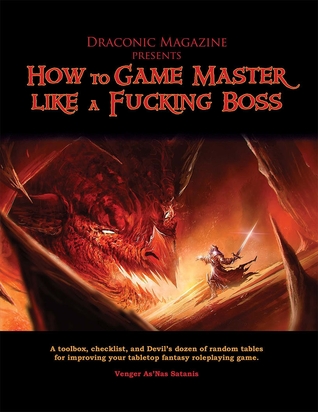
RPGPundit Reviews: How to Game Master Like a Fucking Boss
This is a review of the book "How to Game Master Like a Fucking Boss", written by Venger Satanis, published by Kort'thalis Publishing. This is a review of the print edition, which is a softcover book, 122 pages long. It has a full color image of a kickass-looking fantasy hero facing an enormous red dragon (a repeating theme in Satanis' books, it would seem). The interior art is black and white, and looks suitably as weird/dark-fantasy as you'd expect from a dude who chooses to call himself "Venger Satanis".
You know, several years back (I'm talking like, before Lords of Olympus) I had written a book on Game Mastering for Precis Intermedia. It was a work-for-hire, I got paid, there was even a cover commissioned, but for whatever reason Precis never got around to publishing it. Maybe someday they still will, as I understand it Brett Bernstein has always got a lot on his plate, and it's likely that other stuff just took priority. Mind you, there's been a lot of water under the bridge since then, and I figure I might not keep to all the same ideas I had then, though for the most part I probably would.
So anyways, the point is I've had some chops of my own in writing about GMing (besides the book, there's 10 years of GMing advice on my blog). Let's see just how much of Venger's work I agree with here.
But first, I'll point out something that is a recurring problem with Venger's books: he needs a better proofreader. As with Crimson Dragon Slayer, a quick read of the book discovered (without particularly trying to seek them out) various small errors in his work that could have been avoided had he only been able to get someone to check (or maybe double-check) his work. It's not quite as egregious as the case with Crimson Dragon Slayer, but there's little things, like writing "planet's inhabitance" when he clearly meant "planet's inhabitants".
Anyways, since this isn't a rule-book, it's less of a problem than in the former work.

The format of the first 68 pages of book is of a seemingly disordered variety of guidelines and suggestions for how to GM effectively, like little lectures, varying in length from a single paragraph to a page or so. The last 18 pages of these are just a long "checklist" of things Venger thinks should show up in every campaign (which is mostly stuff that is blatantly obvious, stuff that you see in fantasy tropes in general, but with a couple of quirky ideas too).
Those who have read the Amber RPG would find the entire first section VERY reminiscent (even in terms of some of the title headings) to Erick Wujcik's incredible advice on the same subject. Of course, Venger Satanis is no Erick Wujick. Not that you can blame him for that, no one is. Amber and Shadow Knight are two of the greatest GM-training books ever written, on account of those little lectures. Satanis' book? Well, it's a lot more of a mixed bag.
In the very first statement, he does pretty well. Venger establishes that the main purpose to roleplaying is Immersion. Right he is! I've been saying so for years.
His second point is about "being the Boss"; in other words that the GM needs to be the guy in charge of the pretend-play that leads to immersion, for the sake of everyone. Again, he says what I've been saying since the start of my blog. I'm not totally with him in the particularities of his suggestions along these lines, for example his idea that a GM should try to dress like they're going for a job interview (I always try to dress well, no t-shirts or torn jeans for me, but not because I'm thinking it'll affect my gaming group specifically), but on the whole it seems we're on the same page. The GM is the King, he's the alpha person in the group, or else things are going to go bad.
There's quite a lot of general advice, like 'be prepared', 'give the players what they want but don't go too far', 'avoid too much exposition', 'try to refer to the character's names, rather than the player's, during play', 'know how to deal with players who try to backseat-gamemaster', that sort of thing. Nothing wrong with this stuff; but not a lot of it is really impressive as outside-the-box thinking. I remember in my own GMing book, for example, I made a point of specifically advising GMs NOT to give the players what they want, to make them suffer for it so that when they got what they want through their own effort they'd know they'd earned it. That at least is a bit more challenging (in the sense of making the reader question some of the standard GM advice they've already heard a thousand times) than most of what is being offered here.
He does occasionally get to something that was, of course, one of the chief concerns of my unpublished GMing-guide: the rejection of Forge ideology. The advice here, with a few blips, is largely of the Old-School variety; and once in a while he directly tackles the harmful cowshit of the failed school of Forge-theorists. For example, he rejects the notion of 'failing forward', pointing out that an important part of effective living-world construction is that failure can and often does just happen, with no 'out'.
There are a few rules where he gets the overall point right but kind of misses the mark in other ways. For example, he talks about not treating Charisma as a dump stat, which is very very right. But at the same time, he mentions that treating it like a dump stat is what you did in the 'old days'; only it's not. It's what stupid players have done because stupid GMs have underused the value of that stat in both the old AND new days, but any old-school games that used reaction rolls and retainers could tell you that charisma was no dump stat when used properly by a GM.
There's some other details which I think are not, in fact, general rules for GMs but more about Venger's own playstyle preference. For example, he claims that the right length of a gaming session is 3-5 hours, with 4 being the ideal. My Albion sessions go for 10-12 hours, and believe me they kick ass.
He also suggests that you need as much as 2 hours of prep for every 4 hours of play; that to me is absurd. I know that having close to 30 years of experience as a GM means I might take less time than the average GM, but I don't think I EVER did 5 hours of prep for a 10 hour game. Most of my games involve weeks of campaign-prep, but then rarely more than 20 minutes of prep after that. THAT would be something interesting to offer as GM advice: put a lot into prepping your campaign and you'll be able to get your individual sessions ready in minutes.
Likewise, he also advises that you "always level up after the first session". Nonsense. Why would he suggest this? Because he played in a Tekumel game once where they didn't level up after the first session and then never played again.
Around here, we call people who do that 'malcriados'.
In my original Dark Albion campaign, I think it took four or five sessions before most of my players hit level 2 (and remember, that's 40-60 HOURS of play, because I'm not one of these pussies that can only handle 4 hours at a time). And that campaign didn't do too badly, given that it's still running now, 5 years later, and spawned a best-selling OSR book.
Now, I'm not saying that ALL campaigns should be handled like that, in fact if you play the Appendix P rules by the book it's very likely you level up in the first session; but it seems to me that putting in a rule like "ALWAYS level up after the first session" is just bad advice.
There's more I could note here, like his advice to always sideline NPCs in a fight (my players would at that point be asking 'why the fuck are we letting these guys come with us, then?'). Or how he advocates strongly that "nudity, sex and eroticism" feature prominently in campaigns. It's a trait he shares with a lot of the guys who most want to think of themselves as the OSR 'avant garde', but which in my own experience runs totally counter to what most gamers prefer, and I think for good reason. Romance? Sure. Having to hear the 300lb bearded guy next to you talk about his carnal relations with a nonexistent virgin elf girl in a way that might land him on an NBC news special? not so good!
I'll sum up this part by saying that of course all GMing guides are going to have a portion of what amounts to highly personal preference; but the real test is whether they can be applied universally with any kind of consistency. Some of Satanis' stuff clearly cannot. The stuff that can is good solid advice, but not really stuff that experienced GMs haven't heard before (over and over again, in fact).
Along the way, we learn some quirky details that are more about Venger's own tastes than anything remotely to do with RPGs. I mean this literally; for example, we get told (with the flimsiest of RPG-related justification) about his personal views on Metallica's album history (he thinks the black album was awful). And this is not for a couple of throwaway words; it goes on for three paragraphs!
The second, and probably most useful section of the book is a set of about 28 pages worth of random tables. These are meant to assist GMs in a variety of tasks. Tables include:
- the "whom to blame" table (which mostly involves laying blame on a variety of cthuloid entities)
-past events (which are very similar to the past event tables I put into Dark Albion, including granting some small bonus or effect; but are made for a MUCH more gonzo campaign than Albion is)
-a secondary motivations table (ranging from 'restore glory to the Kezakhan Empire' to 'grow the world's largest potato')
-a list of random 'wise' sayings (some of these are from historical wise men, like Pliny the Elder, Gurdjieff, Aleister Crowley, or Marcus Aurelius; others are from historical idiots Venger must nevertheless admire, like Anton Lavey, Ayn Rand, or Og Mandino; and a couple from fictional characters like 'Rani from Land of the Lost' or 'God from the Old Testament')
-random cult names/leaders/qualities
-random monster features/strangeness/colors (the 'color' table is just a list of 100 color shades, seriously?!)
-random mutant magic items
-random cosmic horror effects
-random stupid gnome hats (dude, seriously, if you want cool gnome-related random tables, go buy Gnomemurdered!)
-random complications
-random NPCs
-a 10-entry random encounter table (there's 100 shades of colors, but only 10 encounters? Really?!)
These tables are very creative. In some ways, they by themselves are worth the price of admission for the book. But they're also often very, very particular. They're not general advice for GMing RPGs, they're not even for general fantasy RPG settings. They're for one very particular type of fantasy game: the kind Venger plays and writes. Namely, weird/dark fantasy with lots of tentacled things and godlike entities and androids and other gonzo stuff with names that have too many apostrophes. IF you sometimes run these types of games, this section is great. If you don't, it's useless to you.
There are a few exceptions, like the table/list of 100 questions to ask a player about their character to help them flesh it out (again, VERY reminiscent of the 'character questionnaire' found in Amber), or the table for 'why characters are together', or the reaction table, none of which have any tentacle-stuff.
The last and by far most useless section of the book is an 18 page glossary of a made-up fantasy language that Venger invented, full of slightly ominous sounding words and an excess of apostrophes. Seriously, 18 pages. First he puts the words in the made-up language with their English meaning, then he reverses this and we get pages of English words with their made-up equivalents.
Seriously, what was this?! It's not even a full language in the sense of the more ponderous of M.A.R. Barker's writings on Tsolyani (or Tolkien's, or whoever), it's just a list of vocab. The only thing I can imagine is that this was an attempt at serious filler to bulk up the book.
Well, actually, I can think of one other possibility...
...Which brings me to one more thing that might be worth pointing out here, something I think most readers, and other reviewers would miss, and that's the influence of the occult on Venger's ideas.
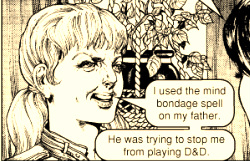
(no, not that kind of occult! The REAL kind!)
The reason both he and I talk so strongly about the importance of a Living World and treating your setting as such, and getting to that point where the Universe becomes more than the sum of its parts and is Conscious on its own (and can even come to surprise you!) is, I think, intricately tied to our mutual involvement in the western esoteric tradition. It ties into ideas of archetype, myth, and even pathworking on abstract planes (aka "scrying", aka "astral travel").
He talks about treating campaign starts as 'initiations', which I would agree with. He even advises meditating before starting a session, something I wouldn't really suggest myself, though meditation in other contexts is definitely something I'd recommend to everyone.
Venger even presents his 'ten steps to good luck' which are really more like guidelines for how to live, that he admits was inspired by the 'philosophers' he reads. Which philosophers? Anthony Robbins, Gurdjieff, and Anton Lavey. Of those three, only Gurdjieff is someone I'd ever recommend, and he was batshit nuts (not that there's anything wrong with that, all the great esoteric philosophers were batshit nuts).

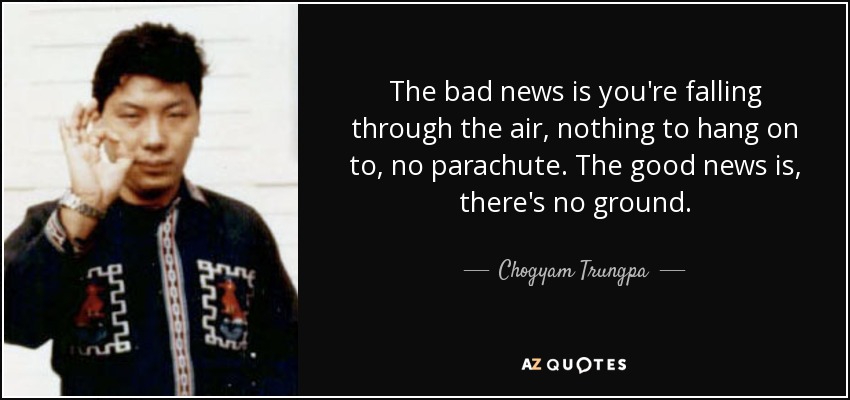
(nuts you say? A fellow who looks like that?)
So yeah, needless to say, Venger's occultism and my own are not quite the same. I'm a little bit more of a Chogyam Trungpa guy than a Gurdjieff guy, more of a Idries Shah guy than a Robbins fan, and for outright magick I'm way more of an Aleister Crowley guy while Venger is a fan of Anton Lavey (who made a career of being a really bad shallow rip-off of Crowley). But that said, it's clear that Venger has had at least some of the same occult-derived trippy consciousness-altering experiences as I have, and that like me he's applied some of this to his game-mastering. It's hard not to if you do both, because GMing and occultism share a common trait of exploring symbolic inner-worlds.

That brings us back to his make-believe language. There's a long tradition in western occultism of 'barbarous words' and arcane languages; even Gurdjieff did it, quite a lot. So there is that possibility: the inclusion of Venger's "Viridian" language (what he calls "the green tongue") might be a kind of spell. Things like magical words gain power when they're directed at people. It is particularly a principle of Chaos Magic that using mass-media can greatly increase the 'charge' of talismanic magick. For example, the famous magician/comic-writer Grant Morrison essentially crafted magick all over his seminal comic series The Invisibles, which he credited with giving him all kind of success in his life and career; and the theme of The Invisibles as a whole might have been a kind of enchantment intended to alter the level of consciousness of its readers.

So our friend Venger might very well have included his magical language (which he urges the reader to "make as much use of it as possible"!) for his own occult purposes. Shit, the whole book might well be a spell.
But if it is or isn't, that really doesn't affect much of it's quality as an RPG product (unless you're an evangelical Christian or something, in which case why the fuck are you buying a book by a guy named "Satanis" in the first place?!). My conclusion on the book as an RPG product is that Venger's work is only really useful at all if you're either an extreme newbie at GMing, or if you are a big fan of the style of fantasy Venger prefers (in which case, as I already said, the random tables would likely make the product worth it to you).
RPGPundit
Currently Smoking: Dunhill Classic Series Rhodesian + C&D's Crowley's Best
Friday, 11 December 2015
Even in the Best Case Scenario, Saying 'Yes' to Player Narrative Authority is a Terrible Mistake
Nevermind the Forge Game standard-scenario of a castrated GM with about as much power as a Monopoly banker, completely subservient to the 'genius' game-designer on the one side and the primma-donna players on the other, forbidden absolutely from ever being allowed to say "No".
Forget about 'say yes or roll the dice'.
Let's look at the best most ideal possible scenario of player narrative influence in a game. Because if we look at that, we understand why the concept itself is fatally flawed.
Player Narrative-control is counterproductive to the goals of play in D&D (or any regular RPG). In an RPG, it is the GM's job to create the world, making it emulative (that is a fancy way of saying 'to make it feel like a living world with its own internal rules'). The player's goal is Immersion, to get so deep in the world and that sense of it being alive, and simultaneously breathing life into their characters, that they eventually feel the character has a life of its own.
Every time the Player has to abstract from identifying with his character's point of view, it runs counter to the Immersive goal.
If a player can jump out of his character and start to define things about the world, it reinforces that the world is not alive. They see 'past the matrix' and the world becomes more of a fiction. It dissociates them from identification with their character.
So even within the boundaries of what you are arguing, making players part of the process of creating the world is counterproductive to the RPG experience. Fundamentally counterproductive, regardless of how much authority the GM retains.
Let's look at the best possible scenario of narrative control, ok? One where the GM has absolute veto power. Not a point-system where if the player spends a point the GM must obey it, or a Forge game where the player gets to trump the GM every time.
Even in a completely voluntary system, you create an issue with GM-authority, because as soon as narrative control is granted even once, the expectation of Narrative control is created. Then you get players arguing with the GM about why the idea they're pushing this time for changing reality should be 'allowed', and the chief argument will amount to "you let Bob change things, why don't you let me"?
Players will be routinely stepping OUT of the emulative experience, to think instead about what part of reality they could retroactively edit in order to get an advantage in the game. They'll be squabbling with the GM and with each other about what is or isn't 'reasonable', and expressing resentment and accusations of favoritism at each other about whose narrative controls are allowed and which are not.
Why should a GM submit himself to that hassle, and potentially cause all kinds of inter-player problems and resentments at the table, just for some kind of ridiculous ideal of 'player agency'?
What benefit is there, if it only reduces Immersion?
None.
So forget about it. Even in the best of all possible worlds, its effect on the game is far more detrimental than beneficial.
RPGPundit
Currently Smoking: Brigham Anniversary Pipe + Image Latakia
Forget about 'say yes or roll the dice'.
Let's look at the best most ideal possible scenario of player narrative influence in a game. Because if we look at that, we understand why the concept itself is fatally flawed.
Player Narrative-control is counterproductive to the goals of play in D&D (or any regular RPG). In an RPG, it is the GM's job to create the world, making it emulative (that is a fancy way of saying 'to make it feel like a living world with its own internal rules'). The player's goal is Immersion, to get so deep in the world and that sense of it being alive, and simultaneously breathing life into their characters, that they eventually feel the character has a life of its own.
Every time the Player has to abstract from identifying with his character's point of view, it runs counter to the Immersive goal.
If a player can jump out of his character and start to define things about the world, it reinforces that the world is not alive. They see 'past the matrix' and the world becomes more of a fiction. It dissociates them from identification with their character.
So even within the boundaries of what you are arguing, making players part of the process of creating the world is counterproductive to the RPG experience. Fundamentally counterproductive, regardless of how much authority the GM retains.
Let's look at the best possible scenario of narrative control, ok? One where the GM has absolute veto power. Not a point-system where if the player spends a point the GM must obey it, or a Forge game where the player gets to trump the GM every time.
Even in a completely voluntary system, you create an issue with GM-authority, because as soon as narrative control is granted even once, the expectation of Narrative control is created. Then you get players arguing with the GM about why the idea they're pushing this time for changing reality should be 'allowed', and the chief argument will amount to "you let Bob change things, why don't you let me"?
Players will be routinely stepping OUT of the emulative experience, to think instead about what part of reality they could retroactively edit in order to get an advantage in the game. They'll be squabbling with the GM and with each other about what is or isn't 'reasonable', and expressing resentment and accusations of favoritism at each other about whose narrative controls are allowed and which are not.
Why should a GM submit himself to that hassle, and potentially cause all kinds of inter-player problems and resentments at the table, just for some kind of ridiculous ideal of 'player agency'?
What benefit is there, if it only reduces Immersion?
None.
So forget about it. Even in the best of all possible worlds, its effect on the game is far more detrimental than beneficial.
RPGPundit
Currently Smoking: Brigham Anniversary Pipe + Image Latakia
Thursday, 10 December 2015
10th Anniversary Classic Rant: 2 Declarations in Relationship to Rules
1. I believe that a good RPG is one where there is harmony between the players and the GM.
All my talk about GM authority comes down to the fact that I don't believe that you get a good RPG out of making the players antagonistic to the GM, or thinking they have to somehow "trick" or "beat" the GM, or even have to somehow "protect themselves" from the GM. My strong belief in GM absolute authority is a call for "peace through absolute power" and all that jazz.
And to me, the more a game emphasizes player mastery over the rules, the more it encourages players to pore through the rules to try to find little loopholes with which to "cheat", to "beat" the GM or to thwart a carefully-crafted encounter, or to create a character that the GM can't "beat"; the more said game will end up decreasing player-GM harmony and creating conflict that is neither necessary nor fun.
2. I believe that a good RPG is one where the rules are tied to the setting/genre, and the more they are tied to that, the better they will work.
Conversely, the more a set of rules create a system within themselves with no particular relation to the world they're supposed to let you play in, the worse they will be.
When Alejo (one of my players) said that I "think rules are there to control" me, I immediately rebutted by saying that I didn't feel that way about all rules systems, that there were many that felt liberating to me, rather than restricting. But at the time, I really couldn't do a good job of explaining WHY that was so, why those rules in particular were liberating. I chalked it up to the idea of a toolkit format; and certainly rules that work as toolkits where the GM can pick and choose from various options and can select which components of the rules work for him (rather than have to take the entire system or reject it entirely because all the rules are intricately knotted to each other so that you can't separate a part you don't like) will tend to be the kind of rules that I enjoy.
But it goes beyond that. Its also a question of how well a system blends into the type of genre you're going to be using it for.
That's why I love Amber more than any other RPG: because with Amber, once you get through the character creation, it simply flows. And it flows because every single part of the Amber rules are directly tied to the setting, with no level of abstraction. You have the four attributes, which reflect the personal talents of your character. And then every other "rule" in the game: the powers, the items, the stuff, they all tie in directly to something that actually physically exists in the game world.
Pattern isn't some abstract technique, its a physical part of the setting. Trumps are a physical part of the setting. There's no rule in Amber that's there just because, or that is present for the system's sake as opposed to the setting's.
Because of this, for a player, after you create your character the rules simply disappear. In fact, the players are using the rules all the time. But the player won't be thinking in terms of "I'm using a rule"; he'll think in terms of "I'm using the Pattern", or "I'm casting a spell" or "I'm using my sword".
The GM, meanwhile, is looking at the mechanical side of things, but the resolution of the mechanics is based directly on what the players are doing in the game world.
This declaration explains why I despise mechanics like Feats, Attacks of Opportunity, Second Wind, etc. They don't reflect what's happening in the world, they reflect how to use the system. When a player takes a feat, he takes it because it will give him a +2 to something. A player is encouraged to think up all the 56 ways to cause and/or get out of causing an Attack of Opportunity, not because it has to do with his character or the world but because it is a way to "beat the system".
The GM, meanwhile, is looking at the mechanical side of things, but the resolution of the mechanics is based directly on what the players are doing in the game world.
This declaration explains why I despise mechanics like Feats, Attacks of Opportunity, Second Wind, etc. They don't reflect what's happening in the world, they reflect how to use the system. When a player takes a feat, he takes it because it will give him a +2 to something. A player is encouraged to think up all the 56 ways to cause and/or get out of causing an Attack of Opportunity, not because it has to do with his character or the world but because it is a way to "beat the system".
I was initially very enthused with the idea of Prestige classes when 3e came out, because they were in theory meant to be a way to reflect a game-world element into the mechanics of a character, but they quickly evolved into anything but that; instead becoming a way to mechanically enhance your character in a specific way, while using some thin setting veneer to justify it.
And to be clear, this whole "system abstracted from setting" situation is hardly exclusive to 4e, or even 3e and 4e; every edition of D&D has had it to some extent, it's only that 3e and 4e seem to be based on the design philosophy that this concept is something that isn't just there, it's somehow good; it's somehow meant to be encouraged.
And lots of games besides D&D have this: every Forge game I've ever seen has it; so do tons of other regular games. Just replace Feats with "point buy advantages/disadvantages" or replace Attacks of Opportunity with "dice pool management".
And consistently, the more an RPG features this sort of thinking, the less I like it; the more the rules feel like a barrier to immersion rather than an aid.
So those two declarations basically sum up my entire thinking about what I consider the difference between rules that make for a good RPG versus rules that make for an RPG that will hinder the GM's efforts to create an immersive atmosphere for his players.
Let the discussion begin.
RPGPundit
(Originally Posted May 18, 2008)
Wednesday, 9 December 2015
DCC Campaign Log: Escape From Living Module 23!
The PCs started the session still inside a ruined living module of the Ancients, deep below the world. There, they had found a single Ancient, a young girl in a stasis pod, and now are determined to get her out of there, recognizing her potentially incredible value.
Here were the interesting quips and events of the session:
-"He's living for the moment."
"that's good!"
"No, I mean he's living, for the moment."
-"the Science Brain is the only chance of finding out what happened to my people"
"We're probably going to end up destroying the Science Brain, you know."
"Why? Why do you always destroy everything??"
*shrug*
-"Whatever mutation the radioactive core gave you, it's not going to get any worse than it is at the present moment."
"That's not reassuring!"
-"You can hear BOLT-0 from the top floor.. he's in singing mode"
"RAINDROPS KEEP FALLING ON MY HEAD..."
Suddenly, the party is attacked by Shadows!

-"Is the Brahmin actually trying to trash-talk the incorporeal undead?"
-"There's only two things you know about the Insane Witches of Fondling Hills... the first is that they're witches. The second? They're insane"
"They also live in a place called the 'fondling hills'..."
-"The Dwarf Wizard cut off one of his own fingertips to spellburn.. he really wants to do 4d12+Lv damage against the Shadow. And save his own ass of course."
-"Fuck Turn Undead.. it's time for Divine Aid!"
-"G.O.D. is beneficent... but he's also useless."
-After the Brahmin takes three hits of friendly-fire from Ropework the Wizard and Dwarf Wizard's pistol shots: "STOP HELPING!"
-It's a special moment when the Cleric realizes that 'divine light' is really just the flash from the camera app in his tablet.
-"The magic nunchucks you're wielding give you a really strong psychic sense that you want to destroy these motherfucking shadows... but then, you probably already felt that anyways."
-"I probably should have done this a lot earlier, but I now cast Holy Sanctuary."
-"The warrior can finish off that last shadow, he can protect himself.. well, in theory".
-"If the brahmin warrior we just left back there dies, we're going to have to put 'death by shitbags' on his tombstone"
"oh please, its not like we're going to go back and bury the body!"
-"I'm not a psycho... I'm a Dwarf!"
The party members have found three more cryo-tubes, these ones having two primitive humans (not "ancients"), a Dwarven Pharmacist, and a duck!

-"Does anyone here speak Duck?"
"I only speak lizard, spider and worm, sorry."
"You didn't have any friends when you were younger, did you?"
"Dude, please, I was an engineer!"
"He used to hang out with all the lizards and worms... but not the cool worms"
-"THE JUVENILE ANCIENT APPEARS TO HAVE SUFFERED PSYCHOLOGICAL TRAUMA. BOLT-0 IS ENTERING COMFORTING MODE... THERE THERE, THERE THERE.."
-The Brahmin warrior, to the 11 year old girl: "Stop crying and woman up".
-"I think at this point the Cleric ought to be officially in charge of the party"
"It makes sense, I'll be the last one left alive anyways"
-"What's your name?"
"I'm Doctor Ack'Basha"
-"You're a pharmacist? So you use Leeches?"
"Have we gone backward in time?!"
-"we found this thing called a Seed Pod.. it says 'warning' and that we it should only be used as directed..." *cue immediately pressing the activation button and releasing a cloud of deadly spores that kills one of the human newbies, and the duck*
"What a tragedy.. he was a mighty duck!"
-The party runs right into a corridor after hearing the mutants they were chasing very audibly being disemboweled. There, they encounter a four-armed Murder Robot!

-"Goddamnit, I give you the Primo Staff for one second to fight the robot and you let it disarm you?!"
-"The dwarven pharmacist tried to pick up the Primo Staff, and now he's tripping balls! I knew it was a good idea not to warn him!"
-Once again, between the two wizards and their firearms, the Brahmin has more back injuries from friendly-fire than from the Murder Robot.
-"It is unbelievably stressful to be the warrior in this party!"
-"does my rage give me a bonus?"
"dude, your character is constantly enraged. You'd probably get a penalty if you ever weren't full of rage"
-"I've cut off two of the fucking robot's arms and blinded him, and he just won't stop.. it's the robot version of the black knight from Monty Python!"

-The robot is finally slain, right after incapacitating the Brahmin warrior. His last words: "TELL BOLT-0 HELLO!"
-"why the fuck is it that all robots have exactly the same voice?!"
-"I put my helmet back on so no one can see my tears"
-The 11-year old girl, to the brahmin warrior: "Stop crying and woman up!"
-"You've sunk to a new low, you've just been dissed by a little girl".
-"We've found the Science Brain! How much do you want to bet it's insane?"
"SILENCE! WHO ARE YOU AND WHY ARE YOU HERE?"
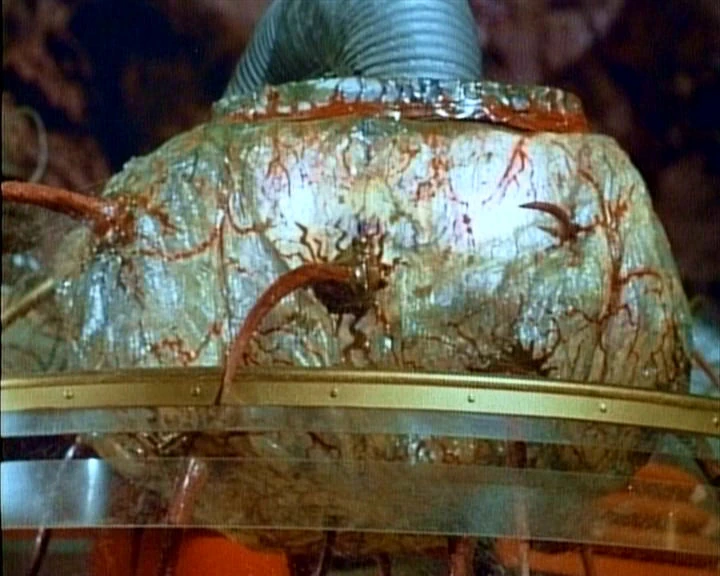
-"Why the hell does the Science Brain also sound like BOLT-0?"
"SILENCE! YOU ARE MISTAKEN! BOLT-O AND ALL OTHER ROBOTS SOUND LIKE ME!!"
-"SILENCE! THIS ENTIRE COMPLEX HAS BEEN UNEXPECTEDLY SHRUNKEN! BEDROCK COLLAPSE IS IMMINENT!"
"Wait, you mean the Dwarf Wizard's misfire of the Enlarge spell has doomed the last complex of the Ancients?"
"SILENCE! YES."
-The party manages to just barely escape the collapsing complex, on an Escape Rocket! It blasts them back to the inner surface and crash-lands on one of the flying islands.

-The group immediately runs into deadly Giant Beetle-Wasps. The Brahmin warrior is overjoyed at having a chance to regain his honor, only to be again incapacitated by a stinger.
-"dude, at this point that Ancient Exoarmor's main role is to hide your humiliation"
-"We've killed off the Beetle-Wasps. The Dwarf-Wizard's Magic Shield spell lasted just long enough to make him completely useless in the fight"
The adventure finished off for the night with the PCs trekking across the grassland of the floating island, up the hills, and getting to an Ancient Tower which was probably the rocket's pre-programmed destination. When they get there, in the middle of a thunderstorm, they are let in by a human in a Victorian Butler's costume. "Good evening.. you are just in time for Lady Norrington's party!"
-"Oh shit, I can smell a haunted house adventure coming on..."
RPGPundit
Currently Smoking: Dunhill Amber Root Bulldog + C&D's Crowley's Best
Tuesday, 8 December 2015
Pictures From Uruguay: INJU Con Edition!
Some pictures for y'all of the Uruguayan Gamers (younger set) doing their thing at the INJU Con organized by 2d4orcos.com!


This one was, if I'm not mistaken, from a Paranoia LARP:


From the presentations of awards at the end of the Con (among which I was given a Dorctorate of Roleplaying):

So yeah, it was a great time, and as you can see the roleplaying scene in Uruguay is young, diverse, and vibrant!
DR. RPGPundit
Currently Smoking: Lorenzetti Oversize + H&H's Beverwyck


This one was, if I'm not mistaken, from a Paranoia LARP:
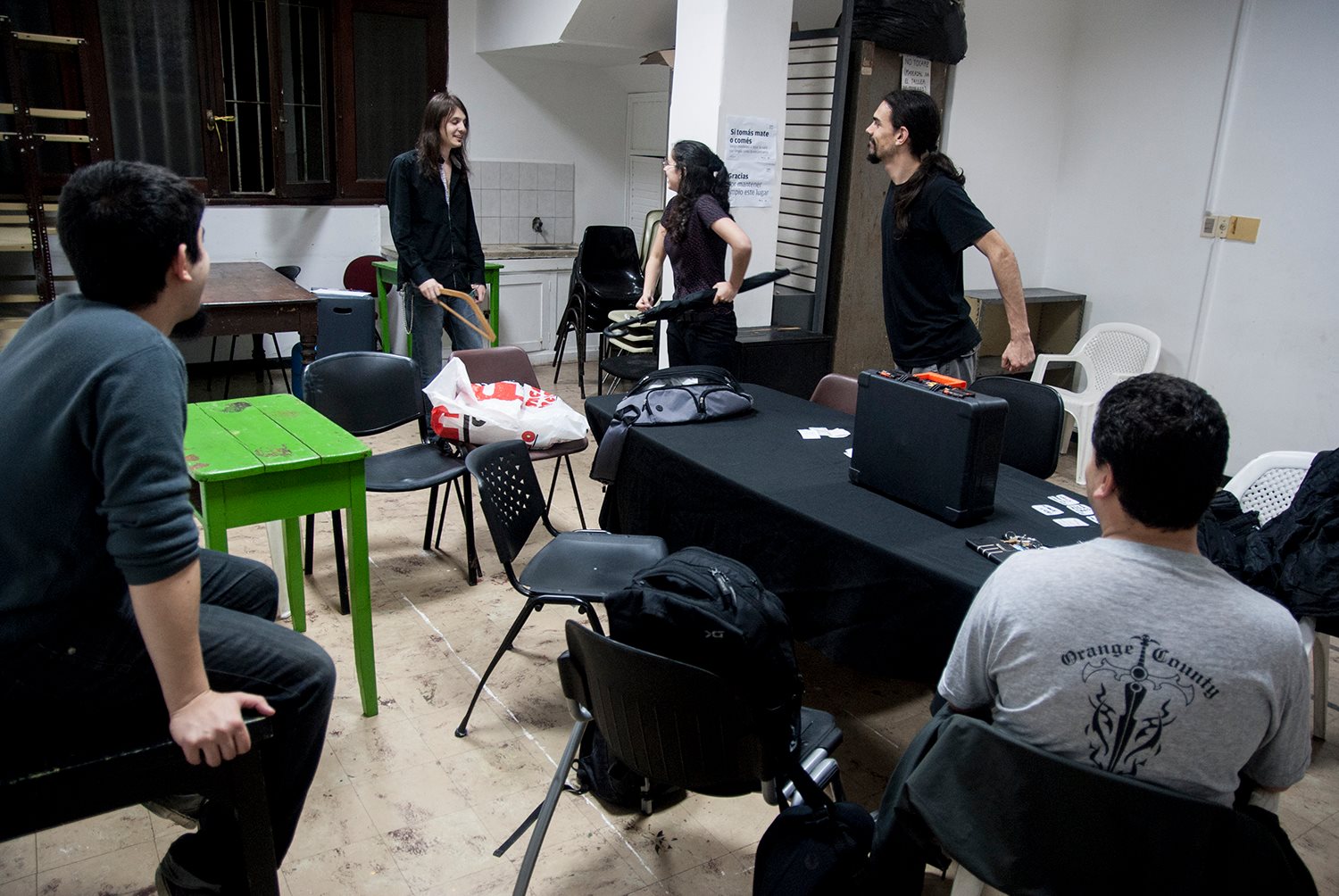

These guys here were doing something called "Soft fighting":


From the presentations of awards at the end of the Con (among which I was given a Dorctorate of Roleplaying):

So yeah, it was a great time, and as you can see the roleplaying scene in Uruguay is young, diverse, and vibrant!
DR. RPGPundit
Currently Smoking: Lorenzetti Oversize + H&H's Beverwyck
Monday, 7 December 2015
When Two Things You Like Are Blended Together...
...and you're just not sure.
I mean, I love chocolate, and bacon, but not totally sure about chocolate with bacon. But it MIGHT be good, if made the right way.
Anyways, that's the dilemma faced in the Roleplaying world with the announcement of this:

Yes, that's Mindjammer, the awesome transhumanist space opera setting by Sarah Newton being combined with Traveller, the old-school hard sci-fi RPG. It's part of a big kickstarter event going down for Mindjammer.
Now in theory, this should be great. Some Trav fans might find little use for it if they're big-time Imperium fans, but in my own case of all the Trav campaigns I've ever run only two have been set in the Imperium (including the totally nutty one I'm currently running).
But I can't be quite sure. Traveller's system works really great for a certain tech level; go too low or too high and then it still works but not quite as great. And what TL would the Commonality be anyways? Certainly way higher than the Imperium.
And then there's all the sci-fi stuff that has come down the tube in the last 40 years that Traveller never had to deal with because it could just flash its "geezer" card. There isn't even a good way to handle cyberspace in Traveller, much less stuff like the personality-warping shit (or indeed, society-warping shit) you see in the Transhumanist setting of Mindjammer.
I guess it's just like chocolate and bacon: whether it'll be any good or not will depend a lot on how its put together.
RPGPundit
Currently Smoking: Blatter Diplomat + C&D's Crowley's Best
I mean, I love chocolate, and bacon, but not totally sure about chocolate with bacon. But it MIGHT be good, if made the right way.
Anyways, that's the dilemma faced in the Roleplaying world with the announcement of this:
Yes, that's Mindjammer, the awesome transhumanist space opera setting by Sarah Newton being combined with Traveller, the old-school hard sci-fi RPG. It's part of a big kickstarter event going down for Mindjammer.
Now in theory, this should be great. Some Trav fans might find little use for it if they're big-time Imperium fans, but in my own case of all the Trav campaigns I've ever run only two have been set in the Imperium (including the totally nutty one I'm currently running).
But I can't be quite sure. Traveller's system works really great for a certain tech level; go too low or too high and then it still works but not quite as great. And what TL would the Commonality be anyways? Certainly way higher than the Imperium.
And then there's all the sci-fi stuff that has come down the tube in the last 40 years that Traveller never had to deal with because it could just flash its "geezer" card. There isn't even a good way to handle cyberspace in Traveller, much less stuff like the personality-warping shit (or indeed, society-warping shit) you see in the Transhumanist setting of Mindjammer.
I guess it's just like chocolate and bacon: whether it'll be any good or not will depend a lot on how its put together.
RPGPundit
Currently Smoking: Blatter Diplomat + C&D's Crowley's Best
Subscribe to:
Posts (Atom)