Friday, 14 October 2016

Thursday, 13 October 2016
Break Thursday: Creepy Clown Edition
Today I take a look at the weird true history of the Clown.
Were they always so creepy?
Is that something new? Or something REALLY REALLY OLD?
Get the whole story of where Clowns come from, how they became what they are, what made them 'go bad' in our culture, and why they have sinister primordial power to begin with, all in the link above!
As always, please feel free to share, +1, like, retweet, etc etc.
RPGPundit
Currently Smoking: Lorenzetti Quiete + C&D's Bailey's Front Porch
Wednesday, 12 October 2016
RPGPundit Reviews: Interstellar Overthruster/A Star For Queen Zoe
This is a review of the twinned RPG book "Interstellar Overthruster" and "A Star For Queen Zoe". It's a single book, with one half covering the first title, and the other half (flipped reverse from what would otherwise be the back cover) being the second title. This is a review of the print edition, which was written by Jed McClure, with no listed publisher.

The book is a slim volume, made in a style highly reminiscent of the old "Traveller" booklets; with "overthruster" being 62 pages long, and "Queen Zoe" 34 pages long. The cover of the former features an image of a field of hexagons with a starship flying over it, and the latter features what looks like an old heraldic crest with a rocket as the central motif. The interior art is black and white, with some maps and comic-style drawings.
So Interstellar Overthruster is presented as "a set of rules to generate a hexcrawl sandbox game in a space opera setting". It should be noted that it is not a set of game rules; instead it would theoretically be used with some set of sci-fi rules from an existing RPG. The author lists games like Traveller, Stars Without Number, and Copper Sea as his inspirations, so presumably the mechanics could be used in those games.
The presumption of the setting is that there are many worlds that were at some point colonized by humans, but that some cataclysm cut them off from contact. There are also non-human aliens, which would have varying cultures and levels of technology. The setting also supposes that terrestrial human-like life (that is, animal life capable of existing in the same general environments as humans) is the most common type of life. It is also listed as a presumption of the setting that every star system will have something unusual about it.
The assumption of the setting is that the PCs are space explorers coming from one of these worlds just emerging out of a dark age, and going forth to discover or rediscover the local star systems. Alternately, the PCs could be explorers from a more civilized area of space, going out to the far frontier regions to map new worlds/civilizations; or they could be lost in an uncharted region of space, due to some kind of wormhole accident or the like. Anyways, you get the general idea. Whatever the reason, the PCs are travelling through space, on a ship, in an area they know almost nothing about.
There's an interesting detail to the methodology the book suggests when it comes to rolling up the hexes of the space sectors you're creating with Interstellar Overthruster. Normally, when I was rolling up a sector of space for Traveller for example (or for that matter, of random wilderness areas in D&D), I'd choose a whole big section, and roll it all up ahead of time. Then I'd figure out how each area rolled fit into a greater whole.
But the author of this book suggests the exact opposite. In fact, he emphasizes in bold that the GM "should resist" rolling up all the star-systems beforehand! Instead, he claims "the intention in the rules is that the referee rolls up each hex at the table", in front of player view, or even let them roll the dice. The justification is that this helps to "maintain suspense". And the GM should only incorporate each located area into the larger campaign after the fact.
In fact, the book argues that you should start out the campaign by taking a blank 'subsector' hex map, and roll randomly to choose a starting hex where the ship begins (and just start rolling random star systems from there).
The also book suggests that resource maintenance is important; some guidelines are given for the handling of supplies, fuel, parts, and oxygen for the PCs' starship.
I'm not sure I'm convinced. I mean, sometimes I do that exact thing, when I'm winging it. But to take that up as a matter of absolute principle strikes me as a bad idea. An entire campaign run that way can very easily look half-baked.
The intended play process covers three main phases. The "scanning phase" is performed from an adjacent hex as the PCs (on their starship) are exploring. Here is where you would roll to see if a hex has a star system and any qualities thereof.
The "survey phase" is conducted when the PCs reach the system, and here is where you roll to see the number of planets.
Finally, the "contact phase" is where an away-team goes to some inhabited world and encounters the intelligent life forms there. This is where rolls are done to determine just what that life and its culture consist of.
Each of the phases are very well delineated, with a sequence of random rolls and tables. You roll first to see if the area of space has some kind of unusual detail (like if it's under control of some alien race, or is part of a weird space phenomenon, a nebula, or plasma cloud, etc.). Next you roll to see if a given hex has a star system of some kind in it. If it does, you check for the type of star; the table included is quite detailed in terms of the various star types.
The survey phase involves figuring out the types of planets in a system. A set of roles determines how amenable to life potentially habitable planets are; qualities of gravity, moons, atmosphere, climate, hydro-sphere, and ecosystem.
The "Contact Phase" is used to determine the specific type of lifeforms; first the most dominant indigenous lifeform (which may or may not be intelligent), and then to see if a lost human colony is present. A human colony, if present, could be at anything from totally stone-age to advanced space-faring technology level. There are tables to determine what the purpose of the colony originally was (if it was military, a mining operation, agricultural, a prison world, etc.), and optionally the dominant human ethnicity. Finally, there's tables to determine if the world also features a presence of an advanced space-faring alien race, present as a research mission, military base, or colony. And likewise a table to determine what form of government either the human or aliens present might have.
There's also a 'cosmic strangeness' table to determine if there's something weird about the world or system. This is rolled on a d100 table, so there's a good amount of variables.
This is the whole of the "Interstellar Overthruster" half of the book. I have to say, while the tables here are not identical to those in Traveller or other sci-fi games with world-making mechanics, they also aren't so unique and different that they would stand out to me as radically special. Yes, it's not as technical or trade-focused as what you get in Traveller, and a bit less hard-sci-fi. But I certainly wouldn't say these tables are generally better than Traveller, or even that they make more interesting world-building results. They do, however, make a slightly different 'style' of world. More 'soft' than 'hard' SF.

So now we get to the flip-side of the book, the sourcebook/campaign "A Star For Queen Zoe". It starts with a four-page in-game fiction piece; which is on par with almost all other game fiction. That is to say, a waste of space. After that, in the introduction to this book, the author talks about how as a teen he was tremendously impressed by Traveller's universe, but never ran a campaign there, as its scope was just too huge and intimidating. Thus, he clarifies, his system for sci-fi setting creation, and his Zoe campaign, operates on a far smaller and more intimate scale. And it creates the setting as the Player Characters go along in it, the theory being that in this way everything in the universe of the setting will be oriented around the PCs.
It's said that the Zoe setting, which is usable for any sci-fi ruleset, does not have any kind of overarching plot. Instead, it provides background for the main planet ("Essex"), and then tools for exploring the sandbox of the local uncharted space.
The default concept of the Zoe setting is that it's been some 1500 years after humanity began to expand into space. Colonization happened in waves, first by sleeper ships then by FTL. Terraforming allowed for the remaking of worlds into earth-like environments. But a great plague managed to wipe out human civilization and lead to a dark age.
Essex, the starting world, just began being colonized when the plague hit. On top of that, a quirk of the world caused an incredibly cold period every 22 years. Thus the Essex colony bordered on total collapse, and colonists ended up regressing and breaking into warring camps. Technology fell to 1800s level.
Details are provided for the various kingdoms of Essex.
Two years before the start date of the campaign, an Earth starship landed on Essex, re-establishing contact.
Obviously, the campaign setting (like Interstellar Overthruster itself) is set up to be system-neutral, but it does have some add-ons for character creation. There's a very simplistic mechanic for rolling for social class (I say simplistic, because there's totally same odds for getting to be a peasant as to be titled aristocracy; something that I strongly suspect was not designed to reflect the intended social divisions of the setting). There's also a list of suggested professions, with some suggested specialization/skill-titles for each profession.
Then there's a list of possible skills along with what ability score should govern it (the abilities being the D&D baseline). Note that these latter skills are not the same as the specializations that each profession has (which have no governing attribute and are far more broad subjects).
There's also a very simple table (d10, where 10 means 'roll again twice', so only 9 actual choices in all) of special resources your character might have on Essex. These range from having a 'secret sordid past' in a criminal underworld, to being an academic prodigy or natural athlete (these two give the vague suggestion of granting a 'bonus to skills', without stating what that bonus should be).
There's a section describing the role of psionics on Essex, but with the suggestion that if your game doesn't have psionics then the section can be ignored wholesale. In either case, no actual psionic rules are provided, only guidance on how to integrate psionics in terms of how they are treated on the planet Essex.
At this point we get to the adventure setup. The PCs are on a mission for Queen Zoe, the queen of the kingdom of Richmond. It is revealed to the PCs that Essex is going to be turned into a colony of the Terran Empire, unless Essex can establish an interstellar empire within two years. This would seem impossible, except that a polar expedition of Richmond's found an intact scout ship, long buried. The PCs are asked to take this ship, go out into space, and find a suitable world to claim as a colony of Richmond. This will alter Essex's status for the Terran empire, which will be constitutionally forced to make them a member-planet rather than an (inferior) colony (and will put Queen Zoe at an advantage over the rival King John who is allied to the Colonial officers from Earth). The PCs will receive some basic training for the mission; they will also have to watch out for Terran agents, who will likely not want Essex to succeed.
A floorplan is provided for the scout ship, and a list of provisions. They will be accompanied by a pilot and an engineer, who are very briefly described.
And that's it. There's a starmap, but all that's filled in is the hex for Essex and the immediately surrounding hexes. Everything else is unexplored territory, and is meant to be filled in with the system provided on the flipside of the book in "Interstellar Overthruster".
So all in all, this is an odd little product. It amounts to some detailed rules for a make-it-as-you-go system of space exploration, and a very basic campaign setup. These rules are different from other rules, but not radically different. They're neither intense hard sci-fi (far from it) nor are they incredibly gonzo; they're just fairly middle-of-the-road soft sci-fi; maybe even more mainstream than Traveller, what with the lack of emphasis on trading. The one conceit of the product is not actually anything to do with with the mechanics or setting material per se, but rather it is the slightly gimmicky notion that the GM should have to roll up each patch of space only as the PCs themselves get there.
I think that if you are already running or planning to run an OSR-style science fiction campaign (be it for Traveller, Stars Without Number, White Star, or any other type of game), and if you find the conceits of Interstellar Overthruster and its methods appealing, then this book might be worthwhile for you. Particularly if for some reason you do not find the various other 'space sector generation' mechanics (like in Traveller or other products) to be quite what you're hoping for.
As far as I can see, that's the only condition in which this book will be of use to you.
RPGPundit
Currently Smoking: Lorenzetti Oversize + H&H's Chestnut
Tuesday, 11 October 2016
RPGPundit Reviews: Arrows of Indra, by the RPGPundit!
Right, the time has come again for the RPGPundit to review one of his own games. But don’t think of this as some kind of advertisement; yes, obviously I have a bias, but so does everyone else. And mine you know up front. If you prefer, think of this more as a guide to the contents along with some “Designer notes” rather than a more conventional review. I mean, its not like I have to wait until the end here to tell you that I like this product!
Anyways, Arrows of Indra is a complete RPG, in the OSR style (that is, with OGL rules based on everyone’s favorite original RPG). Its published by Bedrock Games, written by the RPGPundit. Its available in PDF or print; the print edition is a softcover, full colour cover with B&W illustrations inside, clocking in at about 180 pages (plus character sheet).
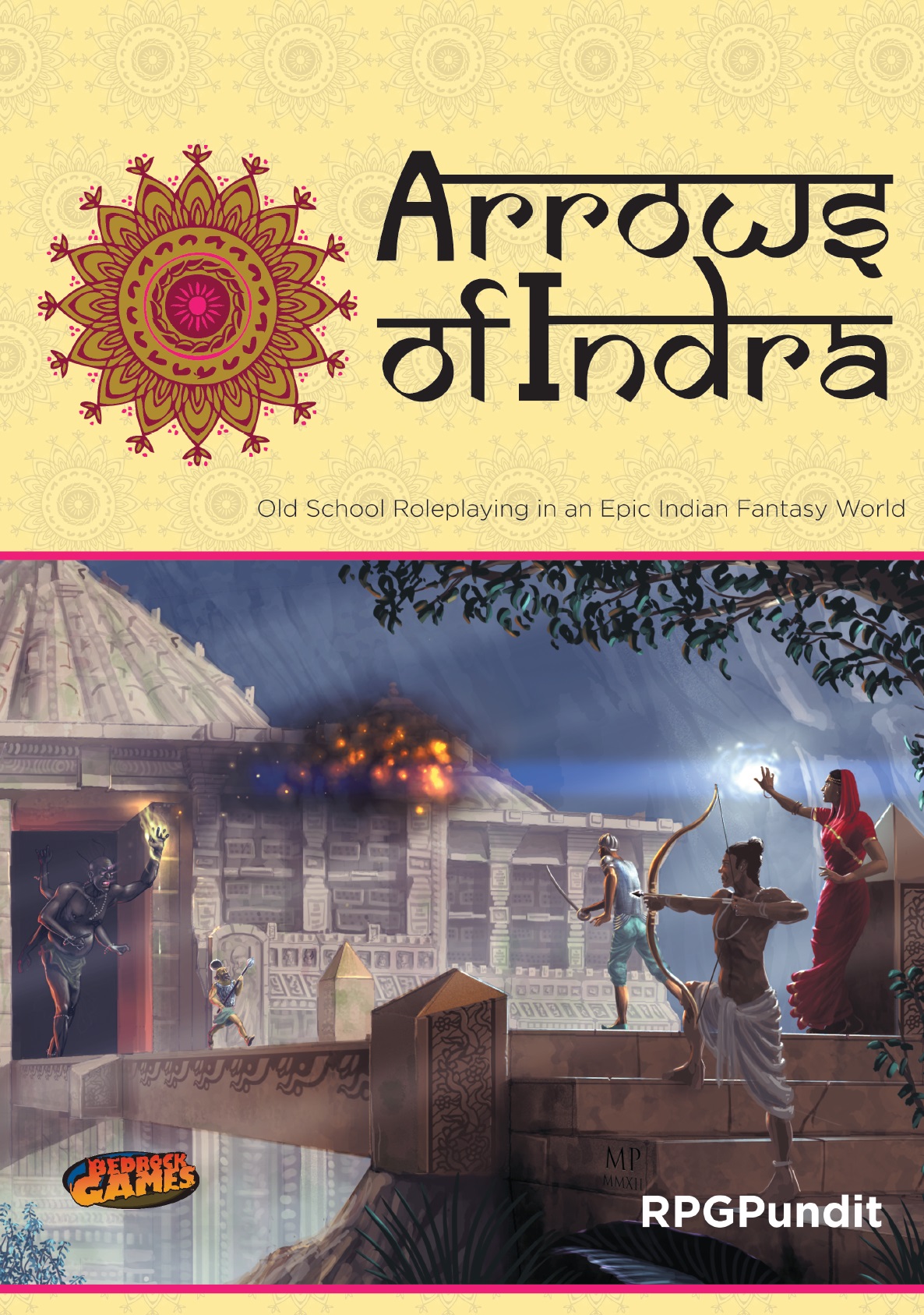
The cover is really amazing (and I can say that while making it clear I had nothing to do with it!), with a matte finish and a beautiful illustration showing a group of Indian heroes holding off an Asura demon at the entrance to an abandoned temple in the middle of the jungle. One detail which might be notable about the cover is that it is, as far as I know, the first RPG cover to feature a transgender person on it (the siddhi or magic-user of the group).
The interior art (again, none of which was my doing) has been somewhat controversial in the sense that some people like it and others really didn’t. It has a style that is meant to evoke old-school art, that is to say, a slightly primitive style; though I think some of the pieces are really quite impressive within that style. Still, not for everyone. I should note that there are also a number of pieces of art from other sources (mostly public domain art), and some really awesome artistic borders on every page. Finally, no one at all has had any unkind words to say about the truly awesome hexmaps made by master cartographer Rob Conley; there are four pages worth of these that put together detail the entire area of the Bharata Kingdoms and its surroundings.
Now, a brief word on what its all about: Arrows of Indra is an attempt to make an Old-school RPG that is based on the world of Epic Indian myth. When designing it, I tried to follow certain rules:
1) over and above all else, I wanted the game to be playable, out of the book, and to be easy and fun to play. I didn’t want players to have to study college-level linguistics or anthropology to have to play, nor did I want what I call “culturewank” to end up drowning out actual playability. For example, I tried wherever possible to use ordinary words in English when such words existed and conveyed what I was trying to communicate; rather than requiring that players relearn common terms in Sanskrit. I used Sanskrit for things like place names, some monsters that didn’t have a readily-available western equivalent, and certain powers or concepts that strongly benefited from using a Sanskrit name without needlessly hampering the reader.
2) At the same time, I wanted the game to be recognizable as an OSR game; while this game is far less similar to any edition of D&D than, say, ACKS or LotFP, it is still very clearly mechanically founded on the OGL. Wherever possible I tried to make the game accessible to those who are accustomed to D&D play, while at the same time without just reducing the setting to a shallow facade.
3) On that note, I wanted the setting to cleave as closely as possible to the authentic historical and mythological sources of “Epic India” (that is, the pseudo-historical India of the Indian Epics: the Vedas, the Ramayana, and particularly the Mahabharata in which the AoI setting takes place), within the context of rules 1 and 2 above.
What this meant in practice was making a number of choices: there were times where I made changes to the mechanics of the game in order to better fit the setting (for example, the skill system, the non-vancian casting, the classes, etc); whenever I did so, I tried to make such a change be one that kept to the old-school feel, while better representing the setting. At the same time, there were many times I had an option between a number of choices regarding the setting (for example, how to present a specific monster); in those cases, I tried to always make the selection out of a list of several authentic possibilities that would keep the game as playable as possible and as close to the familiar as possible.
So Arrows of Indra is not just “AD&D with a dash of Indian backdrop”; and at the same time its not “cultural-academic game which bares almost no resemblance to anything familiar” (avoiding the latter wasn’t hard, by the way, since ultimately, a lot of European mythology has its deepest roots somewhere in India, and there’s a ton of parallels). Everything in the game is there for a reason and has a source in Indian mythology; but this isn’t a “too weird to live” game where you have a rich setting but no idea what to actually do with it and no easy way to get into it without a huge investment of study and familiarization. Its easy-access.
Some people have claimed the game has sacrificed elements of authenticity in order to fit the D&D mold. That’s probably true; I can certainly imagine that someone else could someday make a more authentic game than AoI (whether or not it would be more playable). But the point of fact is, no one has. And you can’t even compare AoI to other non-European D&D-settings; Arrows of Indra stays MUCH closer to the authentic sources for India than L5R does to Asian ones, for example (and don’t even get me started on “oriental adventures”)! I haven’t yet read “Spears of the Dawn”, and I’m sure its awesome but I’d be willing to bet that, at best, it could only match AoI for authenticity.
The end goal, in any case (and which I feel from the playtests and AP reports since the game came out) was to make a game that is definitely Epic Indian adventuring, that is notably different to being in Greyhawk or the Wilderlands, but that at the same time feels very familiarly like D&D: its a game where the players will immediately know what their group is meant to be doing (basically what D&D PCs should always be doing: heroic adventuring!) and in very much the same ways as traditionally, but in a very different world that brings a fresh perspective to it all.
So, let’s take a gander at what’s inside the book, shall we?

Characters are created by rolling for ability scores as per usual; though in addition to the standard elements of scores, race and class, you are also expected to roll or choose a caste and select or be assigned a clan, two vital parts of the setting. These are thoroughly explained in a practical way that explains their role in the world from the perspective of what it would mean to the PC. Its one of the ways that AoI might vary from other old-school games, in that things like culture and customs can (if the GM wishes) be a significant part of the very definition of the PC, and family and clan become a major part of playing in the setting (again, to the degree the GM wishes it). So you also get some quick rules for generating a PC’s immediate family.
For convenience, there’s also a list of 100 male and 100 female names for PCs from a random table, along with a loose definition of the name’s meaning. This was something I added on relatively late in the writing, as a result of playtesting and quickly figuring out that a lot of players haven’t got the slightest idea what a name should be like; I’ll admit that I made the table mostly by just recollection and that most of the names would probably not be historically accurate to the period. Someone creative out there taking their time could probably make a much better, historically-accurate name table.
The player-character races include regular civilized humans of the Bharata kingdoms, barbarian humans (the Bhil), Gandharva (immortal beautiful servants and messengers of the gods), Yaksha (also immortal gold-skinned dwarves who guard treasures of the gods; they are both erudite scholars and passionate romantics), Rakshasa (the descendents of humans interbred with Asura demons; distrusted and tainted), and Vanara (the monkey-men of the south). It's been pointed out that I’ve made the various non-human races (all of which come out of Indian myths of the time) into very close parallels of the core old-school D&D races, and that’s technically true; but again, this was done by making a choice from a number of options. For example, a “Yaksha” could be (depending on which mythological source you look at) a big scary monster, a beautiful tall human, an ethereal spirit with no body at all, or a golden-skinned dwarf who likes to fight, read poetry and guard treasures. I chose from these options the one that was closest to something a D&D player would find familiar.
Some people have also pointed out that I made use of a real-life minority group, the Bhil, in my game, and that I was somehow “reinforcing” the caste structure by including it. These are stupid arguments; I’m utterly opposed to the caste structure in real life, I say so in the introduction to the game itself. But what I am doing is making use of sources. The Bhil are not intended to be “non-humans” by the way they were included, they’re intended to be non-vedic; which they were. And the way people wrote about them back then was no different than how they wrote about, say, the Gandharvas; both were detailed as alternately being not-really-human and/or just-another-tribe. This is a reflection of the mentality of the times, not anything I believe or endorse myself. In any case, moving on to stuff more worth talking about now…
Classes in the game are also set up to roughly reflect the standard class selection of an OSR game, but each have subtle or less-than-subtle differences from their bog-standard equivalents. Priests are not unlike what one would expect in an OSR game, but caste requirements make them far less common, and they have several social restrictions they’re bound to (priests weren’t generally adventurers in Epic India, and I almost considered limiting the class to NPCs; but in the end, as described above, opted for the choice that would be most familiar to OSR gamers). There are also modifications for playing barbarian priest-shamans, or priests that are not of the gods but of Asura-cults.
Fighters as a class are mainly different due to class skills, so more about that later. But there are also subclasses of fighter in the Virakshatriya (holy warrior) which is the term I used to describe those particular Holy-aligned warriors that get mystical powers due to their devotion to a particular god. They’re a little bit cleric, a little bit paladin; and a lot kick-ass. But of course, have serious RP obligations in terms of taboos and rules to follow. Scouts are wilderness men; not unlike rangers but with no magical element to them, but expert trackers, survivalists, good at sneaking, and skilled at fighting barbarians and those giant monsters that the Bharata Kingdoms’ wilderness areas seem full of.
Siddhis are the wizard-class; the main difference between them and your standard old-school Magic User is in that the magic system has been completely redone (this, along with the new skill system, are the two biggest changes in Arrows of Indra, from a mechanical point of view).
Thieves are perhaps the most familiar class in terms of similarity to D&D; and the subclass of Thugee is similar to the Assassin; but mainly I included it almost out of an expectation among players; its not really historically relevant to the period at all (so people can feel free to ignore it if they desire).
Finally, the Yogi is a physical adept (as compared to the siddhi who is a mental adept). They have some of the strictest mechanical and social/RP requirements of the game (they are renunciates who are forbidden from material possessions, among other things), but also have a serious amount of powers. The Yogi is another one of those that might be better off used as an NPC class only in some campaigns.
Another detail that adds to the richness of the setting in AoI is how alignment is handled. Its very important to the context of the setting, and is divided into “Holy”, Neutral, and “Unholy”, rather than the standard good/evil or law/chaos divides. The alignment system is based on how well one fulfills one’s obligations to the gods; and it basically measures not how “good” a person you are (or how you feel about order versus anarchy) but is a measure of how well the gods look upon you. In subsequent parts of the game, when it comes to things like spells, magic items, monster reactions, and divine intervention, alignment ends up having a direct mechanical impact on play. Because of what alignment represents in AoI (compared to in other games), it is also more malleable and somewhat easier to change (even accidentally!).
I’ll mention that some people have commented on thinking it very odd that I didn’t include details about things like Karma or non-dualism (“Advaita”) in the game; this was absolutely intentional and for the reason that at the time of the setting, these concepts were far less developed than in the Hindu religion today. The spirituality of the setting is a Vedic spirituality, based on the old Brahmanical religion and not the modern Hindu religion. It's actually more historically accurate NOT to have these things in there. Some people also claimed I left out union-with-godhead or reincarnation; in fact I didn’t: the former is something Siddhis and Yogis can achieve, the latter is something that explicitly happens to everyone in the game and there are even some forms of magic that allow a Siddhi to mess with it. They’re just not really crucial to the game because of course, what happens after your PC dies won’t usually have a direct bearing on you as a player; your PC is still dead, after all.
The Skill system in Arrows of Indra is neither a point-buy 3e-style system nor a choose-from-proficiency-list type of system either. Instead, what you get are both background skills (reflecting a character’s family or clan training) and then class skills. Both are set up to be rolled from random tables, though some GMs may prefer to have players choose the skills.
Background skills are all basically career-type skills (divided into tables by caste type), and are resolved by beating a DC on a D20 check, plus attribute and bonus. Every time a background skill is taken at character creation it grants a +2 to checks, with subsequent selections granting another +1. Pretty straightforward.
Class skills, on the other hand, are a mix of career-type skills and special abilities (things like weapon proficiencies and spells, mostly). They are divided into basic and advanced tables; with the “advanced” skills being harder to get at (you need to fill up slots on the basic table in order to get a chance to roll on the advanced table).
Skills for priests include things like languages, theology, demonology and magical rituals (called “arcana”).
Fighters get weapon proficiencies (which grant stacking bonuses to hit and damage each time they are taken), horsemanship, charioteering, and (at advanced levels) things like special maneuvers, exotic weapon mastery, and Command (leadership).
Siddhis get basic spells from the class skills; in the form of Mantras (vibrated chants) or Mudras (physical postures or hand gestures that manipulate energy). They can also learn astrology and demonology.
Thieves (who get all the standard “move silent”/”backstab”/”Climb” stuff as basic class abilities to start with) get a wide variety of special talents for their Class skills: languages and literacy, knowledge of poisons, manipulation (bonuses to reaction checks), urban survival, training in thief-favored weapons, appraisal of goods, disguise, and object identification/lore.
The one other element of character building that we have left to cover are what I’ve termed Enlightenment Powers. These are available to Wizards and Priests from level two onward, and round out the magic system.
Magic in Arrows of Indra are based on two different parts: first, Priests have priest arcana (rituals), while siddhis have magical mantras and mudras. These are the basic spells of each type. Then, both priests and siddhis get potential access to Enlightenment powers, which are generally more powerful types of magic that manifest spontaneously without the need of ritual or verbal or somatic components. First level characters don’t get any Enlightenment powers, but from level 2 onward, every time a Priest or Siddhi goes up in level, they have a chance of learning one or more enlightenment powers. There are three ranks of such powers (and 20 powers listed in each rank), and at each level there’s a percentage chance (for ranks 1 and 2 from 2nd level onward, rank 3 from 5th level onward) of gaining a new power. These percentage abilities are modified by the classes’ prime requisite, and the Intelligence ability score determines a maximum number of powers that can be gained in each rank.
Of these powers, mantras, mudras, and arcana, some of them will appear similar to D&D spells for either magic-users or clerics; others will be quite different as they are based on miraculous powers from Indian myth. So for the experienced old-school gamer playing a spellcasting class in AoI, the magic available will sometimes seem familiar and other times excitingly exotic. The way the mechanics work out, a spellcasting character can theoretically gain between 0-2 enlightenment powers each level until 5th after which they could gain between 0-3 enlightenment powers; they will also likely gain one “class skill” power each level. In all cases any power or spell can be used only once a day, but it is possible to “gain” a power or spell more than once in some cases, allowing for multiple uses. All of this means that in some ways the magician in AoI will be a bit less predictable in his development than in D&D, but is likely to get certain powers that would be the equivalent of high-level magic relatively earlier.
Next up the game features a short but relatively complete equipment section, including details on currency, encumbrance, and in-setting systems of loan and credit (usually handled through clan houses). There’s guidelines too for reselling items. Weapons and armor are all based on real Indian weapons and armor (generally of the period), and include a few more unusual objects like the famous Chakram. Whatever one might say of the interior art, p.57 features a spectacular page with authentic drawings of all of standard weapons as they actually would look, and to scale. Certain weapons like Chakram or Strangling Cords have special qualities that are noted in their descriptions. There are price lists for animals, clothing, food, herbalism, housing and transport, siege weapons, and miscellaneous equipment (including some familiar standard adventuring gear like rope or a 10 foot pole, and some much more unusual items like mala beads or a conch shell). There are also price lists for slaves and for hirelings.

The GM section begins on p.64, and starts off with slightly more detailed rules than you’d normally find in an OSR product for Reaction Rolls (which are used for social interaction as well as for animal encounters) and morale rules. There are rules for travel and guidelines for giving out XP. The combat section is relatively familiar to OSR-fans: the game uses ascending AC, initiative is rolled individually (1d6+dex+miscellaneous modifiers for things like weapon speed or spellcasting penalties). As the tone of AoI is a bit more heroic than normal and also meant to be based on Epic Indian myth, there are a few differences: there’s a “critical hit” rule for rolling natural 20s (natural-20s always hit, plus a hit that surpasses opponent’s AC enables you to immediately make a second attack), and there are special rules for firing multiple arrows meant to make archers more effective than typical in OSR games (this is also backed up by the class skill system, where fighters who choose to focus on archery can end up getting very significant bonuses). There’s rules for fighting from a chariot or on an elephant-platform as well, both important features of Indian combat.
Because healing magic is somewhat more rare in AoI than in other games, there are some changes to healing where PCs heal just a little faster with rest than they would in many other OSR games (though nowhere near proportions seen in later D&D editions); but there’s also rules for the Medical skill and herbalism that go a long way to aiding and accelerating healing without having to involve magic.
Then there’s all the standard goodness for things like charging, cover, wrestling, poisons, falling damage, etc.
The next 36 pages cover the setting, with a detailed gazetteer of the Bharata Lands, a guide to the Patala Underworld, a system for generating cave complexes in the same, and random wilderness and city encounter tables.
The Bharata kingdoms are basically a fantasy-version of ancient India as detailed in the Mahabharata period; I had briefly considered making up some more abstract world with an Indian “flavor” but I decided that nothing I could come up with myself would be able to beat the richness, detail and creativity of the actual “Epic India” of the myths. The Bharata Kingdoms, as of the “present” of the setting, already have thousands and thousands of years of history. They are a series of city-states, small kingdoms, decadent principalities, plus one looming somewhat-evil empire currently engaging in threatening expansion. The western, central, southern and eastern areas each have their own distinct quality and style, but all the lands are united by a common overall culture and heritage (though marked by interesting regional variations). The setting section includes guildelines to what life is like in the Bharata Kingdoms, cultural traditions, holidays, the weather, what growing up in the Bharata kingdoms would have been like for the PCs, gender roles (including details on the somewhat different concepts they had on the gender spectrum), and the “Heroic culture” of the current era (a culture that all but encourages people like the PCs to go out and be great adventurers).
There’s detailed descriptions of all the major kingdoms and important city-states, as well as of the wilderlands that surround the Bharata lands: the imposing and magical mountains to the north, the desert of Thar, the various hills and jungles, swamplands and coastal regions; as well as ruins of ancient cities and temples lost to time, kingdoms of Demons, Nagas, cities of the gods, and barbarian tribelands.
All these details include material on local rulers and personalities, as well as current problems and events (and potential adventuring hooks).
The Patala Underworld is the massive underground cave-network of the setting. How massive? It covers the entire planet, and it goes six vast levels deep. Again, this is based on real Indian myth (though of course, in some of the source texts, the Patala underworld was meant to be taken as symbolic or metaphorical, but for adventuring purposes, once again, I chose the literal view). Each level of the Underworld contains multiple regions with their own characteristics, inhabitants, rulers and dangers, and each level overall has a very different quality than the rest. Not only does the book provide descriptions of the Patala Underworld as a whole, it also provides a set of random tables the GM can use to generate small or large sections of the Underworld (with variations to account for underworld-level) for adventuring purposes. Of course, random monster charts are included for each separate level.

The monster section is 25 pages long; and details full stats for 84 different creatures. Every single one of these creatures are specifically taken from Indian sources (with the exception of a couple of giant animals, though giant animals in general are very much in keeping with Indian myth; and the “monstrosity”, a randomly-generated exotic-type monster meant to cover all the really weird types of creatures that appear in myths as one-shots). I should mention that these statblocks are easily and readily compatible with most OSR games.
There are also 19 pages of treasure tables and magic items. Once again, treasure and items reflect Indian myth and history. So for example, while there are certainly magic swords (and maces, lances, daggers, and all kinds of other melee weapons), magic bows are the most significant kind of magic weapon (so in this game, its bows that have alignments and major and secondary powers). While there are some familiar types of magic items like rings or staffs, you will also find magic sutras (holy scriptures), conch shells, mala beads, and herbs; as well as wondrous items like the Yaksha Treasure Chest, the Sea-Emerald of Varuna, the Peacock Crown, the Kara of the Unspeakable Oath, or of course Vimanas (the magical “flying chariots”, some as large as a house). In place of artifacts, there are Celestial Weapons, those weapons of legend that come directly from the gods (or some of the most powerful asura-demons) and have devastating power. These won’t be found in a random treasure horde, they’re only available as major campaign elements, usually to be granted directly from the gods themselves.
The section on the Gods and religion is kept relatively quite small; I could certainly have added a lot more on the subject, but again, I didn’t want it to be an anthropological or religious treatise; its an RPG, and so what’s there is what’s essential to run a credible game. There’s brief descriptions of the major gods, divided into groups (the old Vedic gods, the Vaishnavite family and the Shaivite family, as well as river goddesses); there are guidelines to major religious rituals, and there’s rules on direct Divine Intervention and divine quests; both of which can become increasingly common events for PCs from about 9th level onward.
So at the end of the book, we have a couple of unusual appendices. The first, 6 pages long but jam-packed, is called “higher level play”; but I realize now that this was probably a bad choice of wording, because it implies that the material here is “stuff not usable till your PCs are high level”. In fact, most of it is usable right from the get-go and it is actually more about “high-level play” in the sense of stuff that supports more involved and deeper long-term campaigns. It covers things like long-term costs of living, land ownership and profit from terrains, housing, work as mercenaries, temple priesthoods, running philosophical schools, thief gangs, making money from your background skills, big merchant business, taxation, interacting with royalty (including random tables for “royal attention” for when the PCs get too famous), marriage, children and inheritances, and the standard code of laws and punishments in the Bharata Kingdoms (directly taken from the real-world historical Laws of Manu). Once more, everything in here is directly lifted from different sources on ancient Indian history.
The other appendix is called “In the future”, and it provides a timeline, for those GMs who want such a thing, of future chronological events from the starting period of the campaign until several decades into the future; detailing events as they would transpire in the world if you are following the chronology of the Mahabharata. Of course, nothing obliges a GM to do so.
So, who will like Arrows of Indra, who can use it?
If you like OSR games and wanted to play one in a non-European setting, well obviously then this game is for you (especially if “Indian setting” was on your list of interests).
If you don’t hate OSR games and really love the idea of gaming in an Indian setting, then this is very likely for you.
If you are an OSR gamer, and you’re not really interested in playing in an Indian setting per se, but would really like to borrow interesting mechanics, random tables, setting elements, or dozens of new monsters and magic items readily usable in any OSR-game’s setting, then this would be for you.
Finally, if you’re not interested in running an OSR game at all, but would like to have extensive setting material for an Epic India setting, then you’ll probably be able to make very good use of Arrows of Indra as well.
Anyways, I hope this “review” has been informative as to what’s actually in AoI, and why.
If you want to purchase Arrows of Indra, you can do so from here in print, or here in pdf.
RPGPundit
Currently Smoking: Stanwell Deluxe + Image Latakia
(originally posted August 3, 2013)
Anyways, Arrows of Indra is a complete RPG, in the OSR style (that is, with OGL rules based on everyone’s favorite original RPG). Its published by Bedrock Games, written by the RPGPundit. Its available in PDF or print; the print edition is a softcover, full colour cover with B&W illustrations inside, clocking in at about 180 pages (plus character sheet).
The cover is really amazing (and I can say that while making it clear I had nothing to do with it!), with a matte finish and a beautiful illustration showing a group of Indian heroes holding off an Asura demon at the entrance to an abandoned temple in the middle of the jungle. One detail which might be notable about the cover is that it is, as far as I know, the first RPG cover to feature a transgender person on it (the siddhi or magic-user of the group).
The interior art (again, none of which was my doing) has been somewhat controversial in the sense that some people like it and others really didn’t. It has a style that is meant to evoke old-school art, that is to say, a slightly primitive style; though I think some of the pieces are really quite impressive within that style. Still, not for everyone. I should note that there are also a number of pieces of art from other sources (mostly public domain art), and some really awesome artistic borders on every page. Finally, no one at all has had any unkind words to say about the truly awesome hexmaps made by master cartographer Rob Conley; there are four pages worth of these that put together detail the entire area of the Bharata Kingdoms and its surroundings.
Now, a brief word on what its all about: Arrows of Indra is an attempt to make an Old-school RPG that is based on the world of Epic Indian myth. When designing it, I tried to follow certain rules:
1) over and above all else, I wanted the game to be playable, out of the book, and to be easy and fun to play. I didn’t want players to have to study college-level linguistics or anthropology to have to play, nor did I want what I call “culturewank” to end up drowning out actual playability. For example, I tried wherever possible to use ordinary words in English when such words existed and conveyed what I was trying to communicate; rather than requiring that players relearn common terms in Sanskrit. I used Sanskrit for things like place names, some monsters that didn’t have a readily-available western equivalent, and certain powers or concepts that strongly benefited from using a Sanskrit name without needlessly hampering the reader.
2) At the same time, I wanted the game to be recognizable as an OSR game; while this game is far less similar to any edition of D&D than, say, ACKS or LotFP, it is still very clearly mechanically founded on the OGL. Wherever possible I tried to make the game accessible to those who are accustomed to D&D play, while at the same time without just reducing the setting to a shallow facade.
3) On that note, I wanted the setting to cleave as closely as possible to the authentic historical and mythological sources of “Epic India” (that is, the pseudo-historical India of the Indian Epics: the Vedas, the Ramayana, and particularly the Mahabharata in which the AoI setting takes place), within the context of rules 1 and 2 above.
What this meant in practice was making a number of choices: there were times where I made changes to the mechanics of the game in order to better fit the setting (for example, the skill system, the non-vancian casting, the classes, etc); whenever I did so, I tried to make such a change be one that kept to the old-school feel, while better representing the setting. At the same time, there were many times I had an option between a number of choices regarding the setting (for example, how to present a specific monster); in those cases, I tried to always make the selection out of a list of several authentic possibilities that would keep the game as playable as possible and as close to the familiar as possible.
So Arrows of Indra is not just “AD&D with a dash of Indian backdrop”; and at the same time its not “cultural-academic game which bares almost no resemblance to anything familiar” (avoiding the latter wasn’t hard, by the way, since ultimately, a lot of European mythology has its deepest roots somewhere in India, and there’s a ton of parallels). Everything in the game is there for a reason and has a source in Indian mythology; but this isn’t a “too weird to live” game where you have a rich setting but no idea what to actually do with it and no easy way to get into it without a huge investment of study and familiarization. Its easy-access.
Some people have claimed the game has sacrificed elements of authenticity in order to fit the D&D mold. That’s probably true; I can certainly imagine that someone else could someday make a more authentic game than AoI (whether or not it would be more playable). But the point of fact is, no one has. And you can’t even compare AoI to other non-European D&D-settings; Arrows of Indra stays MUCH closer to the authentic sources for India than L5R does to Asian ones, for example (and don’t even get me started on “oriental adventures”)! I haven’t yet read “Spears of the Dawn”, and I’m sure its awesome but I’d be willing to bet that, at best, it could only match AoI for authenticity.
The end goal, in any case (and which I feel from the playtests and AP reports since the game came out) was to make a game that is definitely Epic Indian adventuring, that is notably different to being in Greyhawk or the Wilderlands, but that at the same time feels very familiarly like D&D: its a game where the players will immediately know what their group is meant to be doing (basically what D&D PCs should always be doing: heroic adventuring!) and in very much the same ways as traditionally, but in a very different world that brings a fresh perspective to it all.
So, let’s take a gander at what’s inside the book, shall we?
Characters are created by rolling for ability scores as per usual; though in addition to the standard elements of scores, race and class, you are also expected to roll or choose a caste and select or be assigned a clan, two vital parts of the setting. These are thoroughly explained in a practical way that explains their role in the world from the perspective of what it would mean to the PC. Its one of the ways that AoI might vary from other old-school games, in that things like culture and customs can (if the GM wishes) be a significant part of the very definition of the PC, and family and clan become a major part of playing in the setting (again, to the degree the GM wishes it). So you also get some quick rules for generating a PC’s immediate family.
For convenience, there’s also a list of 100 male and 100 female names for PCs from a random table, along with a loose definition of the name’s meaning. This was something I added on relatively late in the writing, as a result of playtesting and quickly figuring out that a lot of players haven’t got the slightest idea what a name should be like; I’ll admit that I made the table mostly by just recollection and that most of the names would probably not be historically accurate to the period. Someone creative out there taking their time could probably make a much better, historically-accurate name table.
The player-character races include regular civilized humans of the Bharata kingdoms, barbarian humans (the Bhil), Gandharva (immortal beautiful servants and messengers of the gods), Yaksha (also immortal gold-skinned dwarves who guard treasures of the gods; they are both erudite scholars and passionate romantics), Rakshasa (the descendents of humans interbred with Asura demons; distrusted and tainted), and Vanara (the monkey-men of the south). It's been pointed out that I’ve made the various non-human races (all of which come out of Indian myths of the time) into very close parallels of the core old-school D&D races, and that’s technically true; but again, this was done by making a choice from a number of options. For example, a “Yaksha” could be (depending on which mythological source you look at) a big scary monster, a beautiful tall human, an ethereal spirit with no body at all, or a golden-skinned dwarf who likes to fight, read poetry and guard treasures. I chose from these options the one that was closest to something a D&D player would find familiar.
Some people have also pointed out that I made use of a real-life minority group, the Bhil, in my game, and that I was somehow “reinforcing” the caste structure by including it. These are stupid arguments; I’m utterly opposed to the caste structure in real life, I say so in the introduction to the game itself. But what I am doing is making use of sources. The Bhil are not intended to be “non-humans” by the way they were included, they’re intended to be non-vedic; which they were. And the way people wrote about them back then was no different than how they wrote about, say, the Gandharvas; both were detailed as alternately being not-really-human and/or just-another-tribe. This is a reflection of the mentality of the times, not anything I believe or endorse myself. In any case, moving on to stuff more worth talking about now…
Classes in the game are also set up to roughly reflect the standard class selection of an OSR game, but each have subtle or less-than-subtle differences from their bog-standard equivalents. Priests are not unlike what one would expect in an OSR game, but caste requirements make them far less common, and they have several social restrictions they’re bound to (priests weren’t generally adventurers in Epic India, and I almost considered limiting the class to NPCs; but in the end, as described above, opted for the choice that would be most familiar to OSR gamers). There are also modifications for playing barbarian priest-shamans, or priests that are not of the gods but of Asura-cults.
Fighters as a class are mainly different due to class skills, so more about that later. But there are also subclasses of fighter in the Virakshatriya (holy warrior) which is the term I used to describe those particular Holy-aligned warriors that get mystical powers due to their devotion to a particular god. They’re a little bit cleric, a little bit paladin; and a lot kick-ass. But of course, have serious RP obligations in terms of taboos and rules to follow. Scouts are wilderness men; not unlike rangers but with no magical element to them, but expert trackers, survivalists, good at sneaking, and skilled at fighting barbarians and those giant monsters that the Bharata Kingdoms’ wilderness areas seem full of.
Siddhis are the wizard-class; the main difference between them and your standard old-school Magic User is in that the magic system has been completely redone (this, along with the new skill system, are the two biggest changes in Arrows of Indra, from a mechanical point of view).
Thieves are perhaps the most familiar class in terms of similarity to D&D; and the subclass of Thugee is similar to the Assassin; but mainly I included it almost out of an expectation among players; its not really historically relevant to the period at all (so people can feel free to ignore it if they desire).
Finally, the Yogi is a physical adept (as compared to the siddhi who is a mental adept). They have some of the strictest mechanical and social/RP requirements of the game (they are renunciates who are forbidden from material possessions, among other things), but also have a serious amount of powers. The Yogi is another one of those that might be better off used as an NPC class only in some campaigns.
Another detail that adds to the richness of the setting in AoI is how alignment is handled. Its very important to the context of the setting, and is divided into “Holy”, Neutral, and “Unholy”, rather than the standard good/evil or law/chaos divides. The alignment system is based on how well one fulfills one’s obligations to the gods; and it basically measures not how “good” a person you are (or how you feel about order versus anarchy) but is a measure of how well the gods look upon you. In subsequent parts of the game, when it comes to things like spells, magic items, monster reactions, and divine intervention, alignment ends up having a direct mechanical impact on play. Because of what alignment represents in AoI (compared to in other games), it is also more malleable and somewhat easier to change (even accidentally!).
I’ll mention that some people have commented on thinking it very odd that I didn’t include details about things like Karma or non-dualism (“Advaita”) in the game; this was absolutely intentional and for the reason that at the time of the setting, these concepts were far less developed than in the Hindu religion today. The spirituality of the setting is a Vedic spirituality, based on the old Brahmanical religion and not the modern Hindu religion. It's actually more historically accurate NOT to have these things in there. Some people also claimed I left out union-with-godhead or reincarnation; in fact I didn’t: the former is something Siddhis and Yogis can achieve, the latter is something that explicitly happens to everyone in the game and there are even some forms of magic that allow a Siddhi to mess with it. They’re just not really crucial to the game because of course, what happens after your PC dies won’t usually have a direct bearing on you as a player; your PC is still dead, after all.
The Skill system in Arrows of Indra is neither a point-buy 3e-style system nor a choose-from-proficiency-list type of system either. Instead, what you get are both background skills (reflecting a character’s family or clan training) and then class skills. Both are set up to be rolled from random tables, though some GMs may prefer to have players choose the skills.
Background skills are all basically career-type skills (divided into tables by caste type), and are resolved by beating a DC on a D20 check, plus attribute and bonus. Every time a background skill is taken at character creation it grants a +2 to checks, with subsequent selections granting another +1. Pretty straightforward.
Class skills, on the other hand, are a mix of career-type skills and special abilities (things like weapon proficiencies and spells, mostly). They are divided into basic and advanced tables; with the “advanced” skills being harder to get at (you need to fill up slots on the basic table in order to get a chance to roll on the advanced table).
Skills for priests include things like languages, theology, demonology and magical rituals (called “arcana”).
Fighters get weapon proficiencies (which grant stacking bonuses to hit and damage each time they are taken), horsemanship, charioteering, and (at advanced levels) things like special maneuvers, exotic weapon mastery, and Command (leadership).
Siddhis get basic spells from the class skills; in the form of Mantras (vibrated chants) or Mudras (physical postures or hand gestures that manipulate energy). They can also learn astrology and demonology.
Thieves (who get all the standard “move silent”/”backstab”/”Climb” stuff as basic class abilities to start with) get a wide variety of special talents for their Class skills: languages and literacy, knowledge of poisons, manipulation (bonuses to reaction checks), urban survival, training in thief-favored weapons, appraisal of goods, disguise, and object identification/lore.
The one other element of character building that we have left to cover are what I’ve termed Enlightenment Powers. These are available to Wizards and Priests from level two onward, and round out the magic system.
Magic in Arrows of Indra are based on two different parts: first, Priests have priest arcana (rituals), while siddhis have magical mantras and mudras. These are the basic spells of each type. Then, both priests and siddhis get potential access to Enlightenment powers, which are generally more powerful types of magic that manifest spontaneously without the need of ritual or verbal or somatic components. First level characters don’t get any Enlightenment powers, but from level 2 onward, every time a Priest or Siddhi goes up in level, they have a chance of learning one or more enlightenment powers. There are three ranks of such powers (and 20 powers listed in each rank), and at each level there’s a percentage chance (for ranks 1 and 2 from 2nd level onward, rank 3 from 5th level onward) of gaining a new power. These percentage abilities are modified by the classes’ prime requisite, and the Intelligence ability score determines a maximum number of powers that can be gained in each rank.
Of these powers, mantras, mudras, and arcana, some of them will appear similar to D&D spells for either magic-users or clerics; others will be quite different as they are based on miraculous powers from Indian myth. So for the experienced old-school gamer playing a spellcasting class in AoI, the magic available will sometimes seem familiar and other times excitingly exotic. The way the mechanics work out, a spellcasting character can theoretically gain between 0-2 enlightenment powers each level until 5th after which they could gain between 0-3 enlightenment powers; they will also likely gain one “class skill” power each level. In all cases any power or spell can be used only once a day, but it is possible to “gain” a power or spell more than once in some cases, allowing for multiple uses. All of this means that in some ways the magician in AoI will be a bit less predictable in his development than in D&D, but is likely to get certain powers that would be the equivalent of high-level magic relatively earlier.
Next up the game features a short but relatively complete equipment section, including details on currency, encumbrance, and in-setting systems of loan and credit (usually handled through clan houses). There’s guidelines too for reselling items. Weapons and armor are all based on real Indian weapons and armor (generally of the period), and include a few more unusual objects like the famous Chakram. Whatever one might say of the interior art, p.57 features a spectacular page with authentic drawings of all of standard weapons as they actually would look, and to scale. Certain weapons like Chakram or Strangling Cords have special qualities that are noted in their descriptions. There are price lists for animals, clothing, food, herbalism, housing and transport, siege weapons, and miscellaneous equipment (including some familiar standard adventuring gear like rope or a 10 foot pole, and some much more unusual items like mala beads or a conch shell). There are also price lists for slaves and for hirelings.
The GM section begins on p.64, and starts off with slightly more detailed rules than you’d normally find in an OSR product for Reaction Rolls (which are used for social interaction as well as for animal encounters) and morale rules. There are rules for travel and guidelines for giving out XP. The combat section is relatively familiar to OSR-fans: the game uses ascending AC, initiative is rolled individually (1d6+dex+miscellaneous modifiers for things like weapon speed or spellcasting penalties). As the tone of AoI is a bit more heroic than normal and also meant to be based on Epic Indian myth, there are a few differences: there’s a “critical hit” rule for rolling natural 20s (natural-20s always hit, plus a hit that surpasses opponent’s AC enables you to immediately make a second attack), and there are special rules for firing multiple arrows meant to make archers more effective than typical in OSR games (this is also backed up by the class skill system, where fighters who choose to focus on archery can end up getting very significant bonuses). There’s rules for fighting from a chariot or on an elephant-platform as well, both important features of Indian combat.
Because healing magic is somewhat more rare in AoI than in other games, there are some changes to healing where PCs heal just a little faster with rest than they would in many other OSR games (though nowhere near proportions seen in later D&D editions); but there’s also rules for the Medical skill and herbalism that go a long way to aiding and accelerating healing without having to involve magic.
Then there’s all the standard goodness for things like charging, cover, wrestling, poisons, falling damage, etc.
The next 36 pages cover the setting, with a detailed gazetteer of the Bharata Lands, a guide to the Patala Underworld, a system for generating cave complexes in the same, and random wilderness and city encounter tables.
The Bharata kingdoms are basically a fantasy-version of ancient India as detailed in the Mahabharata period; I had briefly considered making up some more abstract world with an Indian “flavor” but I decided that nothing I could come up with myself would be able to beat the richness, detail and creativity of the actual “Epic India” of the myths. The Bharata Kingdoms, as of the “present” of the setting, already have thousands and thousands of years of history. They are a series of city-states, small kingdoms, decadent principalities, plus one looming somewhat-evil empire currently engaging in threatening expansion. The western, central, southern and eastern areas each have their own distinct quality and style, but all the lands are united by a common overall culture and heritage (though marked by interesting regional variations). The setting section includes guildelines to what life is like in the Bharata Kingdoms, cultural traditions, holidays, the weather, what growing up in the Bharata kingdoms would have been like for the PCs, gender roles (including details on the somewhat different concepts they had on the gender spectrum), and the “Heroic culture” of the current era (a culture that all but encourages people like the PCs to go out and be great adventurers).
There’s detailed descriptions of all the major kingdoms and important city-states, as well as of the wilderlands that surround the Bharata lands: the imposing and magical mountains to the north, the desert of Thar, the various hills and jungles, swamplands and coastal regions; as well as ruins of ancient cities and temples lost to time, kingdoms of Demons, Nagas, cities of the gods, and barbarian tribelands.
All these details include material on local rulers and personalities, as well as current problems and events (and potential adventuring hooks).
The Patala Underworld is the massive underground cave-network of the setting. How massive? It covers the entire planet, and it goes six vast levels deep. Again, this is based on real Indian myth (though of course, in some of the source texts, the Patala underworld was meant to be taken as symbolic or metaphorical, but for adventuring purposes, once again, I chose the literal view). Each level of the Underworld contains multiple regions with their own characteristics, inhabitants, rulers and dangers, and each level overall has a very different quality than the rest. Not only does the book provide descriptions of the Patala Underworld as a whole, it also provides a set of random tables the GM can use to generate small or large sections of the Underworld (with variations to account for underworld-level) for adventuring purposes. Of course, random monster charts are included for each separate level.
There are also random encounters tables for overland travel, along roads or in the different types and regions of wilderness (including separate tables for the different major jungles or mountain ranges of the setting). This section also contains a table of City Encounters, a description of things to do in cities, rules for fighting in the dueling contests of the Kalari arenas, a random table for potential patron missions, and rules for designing and staying in caravanserais.
The monster section is 25 pages long; and details full stats for 84 different creatures. Every single one of these creatures are specifically taken from Indian sources (with the exception of a couple of giant animals, though giant animals in general are very much in keeping with Indian myth; and the “monstrosity”, a randomly-generated exotic-type monster meant to cover all the really weird types of creatures that appear in myths as one-shots). I should mention that these statblocks are easily and readily compatible with most OSR games.
There are also 19 pages of treasure tables and magic items. Once again, treasure and items reflect Indian myth and history. So for example, while there are certainly magic swords (and maces, lances, daggers, and all kinds of other melee weapons), magic bows are the most significant kind of magic weapon (so in this game, its bows that have alignments and major and secondary powers). While there are some familiar types of magic items like rings or staffs, you will also find magic sutras (holy scriptures), conch shells, mala beads, and herbs; as well as wondrous items like the Yaksha Treasure Chest, the Sea-Emerald of Varuna, the Peacock Crown, the Kara of the Unspeakable Oath, or of course Vimanas (the magical “flying chariots”, some as large as a house). In place of artifacts, there are Celestial Weapons, those weapons of legend that come directly from the gods (or some of the most powerful asura-demons) and have devastating power. These won’t be found in a random treasure horde, they’re only available as major campaign elements, usually to be granted directly from the gods themselves.
The section on the Gods and religion is kept relatively quite small; I could certainly have added a lot more on the subject, but again, I didn’t want it to be an anthropological or religious treatise; its an RPG, and so what’s there is what’s essential to run a credible game. There’s brief descriptions of the major gods, divided into groups (the old Vedic gods, the Vaishnavite family and the Shaivite family, as well as river goddesses); there are guidelines to major religious rituals, and there’s rules on direct Divine Intervention and divine quests; both of which can become increasingly common events for PCs from about 9th level onward.
So at the end of the book, we have a couple of unusual appendices. The first, 6 pages long but jam-packed, is called “higher level play”; but I realize now that this was probably a bad choice of wording, because it implies that the material here is “stuff not usable till your PCs are high level”. In fact, most of it is usable right from the get-go and it is actually more about “high-level play” in the sense of stuff that supports more involved and deeper long-term campaigns. It covers things like long-term costs of living, land ownership and profit from terrains, housing, work as mercenaries, temple priesthoods, running philosophical schools, thief gangs, making money from your background skills, big merchant business, taxation, interacting with royalty (including random tables for “royal attention” for when the PCs get too famous), marriage, children and inheritances, and the standard code of laws and punishments in the Bharata Kingdoms (directly taken from the real-world historical Laws of Manu). Once more, everything in here is directly lifted from different sources on ancient Indian history.
The other appendix is called “In the future”, and it provides a timeline, for those GMs who want such a thing, of future chronological events from the starting period of the campaign until several decades into the future; detailing events as they would transpire in the world if you are following the chronology of the Mahabharata. Of course, nothing obliges a GM to do so.
So, who will like Arrows of Indra, who can use it?
If you like OSR games and wanted to play one in a non-European setting, well obviously then this game is for you (especially if “Indian setting” was on your list of interests).
If you don’t hate OSR games and really love the idea of gaming in an Indian setting, then this is very likely for you.
If you are an OSR gamer, and you’re not really interested in playing in an Indian setting per se, but would really like to borrow interesting mechanics, random tables, setting elements, or dozens of new monsters and magic items readily usable in any OSR-game’s setting, then this would be for you.
Finally, if you’re not interested in running an OSR game at all, but would like to have extensive setting material for an Epic India setting, then you’ll probably be able to make very good use of Arrows of Indra as well.
Anyways, I hope this “review” has been informative as to what’s actually in AoI, and why.
If you want to purchase Arrows of Indra, you can do so from here in print, or here in pdf.
RPGPundit
Currently Smoking: Stanwell Deluxe + Image Latakia
(originally posted August 3, 2013)
Monday, 10 October 2016
Break.com Monday: Crazy Spiritual Rebels Edition
So, if you wanted to know what some of my mystical heroes are, here you go. These were only a few, of course, but they were all great batshit spiritual rebels of history that were really on to something.
Check out the link to see their stories, and whether they had a happy ending or not (most didn't, but that's the price you pay for speaking and living truth).
As always, please feel free to share, repost, +1, comment, etc.
Thanks!
Check out the link to see their stories, and whether they had a happy ending or not (most didn't, but that's the price you pay for speaking and living truth).
As always, please feel free to share, repost, +1, comment, etc.
Thanks!
Sunday, 9 October 2016
Wild West Campaign Update: Stalker Girlfriends and Political Parties
So this week, one of the PCs (Deputy Young) got caught up in what started as a hilarious comedic mix-up; a mail-order girlfriend arrived in Dodge to meet with the beau she'd been writing to for months. Only she believed that beau was Deputy Young, only she knew of him as Deputy Cooter. While Cooter, the county jailor, had actually been the author of the love letters, and used Young's photograph to win her over (Cooter himself being a short, goofy looking gap-toothed one-eyed yokel with an eyepatch).
Meanwhile, a black barber by the name of Tyler had bought a storefront on Front Street (the main thoroughfare in Dodge). This caused some controversy, which only got much more controversial when Tyler shot a young farmer named Uriah Lawrence, killing him with a shotgun when Uriah was crossing his back alley. Tyler claimed he mistook Lawrence for another black man, who he'd been waiting to shoot on account of said other man cheating with his wife.
Apart from a few southern yokels, much of the townsfolk were relatively reasonable (no lynch mobs were formed), probably because of their confidence in Sheriff Bassett, who arrested Tyler (and possibly because Tyler did not resist or try to flee). But everyone was quite surprised when a coalition of the City's "Better People" (the group of the non-saloon business-owners and other town fathers) put together bail money ($1000) for Tyler, and got him the best lawyers. They were arguing that Tyler was a victim of the general sense of insecurity in Dodge; that crime and rampant drinking and vice had created a situation that brought about this violence.
Now, these town fathers were not doing this out of some kind of sense of fairness or justice for Tyler. They had their own motives. The "Better People" included George Hoover (who had attempted previously to run for mayor), Marshall Larry Deger (the 300lb corrupt town lawman), the Reverend Wright, and a number of other business owners of a conservative bent. They were trying to take over the town, and bring the drunks and gamblers to heel, which set them directly against the saloon owners and their team. So the Tyler case was a great opportunity to win friends with the Republicans (the party of emancipation) and to showcase the criminal levels of violence and drunkenness in town.
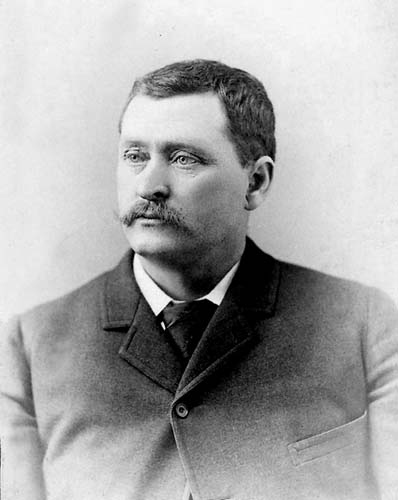
(George Hoover, looking like a barrel of fun)
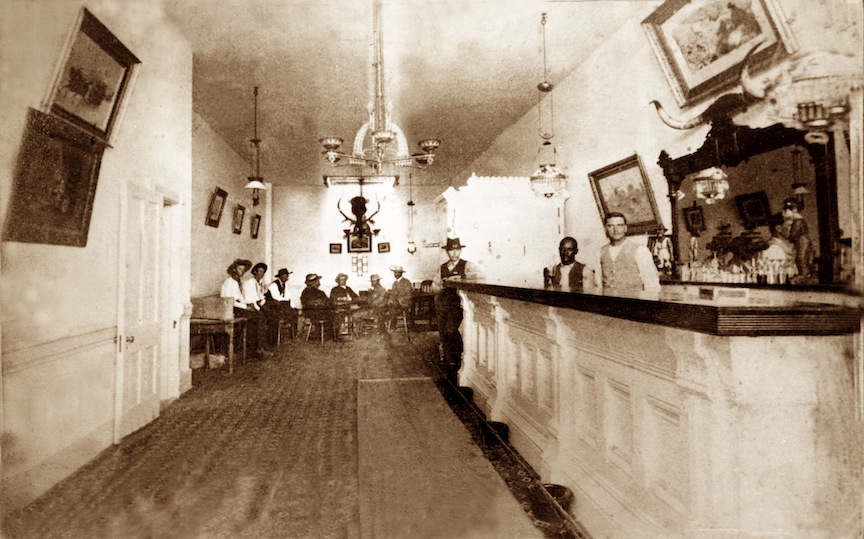
Meanwhile, Young and Cooter were trying to get the whole town involved with their elaborate plan to try to trick the young lady who came to visit. Cooter's plan was to get Young to gradually try to lead her to fall in love with him instead. He got help with this from Young, from the gang at the Long Branch Saloon, from Player-Characters Miller and Smith (to be fair, Miller was reluctantly backing the play; while Smith was encouraging it because he was looking forward to seeing it all come crashing down), and just about everyone else.
It turned out, though, that it was Young himself who screwed things up. He started liking the girl a bit too much; Cooter's attempts to turn her off him by talking about how Young was a lawman in love with his gun only turned her on. She turned out to be mostly interested in her pen-pal beau because of his supposed violent heroism, and seemed to be sexually attracted to bloodshed.
Young ended up sleeping with her, about one minute before realizing she was actually a batshit-crazy stalker.

Not just any kind of stalker, but one who was desperate to see Young get involved in gunfights and kill people, so they could get it on after that.
And while this is going on, the Saloon-owners decide that if the "Better Class" of town have gotten together to campaign for a takeover of the town in the coming elections, they better do the same, and better. So they get Bat Masterson to organize a meeting of all the power-players who stand to lose if Deger and his group take power.

The dashing Masterson gathers Mayor Beatty, mayoral candidate James "Dog" Kelly, Sheriff Bassett, "Colonel" Norton, and billiard magnate Arnold Peacock, as well as (player character) Miller (owner of one and a half saloons and tentative business partner with Beatty) and plan to set up a whole slate of candidates to oppose Deger.
They decide to name themselves something friendly and inviting, so they call themselves the Dodge City Gang.
Cooter finds out that Deputy Young slept with his pen-pal beau, and comes looking for him with a shotgun. There are some moments of tension, but finally Young admits that he's done Cooter wrong (something that costs him a few points of Reputation, but he agreed that the loss wasn't worth shooting Cooter dead over). The stalker girlfriend gets incensed that neither man was willing to shoot the other over her, and walks out on both of them. Oh well, easy come, easy go.
RPGPundit
Currently Smoking: Lorenzetti Horn + Argento Latakia
Saturday, 8 October 2016
Will S&W's new Kickstarter Really Bring in Women Gamers to the OSR?
The answer: highly doubtful.
I've already stated that I have no problem with the kickstarter itself, and certainly not with the women who are doing the art/production for it. Even though S&W itself strikes me as a game that really doesn't serve much purpose in the modern OSR.
But if the purported goal was to bring in new women gamers to the OSR, I seriously doubt that will happen. Not really because of the things I mentioned in the former post, but simply because it's a KS project, being pushed largely within OSR circles, for a game that will largely be sold through the KS plus internal sales.
You know, to get new gamers of any sort, male or female, you'd need to be seriously promoting the game to in more public venues.
But couldn't the project itself draw the interest of more women?
Well, in answer to that, I think something should be pointed out: it was mentioned on theRPGsite thread on this subject, that 29 of the first 30 backers of the S&W project 'to get women interested in the OSR' were MALE backers.
So yeah, this is not very likely to get new women gamers into the OSR.
Meanwhile, I've personally added about a half-dozen women to ranks of OSR-players. How? By running OSR games and welcoming women into my groups, including at gaming events where newbies are present. I've done that mainly with Dark Albion (and a bit of DCC too). I don't think what game you're running matters much, as long as you make it interesting.
But as for publishing? Almost nothing on a small scale will bring in new gamers of any stripe, not in and of itself.
The game that is most likely to bring in new gamers of any kind, including women gamers, continues to be D&D 5e. Mainly because its the one gamers are most likely to encounter.
RPGPundit
Currently Smoking: Lorenzetti Solitario + Stockebbye's Bull's Eye Flake
I've already stated that I have no problem with the kickstarter itself, and certainly not with the women who are doing the art/production for it. Even though S&W itself strikes me as a game that really doesn't serve much purpose in the modern OSR.
But if the purported goal was to bring in new women gamers to the OSR, I seriously doubt that will happen. Not really because of the things I mentioned in the former post, but simply because it's a KS project, being pushed largely within OSR circles, for a game that will largely be sold through the KS plus internal sales.
You know, to get new gamers of any sort, male or female, you'd need to be seriously promoting the game to in more public venues.
But couldn't the project itself draw the interest of more women?
Well, in answer to that, I think something should be pointed out: it was mentioned on theRPGsite thread on this subject, that 29 of the first 30 backers of the S&W project 'to get women interested in the OSR' were MALE backers.
So yeah, this is not very likely to get new women gamers into the OSR.
Meanwhile, I've personally added about a half-dozen women to ranks of OSR-players. How? By running OSR games and welcoming women into my groups, including at gaming events where newbies are present. I've done that mainly with Dark Albion (and a bit of DCC too). I don't think what game you're running matters much, as long as you make it interesting.
But as for publishing? Almost nothing on a small scale will bring in new gamers of any stripe, not in and of itself.
The game that is most likely to bring in new gamers of any kind, including women gamers, continues to be D&D 5e. Mainly because its the one gamers are most likely to encounter.
RPGPundit
Currently Smoking: Lorenzetti Solitario + Stockebbye's Bull's Eye Flake
Subscribe to:
Posts (Atom)