Right, the time has come again for the RPGPundit to review one of his
own games. But don’t think of this as some kind of advertisement; yes,
obviously I have a bias, but so does everyone else. And mine you know
up front. If you prefer, think of this more as a guide to the contents
along with some “Designer notes” rather than a more conventional review.
I mean, its not like I have to wait until the end here to tell you that
I like this product!
Anyways,
Arrows of Indra is a complete RPG, in the OSR style (that
is, with OGL rules based on everyone’s favorite original RPG). Its
published by Bedrock Games, written by the RPGPundit. Its available in
PDF or print; the print edition is a softcover, full colour cover with
B&W illustrations inside, clocking in at about 180 pages (plus
character sheet).
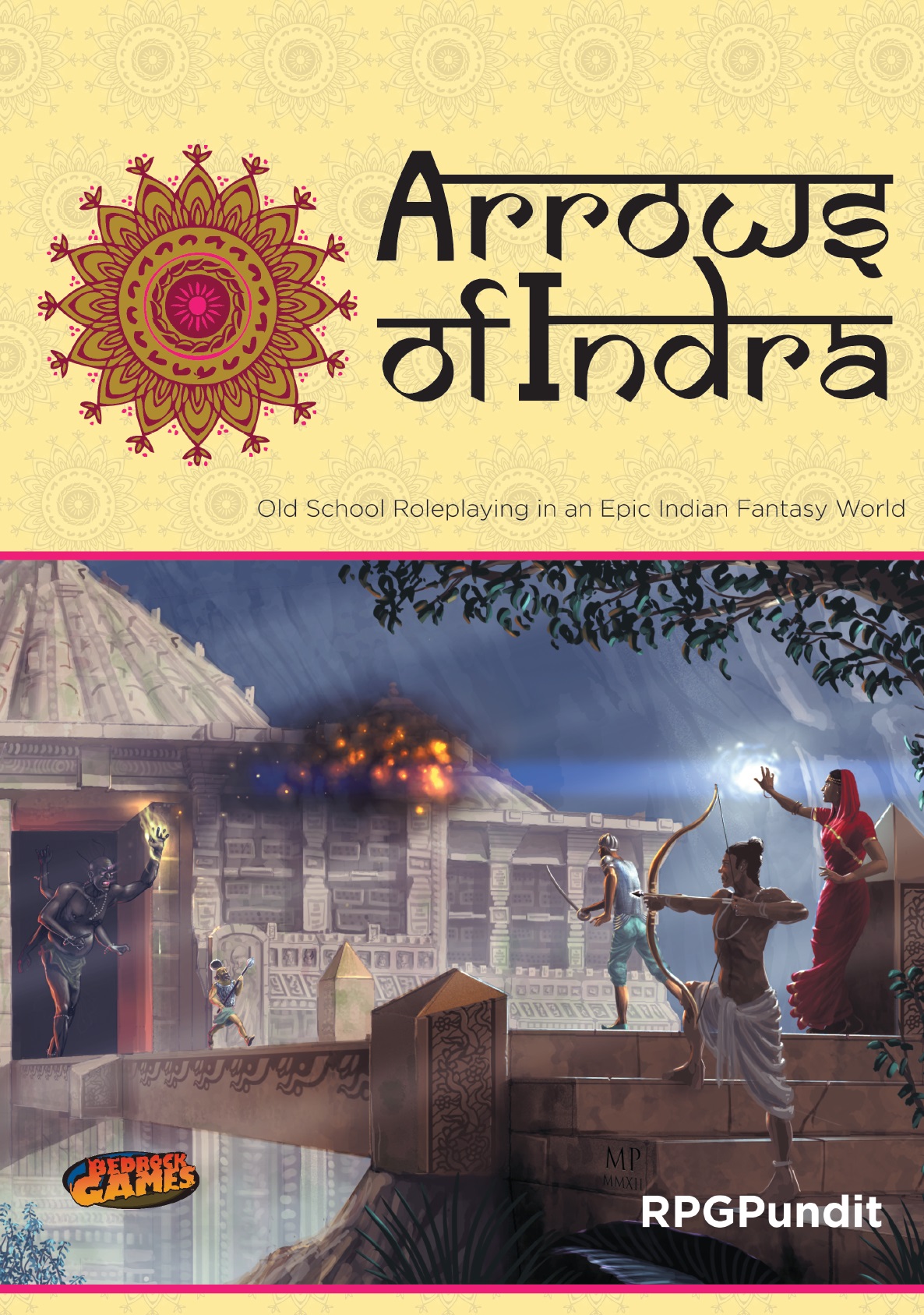
The cover is really amazing (and I can say that while making it clear
I had nothing to do with it!), with a matte finish and a beautiful
illustration showing a group of Indian heroes holding off an Asura demon
at the entrance to an abandoned temple in the middle of the jungle. One
detail which might be notable about the cover is that it is, as far as I
know, the first RPG cover to feature a transgendered person on it (the
siddhi or magic-user of the group).
The interior art (again, none of which was my doing) has been
somewhat controversial in the sense that some people like it and others
really didn’t. It has a style that is meant to evoke old-school art,
that is to say, a slightly primitive style; though I think some of the
pieces are really quite impressive within that style. Still, not for
everyone. I should note that there are also a number of pieces of art
from other sources (mostly public domain art), and some really awesome
artistic borders on every page.
Finally, no one at all has had any
unkind words to say about the truly awesome hexmaps made by master
cartographer Rob Conley; there are four pages worth of these that put
together detail the entire area of the Bharata Kingdoms and its
surroundings.
Now, a brief word on what its all about: Arrows of Indra is an
attempt to make an Old-school RPG that is based on the world of Epic
Indian myth. When designing it, I tried to follow certain rules:
1)
over and above all else, I wanted the game to be playable, out of the
book, and to be easy and fun to play. I didn’t want players to have to
study college-level linguistics or anthropology to have to play, nor did
I want what I call “culturewank” to end up drowning out actual
playability. For example, I tried wherever possible to use ordinary
words in English when such words existed and conveyed what I was trying
to communicate; rather than requiring that players relearn common terms
in Sanskrit. I used Sanskrit for things like place names, some monsters
that didn’t have a readily-available western equivalent, and certain
powers or concepts that strongly benefited from using a Sanskrit name
without needlessly hampering the reader.
2) At the same time, I wanted the game to be recognizable as an OSR
game; while this game is far less similar to any edition of D&D
than, say, ACKS or LotFP, it is still very clearly mechanically founded
on the OGL. Wherever possible I tried to make the game accessible to
those who are accustomed to D&D play, while at the same time without
just reducing the setting to a shallow facade.
3) On that note, I wanted the setting to cleave as closely as
possible to the authentic historical and mythological sources of “Epic
India” (that is, the pseudo-historical India of the Indian Epics: the
Vedas, the Ramayana, and particularly the Mahabharata in which the AoI
setting takes place), within the context of rules 1 and 2 above.
What this meant in practice was making a number of choices: there
were times where I made changes to the mechanics of the game in order to
better fit the setting (for example, the skill system, the non-vancian
casting, the classes, etc); whenever I did so, I tried to make such a
change be one that kept to the old-school feel, while better
representing the setting. At the same time, there were many times I had
an option between a number of choices regarding the setting (for
example, how to present a specific monster); in those cases, I tried to
always make the selection out of a list of several authentic
possibilities that would keep the game as playable as possible and as
close to the familiar as possible.
So Arrows of Indra is not just “AD&D with a dash of Indian
backdrop”; and at the same time its not “cultural-academic game which
bares almost no resemblance to anything familiar” (avoiding the latter
wasn’t hard, by the way, since ultimately, a lot of European mythology
has its deepest roots somewhere in India, and there’s a ton of
parallels). Everything in the game is there for a reason and has a
source in Indian mythology; but this isn’t a “too weird to live” game
where you have a rich setting but no idea what to actually do with it
and no easy way to get into it without a huge investment of study and
familiarization. Its easy-access.
Some people have claimed the game has sacrificed elements of
authenticity in order to fit the D&D mold. That’s probably true; I
can certainly imagine that someone else could someday make a more
authentic game than AoI (whether or not it would be more playable). But
the point of fact is, no one has. And you can’t even compare AoI to
other non-European D&D-settings; Arrows of Indra stays MUCH closer
to the authentic sources for India than L5R does to Asian ones, for
example (and don’t even get me started on “oriental adventures”)! I
haven’t yet read “Spears of the Dawn”, and I’m sure its awesome but I’d
be willing to bet that, at best, it could only match AoI for
authenticity.
The end goal, in any case (and which I feel from the playtests and AP
reports since the game came out) was to make a game that is definitely
Epic Indian adventuring, that is notably different to being in Greyhawk
or the Wilderlands, but that at the same time feels very familiarly like
D&D: its a game where the players will immediately know what their
group is meant to be doing (basically what D&D PCs should always be
doing: heroic adventuring!) and in very much the same ways as
traditionally, but in a very different world that brings a fresh
perspective to it all.
So, let’s take a gander at what’s inside the book, shall we?
Characters are created by rolling for ability scores as per usual;
though in addition to the standard elements of scores, race and class,
you are also expected to roll or choose a caste and select or be
assigned a clan, two vital parts of the setting. These are thoroughly
explained in a practical way that explains their role in the world from
the perspective of what it would mean to the PC. Its one of the ways
that AoI might vary from other old-school games, in that things like
culture and customs can (if the GM wishes) be a significant part of the
very definition of the PC, and family and clan become a major part of
playing in the setting (again, to the degree the GM wishes it). So you
also get some quick rules for generating a PC’s immediate family.
For convenience, there’s also a list of 100 male and 100 female names
for PCs from a random table, along with a loose definition of the
name’s meaning. This was something I added on relatively late in the
writing, as a result of playtesting and quickly figuring out that a lot
of players haven’t got the slightest idea what a name should be like;
I’ll admit that I made the table mostly by just recollection and that
most of the names would probably not be historically accurate to the
period. Someone creative out there taking their time could probably
make a much better, historically-accurate name table.
The player-character races include regular civilized humans of the
Bharata kingdoms, barbarian humans (the Bhil), Gandharva (immortal
beautiful servants and messengers of the gods), Yaksha (also immortal
gold-skinned dwarves who guard treasures of the gods; they are both
erudite scholars and passionate romantics), Rakshasa (the descendents of
humans interbred with Asura demons; distrusted and tainted), and Vanara
(the monkey-men of the south). Its been pointed out that I’ve made the
various non-human races (all of which come out of Indian myths of the
time) into very close parallels of the core old-school D&D races,
and that’s technically true; but again, this was done by making a choice
from a number of options. For example, a “Yaksha” could be (depending
on which mythological source you look at) a big scary monster, a
beautiful tall human, an ethereal spirit with no body at all, or a
golden-skinned dwarf who likes to fight, read poetry and guard
treasures. I chose from these options the one that was closest to
something a D&D player would find familiar.
Some people have also pointed out that I made use of a real-life
minority group, the Bhil, in my game, and that I was somehow
“reinforcing” the caste structure by including it. These are stupid
arguments; I’m utterly opposed to the caste structure in real life, I
say so in the introduction to the game itself. But what I am doing is
making use of sources. The Bhil are not intended to be “non-humans” by
the way they were included, they’re intended to be non-vedic; which they
were. And the way people wrote about them back then was no different
than how they wrote about, say, the Gandharvas; both were detailed as
alternately being not-really-human and/or just-another-tribe. This is a
reflection of the mentality of the times, not anything I believe or
endorse myself.
In any case, moving on to stuff more worth talking
about now…
Classes in the game are also set up to roughly reflect the standard
class selection of an OSR game, but each have subtle or less-than-subtle
differences from their bog-standard equivalents. Priests are not
unlike what one would expect in an OSR game, but caste requirements make
them far less common, and they have several social restrictions they’re
bound to (priests weren’t generally adventurers in Epic India, and I
almost considered limiting the class to NPCs; but in the end, as
described above, opted for the choice that would be most familiar to OSR
gamers). There are also modifications for playing barbarian
priest-shamans, or priests that are not of the gods but of Asura-cults.
Fighters as a class are mainly different due to class skills, so more
about that later. But there are also subclasses of fighter in the
Virakshatriya (holy warrior) which is the term I used to describe those
particular Holy-aligned warriors that get mystical powers due to their
devotion to a particular god. They’re a little bit cleric, a little bit
paladin; and a lot kick-ass. But of course, have serious RP
obligations in terms of taboos and rules to follow. Scouts are
wilderness men; not unlike rangers but with no magical element to them,
but expert trackers, survivalists, good at sneaking, and skilled at
fighting barbarians and those giant monsters that the Bharata Kingdoms’
wilderness areas seem full of.
Siddhis are the wizard-class; the main difference between them and
your standard old-school Magic User is in that the magic system has been
completely redone (this, along with the new skill system, are the two
biggest changes in Arrows of Indra, from a mechanical point of view).
Thieves are perhaps the most familiar class in terms of similarity to
D&D; and the subclass of Thugee is similar to the Assassin; but
mainly I included it almost out of an expectation among players; its not
really historically relevant to the period at all (so people can feel
free to ignore it if they desire).
Finally, the Yogi is a physical adept (as compared to the siddhi who
is a mental adept). They have some of the strictest mechanical and
social/RP requirements of the game (they are renunciates who are
forbidden from material possessions, among other things), but also have a
serious amount of powers. The Yogi is another one of those that might
be better off used as an NPC class only in some campaigns.
Another detail that adds to the richness of the setting in AoI is how
alignment is handled. Its very important to the context of the setting,
and is divided into “Holy”, Neutral, and “Unholy”, rather than the
standard good/evil or law/chaos divides. The alignment system is based
on how well one fulfills one’s obligations to the gods; and it basically
measures not how “good” a person you are (or how you feel about order
versus anarchy) but is a measure of how well the gods look upon you. In
subsequent parts of the game, when it comes to things like spells,
magic items, monster reactions, and divine intervention, alignment ends
up having a direct mechanical impact on play. Because of what alignment
represents in AoI (compared to in other games), it is also more
malleable and somewhat easier to change (even accidentally!).
I’ll mention that some people have commented on thinking it very odd
that I didn’t include details about things like Karma or non-dualism
(“Advaita”) in the game; this was absolutely intentional and for the
reason that at the time of the setting, these concepts were far less
developed than in the Hindu religion today. The spirituality of the
setting is a Vedic spirituality, based on the old Brahmanical religion
and not the modern Hindu religion. Its actually more historically
accurate NOT to have these things in there. Some people also claimed I
left out union-with-godhead or reincarnation; in fact I didn’t: the
former is something Siddhis and Yogis can achieve, the latter is
something that explicitly happens to everyone in the game and there are
even some forms of magic that allow a Siddhi to mess with it. They’re
just not really crucial to the game because of course, what happens
after your PC dies won’t usually have a direct bearing on you as a
player; your PC is still dead, after all.
The Skill system in Arrows of Indra is new, and neither a point-buy
3e-style system nor a choose-from-proficiency-list type of system
either. Instead, what you get are both background skills (reflecting a
character’s family or clan training) and then class skills. Both are set
up to be rolled from random tables, though some GMs may prefer to have
players choose the skills.
Background skills are all basically
career-type skills (divided into tables by caste type), and are resolved
by beating a DC on a D20 check, plus attribute and bonus. Every time a
background skill is taken at character creation it grants a +2 to
checks, with subsequent selections granting another +1. Pretty
straightforward.
Class skills, on the other hand, are a mix of career-type skills and
special abilities (things like weapon proficiencies and spells, mostly).
They are divided into basic and advanced tables; with the “advanced”
skills being harder to get at (you need to fill up slots on the basic
table in order to get a chance to roll on the advanced table).
Skills for priests include things like languages, theology, demonology and magical rituals (called “arcana”).
Fighters
get weapon proficiencies (which grant stacking bonuses to hit and
damage each time they are taken), horsemanship, charioteering, and (at
advanced levels) things like special maneuvers, exotic weapon mastery,
and Command (leadership).
Siddhis get basic spells from the class
skills; in the form of Mantras (vibrated chants) or Mudras (physical
postures or hand gestures that manipulate energy). They can also learn
astrology and demonology.
Thieves (who get all the standard “move
silent”/”backstab”/”Climb” stuff as basic class abilities to start with)
get a wide variety of special talents for their Class skills: languages
and literacy, knowledge of poisons, manipulation (bonuses to reaction
checks), urban survival, training in thief-favored weapons, appraisal of
goods, disguise, and object identification/lore.
The one other element of character building that we have left to
cover are what I’ve termed Enlightenment Powers. These are available to
Wizards and Priests from level two onward, and round out the magic
system.
Magic in Arrows of Indra are based on two different parts:
first, Priests have priest arcana (rituals), while siddhis have magical
mantras and mudras. These are the basic spells of each type. Then,
both priests and siddhis get potential access to Enlightenment powers,
which are generally more powerful types of magic that manifest
spontaneously without the need of ritual or verbal or somatic
components. First level characters don’t get any Enlightenment powers,
but from level 2 onward, every time a Priest or Siddhi goes up in level,
they have a chance of learning one or more enlightenment powers. There
are three ranks of such powers (and 20 powers listed in each rank), and
at each level there’s a percentage chance (for ranks 1 and 2 from 2nd
level onward, rank 3 from 5th level onward) of gaining a new power.
These percentage abilities are modified by the classes’ prime requisite,
and the Intelligence ability score determines a maximum number of
powers that can be gained in each rank.
Of these powers, mantras, mudras, and arcana, some of them will
appear similar to D&D spells for either magic-users or clerics;
others will be quite different as they are based on miraculous powers
mentioned in some Indian source. So for the experienced old-school
gamer playing a spellcasting class in AoI, the magic available will
sometimes seem familiar and other times excitingly exotic. The way the
mechanics work out, a spellcasting character can theoretically gain
between 0-2 enlightenment powers each level until 5th after which they
could gain between 0-3 enlightenment powers; they will also likely gain
one “class skill” power each level. In all cases any power or spell can
be used only once a day, but it is possible to “gain” a power or spell
more than once in some cases, allowing for multiple uses. All of this
means that in some ways the magician in AoI will be a bit less
predictable in his development than in D&D, but is likely to get
certain powers that would be the equivalent of high-level magic
relatively earlier.
Next up the game features a short but relatively complete equipment
section, including details on currency, encumbrance, and in-setting
systems of loan and credit (usually handled through clan houses).
There’s guidelines too for reselling items. Weapons and armor are all
based on real Indian weapons and armor (generally of the period), and
include a few more unusual objects like the famous Chakram. Whatever one
might say of the interior art, p.57 features a spectacular page with
authentic drawings of all of standard weapons as they actually would
look, and to scale. Certain weapons like Chakram or Strangling Cords
have special qualities that are noted in their descriptions. There are
price lists for animals, clothing, food, herbalism, housing and
transport, siege weapons, and miscellaneous equipment (including some
familiar standard adventuring gear like rope or a 10 foot pole, and some
much more unusual items like mala beads or a conch shell). There are
also price lists for slaves and for hirelings.
The GM section begins on p.64, and starts off with slightly more
detailed rules than you’d normally find in an OSR product for Reaction
Rolls (which are used for social interaction as well as for animal
encounters) and morale rules. There are rules for travel and guidelines
for giving out XP. The combat section is relatively familiar to
OSR-fans: the game uses ascending AC, initiative is rolled individually
(1d6+dex+miscellaneous modifiers for things like weapon speed or
spellcasting penalties). As the tone of AoI is a bit more heroic than
normal and also meant to be based on Epic Indian myth, there are a few
differences: there’s a “critical hit” rule for rolling natural 20s
(natural-20s always hit, plus a hit that surpasses opponent’s AC enables
you to immediately make a second attack), and there are special rules
for firing multiple arrows meant to make archers more effective than
typical in OSR games (this is also backed up by the class skill system,
where fighters who choose to focus on archery can end up getting very
significant bonuses). There’s rules for fighting from a chariot or on an
elephant-platform as well, both important features of Indian combat.
Because healing magic is somewhat more rare in AoI than in other
games, there are some changes to healing where PCs heal just a little
faster with rest than they would in many other OSR games (though nowhere
near proportions seen in later D&D editions); but there’s also
rules for the Medical skill and herbalism that go a long way to aiding
and accelerating healing without having to involve magic.
Then there’s all the standard goodness for things like charging, cover, wrestling, poisons, falling damage, etc.
The next 36 pages cover the setting, with a detailed gazetteer of the
Bharata Lands, a guide to the Patala Underworld, a system for
generating cave complexes in the same, and random wilderness and city
encounter tables.
The Bharata kingdoms are basically a
fantasy-version of ancient India as detailed in the Mahabharata period; I
had briefly considered making up some more abstract world with an
Indian “flavor” but I decided that nothing I could come up with myself
would be able to beat the richness, detail and creativity of the actual
“Epic India” of the myths. The Bharata Kingdoms, as of the “present” of
the setting, already have thousands and thousands of years of history.
They are a series of city-states, small kingdoms, decadent
principalities, plus one looming somewhat-evil empire currently engaging
in threatening expansion. The western, central, southern and eastern
areas each have their own distinct quality and style, but all the lands
are united by a common overall culture and heritage (though marked by
interesting regional variations). The setting section includes
guidelines to what life is like in the Bharata Kingdoms, cultural
traditions, holidays, the weather, what growing up in the Bharata
kingdoms would have been like for the PCs, gender roles (including
details on the somewhat different concepts they had on the gender
spectrum), and the “Heroic culture” of the current era (a culture that
all but encourages people like the PCs to go out and be great
adventurers).
There’s detailed descriptions of all the major kingdoms and important
city-states, as well as of the wilderlands that surround the Bharata
lands: the imposing and magical mountains to the north, the desert of
Thar, the various hills and jungles, swamplands and coastal regions; as
well as ruins of ancient cities and temples lost to time, kingdoms of
Demons, Nagas, cities of the gods, and barbarian tribelands.
All
these details include material on local rulers and personalities, as
well as current problems and events (and potential adventuring hooks).
The Patala Underworld is the massive underground cave-network of the
setting. How massive? It covers the entire planet, and it goes six vast
levels deep. Again, this is based on real Indian myth (though of course,
in some of the source texts, the Patala underworld was meant to be
taken as symbolic or metaphorical, but for adventuring purposes, once
again, I chose the literal view). Each level of the Underworld contains
multiple regions with their own characteristics, inhabitants, rulers and
dangers, and each level overall has a very different quality than the
rest. Not only does the book provide descriptions of the Patala
Underworld as a whole, it also provides a set of random tables the GM
can use to generate small or large sections of the Underworld (with
variations to account for underworld-level) for adventuring purposes.
Of course, random monster charts are included for each separate level.
There are also random encounters tables for overland travel, along
roads or in the different types and regions of wilderness (including
separate tables for the different major jungles or mountain ranges of
the setting). This section also contains a table of City Encounters, a
description of things to do in cities, rules for fighting in the dueling
contests of the Kalari arenas, a random table for potential patron
missions, and rules for designing and staying in caravanserais.
The monster section is 25 pages long; and details full stats for 84
different creatures. Every single one of these creatures are
specifically taken from Indian sources (with the exception of a couple
of giant animals, though giant animals in general are very much in
keeping with Indian myth; and the “monstrosity”, a randomly-generated
exotic-type monster meant to cover all the really weird types of
creatures that appear in myths as one-shots). I should mention that
these statblocks are easily and readily compatible with most OSR games.
There are also 19 pages of treasure tables and magic items. Once
again, treasure and items reflect Indian myth and history. So for
example, while there are certainly magic swords (and maces, lances,
daggers, and all kinds of other melee weapons), magic bows are the most
significant kind of magic weapon (so in this game, its bows that have
alignments and major and secondary powers). While there are some
familiar types of magic items like rings or staffs, you will also find
magic sutras (holy scriptures), conch shells, mala beads, and herbs; as
well as wondrous items like the Yaksha Treasure Chest, the Sea-Emerald
of Varuna, the Peacock Crown, the Kara of the Unspeakable Oath, or of
course Vimanas (the magical “flying chariots”, some as large as a
house). In place of artifacts, there are Celestial Weapons, those
weapons of legend that come directly from the gods (or some of the most
powerful asura-demons) and have devastating power. These won’t be found
in a random treasure horde, they’re only available as major campaign
elements, usually to be granted directly from the gods themselves.
The section on the Gods and religion is kept relatively quite small; I
could certainly have added a lot more on the subject, but again, I
didn’t want it to be an anthropological or religious treatise; its an
RPG, and so what’s there is what’s essential to run a credible game.
There’s brief descriptions of the major gods, divided into groups (the
old Vedic gods, the Vaishnavite family and the Shaivite family, as well
as river goddesses); there are guidelines to major religious rituals,
and there’s rules on direct Divine Intervention and divine quests; both
of which can become increasingly common events for PCs from about 9th
level onward.
So at the end of the book, we have a couple of unusual appendices.
The first, 6 pages long but jam-packed, is called “higher level play”;
but I realize now that this was probably a bad choice of wording,
because it implies that the material here is “stuff not usable till your
PCs are high level”. In fact, most of it is usable right from the
get-go and it is actually more about “high-level play” in the sense of
stuff that supports more involved and deeper long-term campaigns. It
covers things like long-term costs of living, land ownership and profit
from terrains, housing, work as mercenaries, temple priesthoods, running
philosophical schools, thief gangs, making money from your background
skills, big merchant business, taxation, interacting with royalty
(including random tables for “royal attention” for when the PCs get too
famous), marriage, children and inheritances, and the standard code of
laws and punishments in the Bharata Kingdoms (directly taken from the
real-world historical Laws of Manu). Once more, everything in here is
directly lifted from different sources on ancient Indian history.
The other appendix is called “In the future”, and it provides a
timeline, for those GMs who want such a thing, of future chronological
events from the starting period of the campaign until several decades
into the future; detailing events as they would transpire in the world
if you are following the chronology of the Mahabharata. Of course,
nothing obliges a GM to do so.
So, who will like Arrows of Indra, who can use it?
If you like
OSR games and wanted to play one in a non-European setting, well
obviously then this game is for you (especially if “Indian setting” was
on your list of interests).
If you don’t hate OSR games and really love the idea of gaming in an Indian setting, then this is very likely for you.
If you are an OSR gamer, and you’re not really interested in playing
in an Indian setting per se, but would really like to borrow interesting
mechanics, random tables, setting elements, or dozens of new monsters
and magic items readily usable in any OSR-game’s setting, then this
would be for you.
Finally, if you’re not interested in running an OSR game at all, but
would like to have extensive setting material for an Epic India setting,
then you’ll probably be able to make very good use of Arrows of Indra
as well.
Anyways, I hope this “review” has been informative as to what’s actually in AoI, and why.
If you want to purchase Arrows of Indra, you can do so from
here in print, or
here in pdf.
RPGPundit
Currently Smoking: Raleigh jopo + Gawith’s Navy Flake
(originally posted August 3, 2013)