The new and improved defender of RPGs!

Tuesday, 3 April 2018

Classic Rant: Why Can't Clerics Just Stop the Frogmen?

I've had or seen several people asking why it is in the Dark Albion setting that the Clerics, with all their power as a single coherent order and all their magic, don't stop the Frogmen? After all, the Cleric's magic and military structure is notable; and their miraculous power can often over-rule the chaos-based magic of the Frogs. Even if we assume the Frogs are too powerful now, why didn't the Clerics stop the Frogs from taking over Frankland in the first place??

(From an Anglish illustration: "Frogmen speaking through the mouths of human heretics"


To address the first question first: the Frogmen have too much power for the Clerics by themselves to deal with, by a longshot. Consider logistics: the Frogmen control a vast kingdom, and even though they are a minority in their own lands, they are assisted by a relatively loyal cadre of chaos-worshiping humans who know they would be burnt at the stake should the Frogmen fall. These act as the soldiers and overseers of the large peasant population. The Clerical order, on the other hand, does not have authority to control armies directly, but must operate with the kingdoms that they find themselves located in. It's not enough that the clerics might want a holy war against the Frog menace, they would need to convince countries like Albion, Burgundy, Lorraine, Arcadia or Iberia to work together on this. 

Second, while clerical magic can be very impressive, Clerics are only a tiny percentage of the population. There are perhaps barely 5000 clerics in all of Albion at any given time; this figure includes clerics who are still children/novices, elderly clerics, the infirm, clerics who run the miraculous sites (like the healing waters of Bath), etc. Only about 1 in 1000 people born are gifted to be clerics (there being about 5 million people in Albion, total), and they are better suited as elite troops (or sometimes, as commanders) than to serve as a rank and file army. The Frogmen are much more than this, there's about 420000 Frogmen ruling over a population of 13 million humans. They have magic items they can use themselves or pass on to trusted humans. They can call on their dark gods to grant powers and mutations. They send out agents to corrupt or divide those kingdoms that oppose them (depending on what you want for your campaign, Queen Margaret may be one of them!). There are plenty of reasons why the Frogmen, having now succeeded, may be very difficult to stamp out.

A perhaps much more interesting question is: why did clerics fail to find and stop the corruption of the Frankish Kingdom in the first place?

There were several reasons for this: first, you have to understand the situation of Clerics. They are an order, within the Church. I mentioned above that the Clerics are only 1 in 1000 humans. Compare this to the clergy (priests, monks, and nuns), which occupies about 1 in 50 adults at this time. Additionally, Clerics are independent of the standard ecclesiastical hierarchy; they govern themselves and are answerable only to the Pontifex. This has certain advantages, in that they can not be manipulated or abused by corrupt priests or bishops, but it also has the disadvantage that their absence from the standard hierarchy makes the latter vulnerable to corruption. Clerics operate in small groups, or are assigned individually to very important nobles, or to a bishop, or work as inquisitors, or fight with armies (all these aside from those cleric-administrators that run the clerical houses). That is to say, they are usually pretty spread out. It is thus potentially easy for those corrupted to keep clerics 'in the dark', or if necessary to get rid of individual clerics who find out the truth.

Second, the tactics the Frogmen used: they sent out human agents first, to gradually corrupt the nobility into decadence and sin, while corrupting part of the Church into the Cathari heresy. The latter in particular distracted the Clerics (and other Frankland nobles who were devout to Law), who saw a visible enemy (the heretics) and went off to fight them, losing sight of the more subtle corruption of the aristocracy. In the end the Frankish armies won the battle against the Cathari, but lost the war against the Frogs. Their tired armies were betrayed by some of their own commanders when the Frogmen finally started streaming out of the Paris Swamp. Sects of human chaos-worshipers emerged at the same time all over Frankland. 

The Clerics had managed to catch a number of Cults and conspiracies, and to oppose the major heresy (Catharism) before their eyes, but they failed to uncover the masterminds behind it all. They had, until that time, assumed the Frogmen to be dangerous chaos humanoids in the same way Anglishmen view goblins: scary and dangerous but more likely to eat humans than to try to use subtlety to corrupt them. It hit the clerics completely out of left field, along with all the rest of the lands of the Sun.

(they used to look like this


(until they suddenly became something like this


Finally, a note from the point of view of mechanics: remember that while Clerics have a lot of social advantage in the setting, the Dark Albion setting is generally a low-level world. While Clerics, being (most of them) dedicated to a life of opposing Chaos, tend on average to have more experience than most other people in the world, the average Cleric is still only level 1-4. The greatest, most advanced clerics (the Commanders and Supreme Commanders of the Order) are only level 9-14. So we're talking maybe one to three clerics of level 9+ PER COUNTRY. Someone might ask "why doesn't Commune just solve everything"? The answer is that there's likely only the tiniest number of Clerics alive at any given time who even have that power. As great as the Clerics may be, they're far from omnipotent, nor are they immune to being fooled or betrayed.

RPGPundit

Currently Smoking: Lorenzetti Solitario Egg + Brebbia No.8

(Originally posted January 6, 2016)

Monday, 2 April 2018

The Door of 16 Gates, Now in Spanish

Hola!

Hoy aviso que la aventura de "RPGPundit Presents #25: El Umbral De Las 16 Puertas" ahora esta disponible!


Explora una puerta mágica que usa líneas ley geománticas para transportar a tus PJs a 16 planos de existencia diferentes. Esta puerta puede ser integrada en cualquier aventura de fantasía, ya sea como curiosidad o como su eje central. Ya sea visitando el Sendero de los Mundos o el enorme Fuerte Enano, este artefacto desconcertará e intrigará a tus jugadores.


Con 31 paginas, es el suplemento de RPGPundit Presents mas grande hasta ahora!


Compra El Umbral De Las 16 Puertas en DTRPG, o en el webstore de Precis Intermedia!


RPGPundit

Currently Smoking: Lorenzetti Oversize + H&H's Chestnut


Sunday, 1 April 2018

RPGPundit's First VIDEO RPG Review: "Bone Divination for Game Masters"

So this is a weird entry in two respects: first, that it is a video review. I've never done a video before. In fact, apart from a couple of interviews on RPG podcasts in Spanish, I've never done any video stuff before at all!

Second, it is different in the sense that it is a review of an RPG product you can't actually buy.  At least, not online. You can only get them at certain gaming Cons.  It was still a subject so "up my alley", as it were, that I had to go ahead and do the review anyways, even though it didn't technically fit my rules.

So keep in mind when I say "you may want to pick this up if...", I should maybe have added that right now, at least, you can only pick it up if you go to Cons where Bittman is in attendance.  Of course, who knows?! Could the Pundit Bump cause enough interest and demand for him to make this into a full blown product (in spite of my slight reservations about the concept)? We'll have to see.

So, check out my video review of Jobe Bittman's "Bone Divination for Game Masters":


Let me know what you thought, and whether you'd want to see more videos in the future!

RPGPundit

Currently Smoking: Lorenzetti Egg + Gawith's Navy Flake


Saturday, 31 March 2018

Lion & Dragon Campaign, Plus Some Really Creative Use of High-tech

So, last night, we played Lion & Dragon. It was a great session. It had a lot of action, a lot of adventure in the D&D style and yet was deeply Medieval-Authentic.


For example, the PCs attended the court of an Earl and later a King. They got mixed up with a powerful and manipulative Magister. One of the PCs, a knight, got himself a squire who was the grandson of the PCs' deceased mentor.

But then they also went into an enchanted forest, and there fought against a Clay Giant (the stats of which you can find in the Lion & Dragon rulebook), and against a water-spirit knight (which will be stated out in a future RPGPundit Presents supplement - it's technically an elemental but looks NOTHING like a D&D elemental; this is what medieval-authentic 'elementals' were like).

The Scots Man ended up decapitating the Water Knight, but wasn't allowed to keep the knight's magic sword (instead, another PC who was the Scotsman's employer took it, since the scotsman was not of a class to be allowed to carry such a sword). This was an awesome example of the medieval social class system at work; fortunately the Scotsman PC was well aware that this was a reality of the setting, and was quite happy with his reward of one whole Pound, which was more money than he'd ever seen in his life.

Also the player of one of our magisters was surprised to realize that Occultism Lore is all you really need in order to "Identify" magic items in this game.


So that's it for MY L&D game, but over at Swords & Stitchery, things get a lot weirder! Eric, who writes that blog, has often thought of some really creative and unusual ways to blend various OSR products and subjects, and Dark Albion and Lion & Dragon are two of his favorites, luckily for me!


So recently, he's had a couple of posts where he combines Lion & Dragon with the 30 years war and Expedition to the Barrier Peaks, to make a UFO-themed adventure. Along the way he links up to Dark Albion, my bestselling Cults of Chaos book, and even RPGPundit Presents #3: High Tech Weapons.


 As if to double down, in his next post he combines Barrier Peaks, the war in Bohemia, L&D, and crazy robots from RPGPundit Presents #19: Frantabulous Robot Generator!

Putting on my reviewer-hat for a second, I would have to note that this is not the kind of behavior I get up to in my Lion & Dragon campaign.  For me, I have a strict line: there's my Medieval-Authentic game, and there's my Gonzo games. The two do not cross.  I want my medieval-authentic game to feel super medieval, and that means it's unlikely to ever see robots. Golems, yes! But not robots.

However, don't get me wrong! I LOVE that Eric likes to mash things up like this and he enjoys it. That's just great with me. I don't want everyone who buys L&D to feel like their game has to be super duper medieval-authentic. I want them to have the tools to do that IF that's what they want to do. But if they want to borrow some of it and mostly play a game that's more vanilla fantasy, or if they want to mix it up with other products (especially if they're MY products, of course!) and play it as Medieval-Gonzo, then more power to them! Go nuts! It's your game. I'm not part of the Cult of the Game Designer; at the table it's the GM who is king.


So check out Swords & Stitchery's crazy-awesome blog. And if you haven't yet, be sure to check out Lion & Dragon as well as all my other Medieval-authentic AND Gonzo stuff!


RPGPundit

Currently Smoking: Castello 4k collection canadian + Mclintock Syrian Latakia


Friday, 30 March 2018

RPGPundit Interviews Rob Kuntz (Part 3 of 3)!

Here's the final part of our interview with Robert J. Kuntz, one of the founding fathers of D&D!


Check out Part I here, and Part II here, if you haven't already!


7. What do you think is the biggest thing (or things) that most of the so-called cognoscenti who have published or written extensively on social media about the origins of D&D have kept getting terribly wrong? Or vital details that they've totally omitted from their narrative of the origin story?

A: It is not my purpose with my upcoming work (as it was not with Dave Arneson's True Genius, TLS, 2017) to compare through its content what is wrong with previous works on the subject of D&D's history.  If that comes up at all it will by and through the readers of my works and by way of their own comparisons.  I am concentrating, in large part, on what has not been done as ascertained from such works, such as my the primary design-oriented approach I take with DATG, for instance, which had never been done.  Concerning the latter there's a very good reason for that, for these previous books are not written by designers but instead by historians who are mainly collectors and arrangers of information.  But the interpretation of design information is not their forte, so this is where I fill in that immense void, especially when that intersects with the recurring question of "What is a role playing game?"

However--and given my unique position within the primary historical stream of that history--I will state the following about the research forms (or procedures) used or not used in generating such matter and as I have noted to date:

They do not include, for the majority of cases, a well rounded view by not taking into account existing living persons information from that time. Because of that there are omissions, incorrect dates, and often times conflicting stories, etc. which are then (and still) forwarded as history.

In my case alone, though I could probably speak for others but won't, I have never been approached to confirm or deny secondarily sourced information about myself, about what I was involved in and/or have primary knowledge of, even though
my name is referenced many times in these works.

I also get the feeling that the information source (again not including people, just what they printed in the past), "if it is not in print" at some arbitrarily assigned cut-off point in the past that "it doesn't count."

Now take into account my finished expose on Don Kaye that I've mentioned, above, and counterpoint that against such an artificial construct.  Does Don Kaye's history exist or not because someone finally wrote about it but had just verbally transmitted it prior to that? As one can readily fathom, the whole proposition becomes absurd from a scholarly point of view, kinda like a news reporter covering an airplane crash insisting that the information derived from its survivors is only "true or verifiable" when printed or broadcast.

Couple that arbitrary procedure with a proclivity to not interview
primary sources from that day and you can start sensing a developing void in the holistic subject.


8. You, like myself, have not been shy about your political views and ideas. Is it fair to say that you think the influence of the "SJW Left" on the hobby has been pernicious? And if so, what are the biggest ways it's been a problem?
 Also, do you think we're losing ground in that sense, in terms of the culture-war fight for the hobby? Or are we starting to win?


A: The idea that politics should have anything to do with gaming is a non-starter for me; that is, anything but the ideology of fun and the freedom to express that fun in different ways.  Freedom is a Conservative concept.  Whether you are Left or Right, we all basically rely in America, and in this industry, upon some basic Conservative principles:  freedom of speech and association, security in the pursuit of what those freedoms may entail as long as we do not interfere with others in those pursuits, and a free enterprise market with which to share our ideas.

So anything that steps outside of that is not freedom, it is the attempted restriction of freedom, in fact.

Has the Left in this hobby-cum-industry attempted to constrict freedoms by pushing against or by making attempted ends-around them?  I have experienced some of this.  People are less tolerant these days of certain freedoms because world views have become polarized.  They are more apt not to see or even understand what freedoms mean and that these are a two way street.

When that happens you may be on the track to a perniciousness which is where true discourse ends and emotion takes over.  In my view this is more problematical with the Left as their ideas of equally accorded freedoms are sometimes conditional (and thus do not pass the Conservative POV that I have noted, above) and very often, and perceptibly, many on the Left talk down to others who would challenge their views and from the perch of a self-created moral high ground.  Such views might even be considered elitist at times; and at the very least I have certainly always seen them as judgmental.

Now, that said, I cannot maintain a greatly informed POV on how this may have impacted our industry-hobby; I have some personal examples, and some from adjacent industries, like film or comics, but otherwise I hear such stories as aftershocks.  I am somewhat absent from our hobby in that particular area.

But I do believe that such negative paths are best avoided for the healthy exchange of ideas and the progress we seek within the hobby.  In either case people will fall where they may within such a free association structure, but when that structure appears to exclude constructive criticism or inclusiveness based upon a certain strain of "smell test" then we have moved from free and open association to a sort of club member verification ritual; and that has never been part of this hobby, but it certainly could be compared to the Old South mentality of segregation and exclusion.

Now, I am aware that this polarization has reached every part of our society and it does seem that lines are being drawn everywhere, and mostly by the Left.  So I am not surprised that the majority of instances where I hear passing stories involves such POVs which I do not rank as discourse or freedom.

Are we winning?  Well, no.  The longer a polarization exists in America, no matter in what sector, no unity can exist and thus the views will remain divided and potentially volatile.  One cannot win as a group like that, whether small or large.

People in my view should just concentrate on what makes this  hobby worthwhile which is the fun and great experiences derived from creating and playing games.  It would be better while doing so to forget about projecting any politics into it other than in defense of those freedoms as I noted above.  Humans being humans, there are always going to be opposing POVs, that's to be expected.  So it's best to leave politics out of that as we are already disposed, being individuals, to having enough frictions that guarantee edging up our boiling points to begin with.


9. OK, last question: do you have a favorite game designer/writer in the modern OSR (the new generation, if you will)?

Oh, these types of questions are really impossible to answer, especially from another designer such as myself.  The reason being is that design is supposed to, in my view/attitude, advance beyond the known and not just rearrange previous bases by way of different thematic overlays and minimally tweaked mechanics.

So this forces a singular comparative analysis for each which is not always so easily reduced to a 1st or 2nd, etc. categorization.  I am more interested in what designs (and their designers) accomplish by way of what has not been done, a more difficult assessment when my views (past, future or present) are brought to bear for that comparison.  Notwithstanding all of this objective/subjective rigamarole, I do have what might be considered some personal (and/or professional) metrics.

For example, I liked what Jeff Dee did with Cavemaster.  The reasons for that particular excitement on my part were simple:  He brought a difficult theme and integrated the historical information as a comprehensive design which really appears to project you down its imagined path and he did so by adding in some unique systems for it, which essentially is what GDW originally did with En Garde bitd.

Kyrinn Eis also did this with her World of Urutsk; but I appreciate her design endeavors for different reasons than I do Dee's.  They forward holistic design attitudes (RPG, board game extension, miniature rules) and thus push the design horizon to integrative levels while at the same time introducing stream-lined mechanics.

I am not in touch with the majority of current designs as there are so many of them.  I'm a designer and thus my focus is design and not critiquing other designs, the latter which would be a full time occupation.  But from what I have read and experienced when time or circumstance allowed, the above-mentioned would be considered in my professional view as very encouraging examples of design.


10. Postscript question: are all your elves gender-fluid?

A:No, but their stunt doubles may be depending upon the clauses in their union contracts...


***

That's it for this interview. Let me know who else you'd like to see me interview!

RPGPundit

Currently Smoking: Lorenzetti Poker + H&H's Chestnut

Thursday, 29 March 2018

Classic Rant: PC Interaction With the World in Regular RPGs

A PC is in an alley, facing some thugs, he has no weapons, he says "I look around for a piece of wood" (or at least, my player would say that, some other idiot's player would say "can there be a piece of wood there?", trying to make a demand on the world instead of interact with it; but that's largely semantics).

Here is what I (or any proper GM) would do; and keep in mind that in this very simple scenario, the whole process would probably be nearly instantaneous:

1) consider the nature of the world of the setting, and the specific place in particular that the PC is. That is, what region of the world he's in, the nature of the city in that region, the nature of the neighbourhood in that city, the nature of the alley in particular. Is wood something people use? Is it likely to be found just dropped there in an alley? If so, will it be wood that is just the right size for him to potentially use as a weapon; or would it be too large, small, or brittle to be worth anything?

2) based on that, the possible answers are that either yes there is wood there, no there isn't, or there might be wood there.

3) the ONLY thing that matters is not whether the players want it, not whether it advances the 'story' (because NO ONE involved should be trying to 'make a story' here), or any other reason except "does it fit the reality of the world?"; that's it, the only consideration.

4) if I decide that there is definitely wood there, because in this city in this world there would always be wood in every alley (like say that they mostly use wood-burning stoves here and it's winter and the wood is likely to be piled in alleys in this city), or that the odds are sufficiently enormous anyways that I don't need to question it further, I say "Yes".

If I decide that there is really way too slim a chance of there being the right type of wood (right size and strength for what the player wants), because wtf would a piece of wood be doing in an urban alleyway? Then I say "no".

If I decide that there's a chance large enough to bother with that wood could be there (wood in alleys in this place is common but not an absolute certainty) but far from an absolute certainty; that is, quite a few alleys in this city might have wood of the right size and strength but by no means all of them will, then I will either make a judgment on it based on my own immediate sensing of the world, or I will determine a % chance and roll it (so, say wood is not usually used to heat or cook with here, but in this area of the city there is a lot of construction going on; so there might be a 2/6 chance of wood being there).


Note of course that as a decent GM, I could also choose to immediately respond, with the gist of the PC's plan in mind, that there's definitely a rock there, or a barrel lid, or whatever else might certainly be there. If the general concept of what the Player is actually looking for is understood, there's no point in playing "20 questions" if it can be avoided. You can say "no, but there's a stone/broken bottle/piece of chain", or conversely you can say "no, and you can't really see anything at all there you could use as an improvised weapon".

Note, again, how in NO CASE is the decision based on what the Player's whims are, what my whims are (in the sense of whether I like player 1 more than player 2 or whether I think the player's idea of using a stick to fend them off is cool or lame or anything else), or some kind of idiotic quixotic notion of story-creation. All of those things would be anti-immersive.

The stick is there or not because in this virtual reality it either is there or it's not.

RPGPundit

Currently Smoking: Italian Redbark + Brebbia no.7

(Originally Posted December 28, 2015)

Wednesday, 28 March 2018

Raiders of R'lyeh: Better Late Than Never!


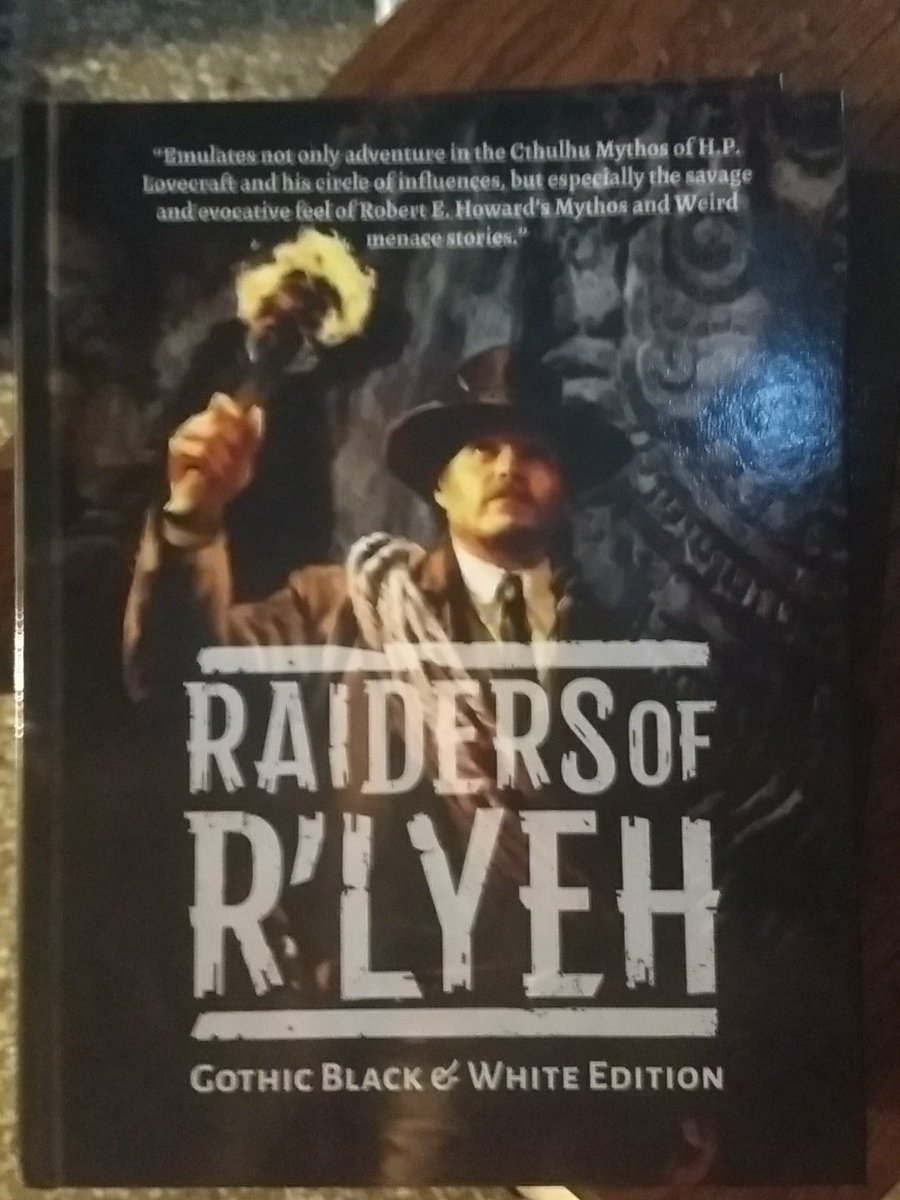
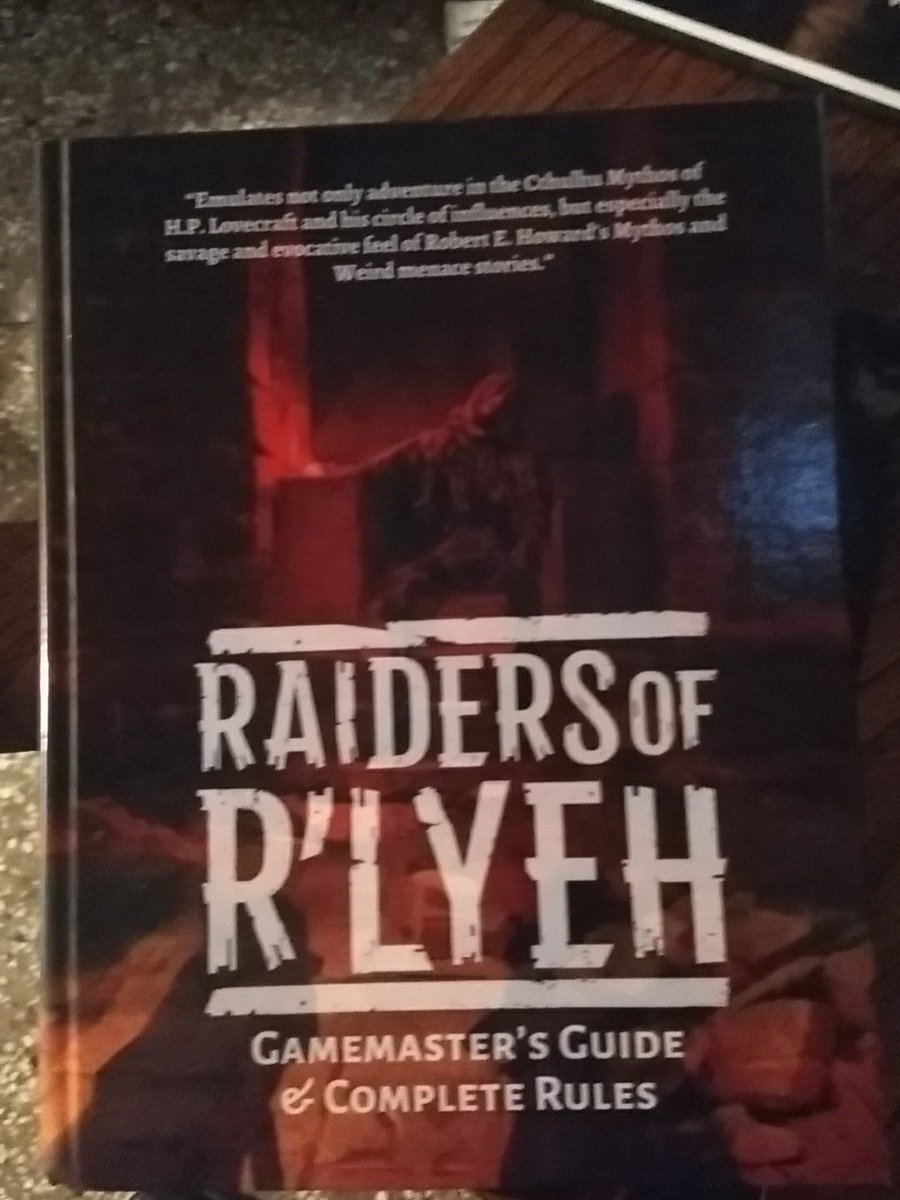
Well, it's been years and years, but at long last, these came to my door:


That's the basic book, if you will, the complete rules.

And this (at almost 500 pages) is the full rules plus Gamemaster Guide:


And man, are they great.

Of course I'll be doing a full review of Raiders of R'lyeh, but I just wanted to share this now. I was a consultant on this book and was a big part of designing some parts of the rules. And I think it's a truly great game.

So be sure to check it out!


RPGPundit

Currently Smoking: Lorenzeti Poker + H&H's Chestnut