The new and improved defender of RPGs!

Sunday, 14 December 2014

Lords of Olympus: Scrying And Mortal Cabals


In the classical world, I mean in the real historical world of the Greeks and Romans, many forms of what we might term “magic” were either looked upon poorly or directly forbidden.  But divination, which could be said to include both attempts to perceive the future by signs (“augury”), attempts to receive visions of other people or places in the present, and communication with spirits (or even gods), or even the spirits of the dead, in order to receive information and tutelage, was considered a highly honored science.

At the same time, the ancients were quite clear about these sciences being highly complicated, and not something that just anyone could practice.  It was understood that there were both frauds who were clearly fake diviners, and also differing degrees of skilled fortune-tellers, some who had much more talent or expertise than others.  Some of it was believed to depend upon benediction from the Gods (and tied to formal priesthood or initiation in mystery cults), while in other cases there was a suggestion that bloodline could influence one’s raw talent at the art.

In Lords of Olympus the Scrying Power is something that could be seen as the “real” or “ideal” version of this power that mortals can only barely touch upon.  The power-levels related to using Scrying pair up nicely with this, so that mortals can only receive “the vaguest glimpses”, while the gods can gain the most clear visions.  Likewise, in terms of communication, the gods have sufficient power to be able to use Scrying as an inter-dimensional communication system with one another, while mortals can only accomplish the same with extreme difficulty.

The obvious use in a LoO campaign for scrying is to allow PCs to communicate with each other and with NPCs, and (in its Advanced version) even create a magical Gate between themselves and where/who they are scrying with for a shortcut in traveling the multiverse.

But thinking about the above setting-information, a number of interesting ideas arise; its amusing to think that Scrying could also be used in a campaign as a plot device, where Mortals may try to contact a PC as part of mortal magic-use.
Imagine, for example, that a cabal of mortal mages might end up trying to use Scrying as a way to communicate with an immortal to gain said deity as a powerful patron. Or, perhaps in a more sinister motive, to use a young godling for who-knows-what unspeakable blood-rites, or perhaps some kind of a breeding program, or to sacrifice to some supposedly powerful entity.
Its even possible that this could be something weaponized in a Modern or futuristic world; where a government agency aware of the existence of the gods and the viability of magic could try to use Scrying as a way to gather information on these powerful non-human beings they don’t worship as gods, but consider potentially world-threatening beings that need to be studied and perhaps destroyed to protect the security of their civilization!

In general in a Lords of Olympus games, mortals are rarely considered powerful enough to be a real threat to even starting-level Olympian PCs.  But it can be a challenging and interesting experiment for a GM to try to see just how dangerous, powerful, or influential he could make a fully-mortal Secret Order, Cabal, or Government Agency (without relying on going beyond the “rules” of the game or involving actual divine agents).  In my own experience, its the type of thing players (particularly experienced players) will rarely expect.

RPGPundit

Currently Smoking: Ben Wade Rhodesian + Image Latakia

(originally posted August 16, 2013; on the old blog)

Saturday, 13 December 2014

RPGPundit Reviews: the 5e Monster Manual


This is a kind of mini-review, by my standards, anyways.  I got the Monster Manual and the DMG for 5th edition last week, after some mailing mix-up, as part of the compensation for my Consulting on 5e.  I'll note, thus (as if anyone out there still didn't know this by now) that I was involved on the 5e project, and that bias should be kept in mind.  Even so, as far as I recall I had no role whatsoever in the design of the monsters (there may have been some very brief chat about design goals, but absolutely nothing to do with the concrete mechanics of the thing), and I think I can be relatively objective within the boundaries of my biases here.

So, this is a review of the new Dungeons & Dragons Monster Manual.  It was published by Wizards of the Coast, and Chris Perkins was the lead designer (out of what appears to have been a large team) for this particular book.

I'm not going to go into the usual level of detail for this book, seeing as how most of you reading will already be familiar with D&D in general, and 5th edition in particular.  Suffice it to say, like all 5e rulebooks, the Monster Manual is actually a supplement/expansion of the core Basic D&D rules, which are available for free download on PDF from the Wizards website.

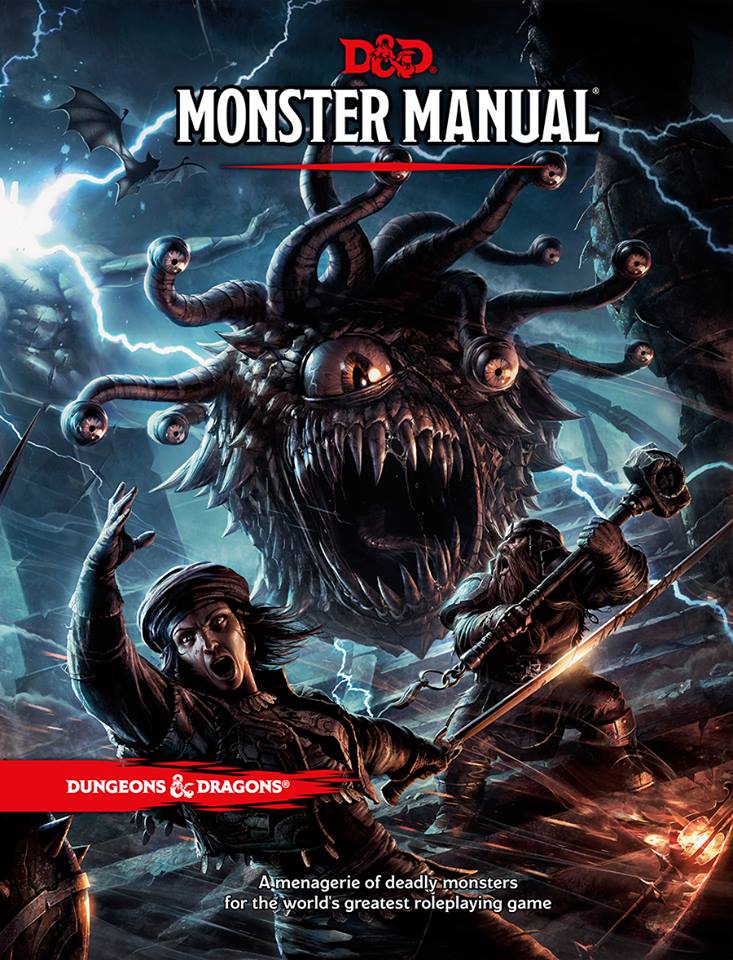
The book is 350 pages long, jam-packed with text and images; its interior is full-color with very impressive art.  The book is a hardcover with a very well-rendered image of a Beholder (in a fight with what we can presume are some player characters) featuring prominently.  The Beholder is, I think, a very good choice for the Monster Manual cover, as it is one of the great iconic D&D monsters, and one we associate with D&D far more exclusively than some of the other popular monsters of the game.


Now, I've never been one of these D&D gamers obsessed with the Monster Manual.  I've never needed more than a few dozen monsters to manage a campaign.  I'm not a sentimentalist here. This might affect my view of things.

So the real question as I see it is not "what is the Monster Manual?", because you all know that already, but rather, how does this Monster Manual compare to what has come before?

Pretty favorably, I'd say.

If we look back at a retrospective: the 1e Monster Manual was quite inspirational in an old-school way, but it was certainly lacking in some of the detail that later editions would have.  The 2e Monstruous Compendium (or whatever it was called) is a favorite of some, but not of mine.  Its over-detailed ecological notes were too impractical for my tastes, and the three-ring binder format was (to me) much more of a hassle than it was worth.  To me, it exemplified a lot of what was bad about post-old-school design.  The 3e Monster Manual was a return to sanity, but I didn't feel it was really ideal either; the art was that kind of irritating 'dungeonpunk' aesthetic that exemplified that edition.  In many cases in all three of these editions, it seemed as though the monsters weren't particularly unique; variances in hit dice or attack bonuses did not necessarily tell you all that much about the playable differences (2e fluff excluded) between one type of humanoid monster and another.  And of course, the 4e monster manual doesn't even count.

In many ways, I think the 5e Monster Manual incorporates some of the best of all the previous editions.  The artwork is amazing. The material, almost everything in it, is strongly playable; there's nothing there that's just flavor-text meant for the GM to be entertained but useless in actual play.  There's plenty of descriptive material, but of the kind you can very directly apply to the PCs' encounters with the monster in question.  And there's very creative elements of individualization for all the monsters: things like descriptions of the creature's lair (sometimes, in cases of very powerful monsters, complete with "lair actions" that can be used to emulate the creature's control of its home environment), motivations for roleplay, and specific and unique tactics and attacks.  The end result is that not only do Kobolds seem very different from Goblins, but Green Dragons seem very different from Red Dragons, and not just because of the type of breath weapon they use.

Are there any details that I think the 5e Monster Manual does less well on than some of the other versions?  Yes; a couple of practical elements in old-school play: number appearing, morale, and treasure types.  I know that there are rules on the last two of these in the DMG, but I'm spoiled on the old Rules Cyclopedia when it came to this.  Ah well, you can't win them all.

The last question is, really, can you use this book if you are not playing 5e and have no intention of playing 5e?
I would say yes.  Statistically, 5e has sufficient similarities to most of the other D&D-variants that conversion would be fairly easy.  There are some clever ideas, like hit die type being determined by size, monster backgrounds, lair information, special abilities, etc. that could easily be introduced as house rules for (for example) an old-school game.  The background and details on many of the monsters is sufficiently novel, interesting, and (most importantly) practical that anyone could be interested in this book as a sourcebook for non-5e play.

That makes this book especially valuable, because it makes it useful even to someone who has no intention of playing 5e.

All in all, the new Monster Manual manages, in my opinion, to be a worthy successor to some of the best to have had that title before it.  As art, as game material, and as inspiration, it's a job well done.


RPGPundit

Currently Smoking: Stanwell compact + Image latakia

Friday, 12 December 2014

The First Glimpse at Dark Albion: The Rose War

I'm busy fighting on G+ about how Onebookshelf/RPGnow/DrivethruRPG, the hobby's PDF-sales giant, has decided to stick to their banning of a game that some people in the hobby don't like, and offer no assurances they won't do it again the next time the Outrage Brigade tries to apply pressure.

I'm also working on a short review of the 5e Monster Manual, nothing special, just my thoughts on it.
And I'm busy working on my little surprise that you'll find out about next week, my new project/job.

But more than anything, I'm trying to frantically get work done on Dark Albion.  Dominique Crouzet is ahead of me, and already getting the presentation done for the stuff I've sent him so far.

And holy sweet fuck, it is beautiful.  This might take LoO's title as the prettiest book I've ever had published.

But don't take my word for it; here's one sample page for you to judge for yourself.  It is low-rez and of course the final version will be of much better resolution, but it will give you a very good idea of what the final product will look like:


(click to enlarge)

So yeah, pretty awesome, huh?

Stay tuned for more, and save your pennies for Dark Albion: The Rose War, coming out sometime early next year.

RPGPundit

Currently Smoking: Ben Wade Canadian + Image Latakia


P.S.: I know for a fact that Dominique Crouzet would be interested in any work (not necessarily just RPG related) that would relate to his skills in art, layout, etc. So consider this an add for his admirable skills.

Thursday, 11 December 2014

DCC Campaign Update: Inhuman Freudian Terror at Ice Dome Zero


In this weekend's adventure the party confronted:

-the realization that even protected by a dome, they were somewhere really fucking cold.

-that the central power sphere of the dome was apparently missing.

-that their cleric was too, after the previous night's patron-induced orgy.

-that "what happens in x, stays in x" has become the motto of the party.

-that there were traces of suspicious slime in the dome.

 -that no slime is ever a good slime.

-that the "totally abandoned" dome might not be as totally abandoned as Sezrekan made it out to be.

-that the outside of the dome might be populated by abominable snowmen, or yetii, or sasquatches. Or some damn thing.

-almost immediately thereafter, that the Sasquatches(Sasquatchii?) are inside the dome!

-that the dwarf Feld, son of Feldstein may have been kidnapped by Yetises. Possibly slimy yetises.

-that for some damn reason, pluralizing tundra-monsters is tough.

-that in spite of being frozen, powerless and an apparently sasquatch-filled deathtrap, Ice Dome Zero is not without its charms. Charms like laser pistols, blaster pistols, laser rifles, blaster rifles, and 24 cobalt limpet mines. Also parkas.

-the sudden epiphany that their mysterious enemies might not be abominable snowmens at all, but just guys in primitive parkas. Albeit slimy parkas.

-that the best plan they have is to seal the door and cast sequester.

-that the above plan may have been for naught, as Feld is back and acting really weird.

-that Feld wants them to come with him to what is clearly some kind of obvious trap.

-that "she" is waiting for them, and really loves them, and just wants to care for them.

-that "she", as it turns out, is in fact a giant slug-creature called the Gorlax, that exudes addictive love-slime out of its spike-nipples.

-that discovering this turn of events in the middle of seeing a bunch of the Gorlax's Cold Mutant love-slaves "feeding" was not the most appetizing way of discovering the truth. But at least it turns out that there were no sasquatches after all.

-that unfortunately, what is there, in the volcanic cave under Ice Dome Zero, is a giant emotionally-needy love-smothering Slug-monster, about 20 Cold Mutants, a dozen little (still giant) slugs, and one recent dwarf convert.

-that fighting the gorlax and her forces from a safe distance doesn't protect you, when the narcotic effect of her freshly exuded panic-slime is transmissible by scent.

-that once you've suckled love-slime from one of the gorlax's spike-nipples, you start to question whether there isn't good slime after all.

-that when everyone else in the party is suddenly experiencing a weird codependent girlfriend/mother Freudian love thing with a giant slug, its time for Bill the Elf to run like hell, and consider blowing the entire dome to shit just to save his own ass.

-that in the middle of all these Freudian connotations, casting charm person on a dwarf under the Gorlax's slime-induced "in a relationship"-status only generate an even worse child-of-divorce type emotionally-paralyzing conflict.

-that when you're trying to avoid being affected by airborne slime pheromones, you're willing to go to desperate measures, including taping a plastic bag full of water over your head.

-that air-filter masks from the Dome's lab is probably an easier solution.

-that the Gorlax really isn't evil. She just wants to love all men, and for all men to love her in a dependent and emotionally-supportive way and to listen to her interesting conversation.

-that actually, she also does have a plan to reproduce hundreds more little gorlaxes and take over the world. But she's doing it because of the love!

-that any possibility of finding an easy way out of this (potentially involving lava) evaporates when it becomes clear that the reason why this particular giant slug monster is so large and so powerful is that at some point she ate the Dome's Powersphere.

-that when all other options fail, the only solution left is apparently to create a distraction to get some of the Gorlax's slime-tripping boyfriends out of the way and shoot the living fuck out of her.

-that in the end the Gorlax's death only leaves anyone who's tasted her sweet sweet slime-milk feeling despondent and depressed in the knowledge that never again will they feel a love as pure and tender as when they were suckling on the spike-nipple of a giant slug monster.

-that after everything seems resolved an the powersphere is recovered, there's still a dozen little slug-monsters crawling around the dome to deal with.

-that to top it all off, even with the powersphere the dome's systems don't actually work.

-that when nothing else could go wrong, Feld son of Feldstein comes back with a hundred Cold Mutant warriors at his back.

-that the Cold Mutants had always known Ice Dome Zero as the "Forbidden Place", and dreaded the monsters that would come to steal some of their men from the tribe; but when Feld actually explained to them that the Gorlax would give them warmth and food, suddenly it was paradise to them.

-that the discovery that the elves, who had kept them out in the cold even before the monsters, have now killed the creature that could have been feeding and warming them all this time, is enough to drive the Cold Mutants into a murderous elf-killing rage.

-that promising the Cold Mutants freedom only generates the response "They want to give us freedom! Kill them!!"

-that everything gets smoothed over by a Very Dwarvish Coup, when Qomos the dwarf and Feld the dwarf conspire to have the Cold Mutants move into the Dome with them, and to even spare the elves as long as the elves will now be the Dome's slaves.

-that apparently, Bill the Elf is not pleased with his dreams of finally having an elven Dome as his own personal Fortress of Solitude is dashed when he's going to be a 'slave' (even if just a pretend one to placate the Cold Mutants) and instead Qomos the Dwarf gets to be the dome's "Decider".

RPGPundit

Currently Smoking: Dunhill shell Diplomat + C&D's Crowley's Best

Wednesday, 10 December 2014

RPGPundit Reviews: Doctor Who Adventures in Time And Space (Limited Edition Rulebook)


This is a review of the "Doctor Who: Adventures in Time and Space (Limited Edition Rulebook)", published by Cubicle 7, written by David Chapman. It is, in essence, an updated version of the original DWAITAS RPG, which was published a few years ago by C7 as a box set.  I should note for fairness sake that I was a significant playtester in that system, to the point that a few of the ideas and mechanics in that game originated from me; naturally, I think I can still be objective about this game (to the extent one can be objective about a game one contributed to that is also on the subject of his favorite sci-fi TV show), but the fact is worth noting. 

This edition is not a boxed set; instead it is a spectacular hardcover book (230 pages of rules, plus a bunch of reference stuff at the back), covered to the gills in Dr. Who images up to and including material from the 50th Anniversary Special.  The paper quality is awesome; it is full-color throughout.  The cover is a full-colour image (a promotional shot, I think) from the 50th anniversary special, featuring the Tennant and Smith Doctors as well as the "War Doctor" (John Hurt). Clearly, no expense has been spared with this book.


There is, I think, in the first place an important distinction to be made from the original game to this one.  The original boxed set was very clearly created with the idea of bringing in people who were fans of the show but beginners to RPGs.  It was at least intended to be highly user-friendly to the beginner, and had a lot of "game" parts (the story point chits, the cutouts for tech items, a 'quick start' guide, pre-made character sheets, dice, etc.).  This book is clearly a different creature in that sense; it is designed for collectors: either RPG gamers who are big fans of the show, or non-rpg-playing collectors who may never have an interest in actually running the game but want it as a kind of 'sourcebook' of the series.  But either way, it is clearly not directly marketed at the 12 year old British kid who's a big Doctor Who fan and has never roleplayed.  I don't know for sure if this means that C7's attempt/hope that the original DWAITAS would bring in a lot of new (mostly British) gamers turned out to be a failure, but I kind of suspect that this was the case.  Otherwise, we'd have heard more about this success.
If so, that's a pity.  But we can still appreciate this book for what it is, not as user-friendly or beginner-friendly, but definitely a work of art.

It should be noted that, if you already own the original box set, there are no huge radical changes in the rules that would make this book worthwhile to you on that basis alone.  There's some updated material, what with the old set having been released (with the wrong doctor on the cover) just as Smith was coming on, and this one having been released (with the wrong doctors on the cover) just as Capaldi was taking over.  Ah, C7, always just a bit more than fashionably late to the party..
In any case, if you do already own the box set, your main motivation to have this book would be for its prettiness, or to have a more standard RPG book (especially if your box has been well used and is kind of falling apart by now, and you've lost half of the little extras it had anyways); or its collectable value, I guess.

I really can't emphasize enough just how covered in images, all photographic, from the series.  With the high production value, it would certainly make a great acquisition (or gift) for anyone who's a Doctor Who fan.

As for the game system itself, its a fairly rules-light affair, though with structure; and it borders the line with some storygamey-type mechanics while still being firmly on the side of an RPG (I remember the battleground that was the original playtest/design process).  Anyways, the rule-set would be right up the alley of anyone who likes a FATE-type system, complete with "story points" being a mechanic that fulfills a similar role to FATE points.

Now, looking at this game from an RPG perspective, any Doctor Who game runs into a fairly major challenge when it comes to emulation.  There were three different attempts at a Doctor Who RPG: the FASA game from the 80s, which was ridiculously rules-heavy and not a good fit at all. The "Time Lord" RPG from the 90s, which was much closer, and this present game.  DWAITAS is set up, rules-wise, to try as much as possible to be emulative of the game. You see a lot of mechanics made to reflect this.  However, there's a few problems inherent in Doctor Who that are almost insurmountable.

First, the structure of Doctor Who is such that it is a small core-cast.  The doctor and one, two, or maybe (only rarely) three companions.  This isn't a huge problem; on the contrary it makes the game suitable for small groups, which can sometimes be a plus.  But if you have a group of five or more players, it will seem kind of anti-emulative.

But a bigger issue is just who will play the Doctor.  How do you play, as a PC, a character so protagonistic compared to everyone else in the room; a character who is tremendously smarter than anyone who would play him?  Even if you assume you will have a player familiar with Doctor Who, that won't just have his Doctor grab a machine rifle and start wasting Ice Warriors in a shoot-out, it's still likely that whatever accurate interpretation they attempt still won't be up to par compared to the actual character (at least, not with a tremendous amount of GM fudging).
You could, of course, run the Doctor as an NPC, but then you have a problem that most other RPG sessions desperately try to avoid: the main hero is then an NPC.  The other characters, the PCs, are then relegated to acting as assistants to the GM's character.

There's really no good answer to this, and in spite of having participated in the creation of this game (and feeling it was as close as it could get to emulative), I still don't feel like DWAITAS managed to find any effective answer.  The book suggests that the players should muddle through it as best they can, counting on the honor system to have the PC effectively portray the Doctor, and on the system's balance to make it so that the player with the Doctor doesn't overshadow everyone else.  It also suggests, as an option, the possibility that the players could take turn playing the Doctor (either on a per-session basis, or by switching players for the Doctor any time he regenerates); but I think this only accentuates how much of a problem the situation really is.
The book presents one other option as well: that its totally possible to run a DWAITAS game without the Doctor.  After all, the book reasons, UNIT and Sarah Jane (or Torchwood, for that matter) both demonstrate that you can have Doctor Who-style adventures without the Doctor actually being around. Out of all the possibilities, that one seems in some ways the most palatable to me; but of course, if you go that way, it still feels when it comes down to it like you're not actually playing Doctor Who.

In any case, I don't think the method has been designed, within the RPG fold at least, to handle this problem fully.  And DWAITAS at least does the best it can.  On to the rules, then!

Character creation is relatively uncomplicated, for a point-buy system. It would have been far less complicated if they had used a random generation system, but as it stands, its not too bad. Attributes are purchased on a one-for-one basis, which is good. There is no "dump stat", per se; the stats are Awareness, Co-ordination, Ingenuity, Presence, Resolve and Strength, and basically all of them are important (though if you're doing a Dr. Who style game, the typical character will likely want to have more awareness and co-ordination than they will strength).
Traits are a bit more complicated, with most traits (the minor ones) costing one point, while most of the rest (the "major" traits) cost two points. But there are some traits that are "special" traits, and those cost a variable amount of points AND they reduce your starting story point value. There are also "bad traits" (which only worsens the point-buy quagmire), which of course give you extra points if you cross-your-heart promise to roleplay certain things like being a coward, or argumentative or impulsive. Though to be fair to the author, the majority of bad traits do offer an actual mechanical penalty, even though its all too easy in pointbuy to minmax those away too (by taking "bad traits" about things you don't care about in the least and have no intention of ever using).

The traits, good and bad, are taken in most cases directly from some kind of example within the tv series. In many cases you can directly point out which companion, alien, doctor, or character is the cause for a given trait being present. For the most part this is good, because it adds flavour, though in a couple of cases I was asking myself "really? we really need to have that?" Likewise, there are one or two that don't really seem to connect to anything, and are there I think mostly because they're standard RPG "feat" fare (like "Animal Friendship").

The special traits are how you create alien characters, especially Time Lords, though not only them. The "Alien" trait is a special trait that simply designates you as an alien (and removes the normal attribute maximum limit of 6) and is required in order to purchase any of the further non-human traits. There is also a trait, "Experienced" that allows you to play characters with some more attribute and skill points in exchange for having less story points (and also an "inexperienced" trait if you want to play very young characters). There's two kinds of immortal there (both the "won't age and die naturally type" and the Captain Jack "comes back to life and is unkillable" type). The "Time Agent", "Time Lord" and "Time Lord -Experienced" traits round out the potential for creating special characters.
Those last two are special packages. If you take "Time Lord" you get a whole bunch of special traits included in the deal, which non-timelord alien characters can buy individually (Feel the Turn of the Universe, Vortex, Code of Conduct, and a Major Gadget, plus a +2 bonus to their Ingenuity and the power of regeneration). They do not automatically get a TARDIS, the "major gadget" is a personal gadget on the level of a Sonic Screwdriver (which frankly, I find kind of silly, I don't think every timelord will automatically be carrying around a gadget). In exchange for all this stuff, Time Lords must spend 2 character points and reduce their story points by 4. They must also have at least 2 bad traits (to simulate the eccentricity caused by viewing the Untempered Schism). An Experienced Time Lord is one who has already used up one of his regenerations, in exchange for 4 extra skill points and more familiarity with different time periods.

I remember the process by which this system came about, it was one of the last things discussed during the Playtest phase. The original rules were something of a mess. I had pointed out to the team that, in the original rules, a time lord on his sixth or seventh regeneration would be a cripple. Instead, the system that ended up coming out of the process turns out to be very well done, and allows for the creation of powerful time lords that at the same time do not overwhelm the rest of the party.

The skills section details the 12 skills of the doctor who game. That's right, there's only 12 skills. Athletics, convince, craft, fighting, knowledge, marksman, medicine, science, subterfuge, survival, technology and transport. That's all of them. There are optional rules to allow characters to have "areas of expertise" (which allow you to purchase a specialized +3 bonus for only one point, but only in skills already at 3 or above), essentially specializations, but in the default rules there's not even that. So yeah, "knowledge" is not a cascade skill like in D20, its just how much information your character knows in general.
The author had a good reason for wanting to keep skills to a minimum; we didn't want the Palladium system here. This was originally an introductory RPG, and its also emulating a setting which is vaguely pulp-like in that it seems characters are generally good at a great many things. A ton of Dr.Who scientists are, for example, "SCIENTISTS": they are as good at fixing electronics as they are at knowing about quantum physics. So making a "scientist" character have to spend his meager skill points on biology, chemistry, physics and electronics/repair skills would have been contrary to emulation of genre.

There are a few skills I would have liked to have seen (and said so in the playtest); I was a big advocate for there being a Perception and/or Investigation skill, but the author felt that perception, like "dodging" is not so much a learned skill as an instinct and that investigation is better covered within other skills.
So most actions in the game are rolled by adding an attribute plus a skill. Punching someone, for example, is done by Strength + Fighting. Something like Dodging can be done using Coordination + Fighting, or Awareness + Coordination. Yes, those are two attributes. So most of the time you're using attribute + skill, but sometimes you're using attribute+attribute. Perception checks can be Awareness + a relevant skill, or they can be Awareness + ingenuity. Its all a bit arbitrary. I don't think that the kids will have any problem with it; D&D basic was loads more arbitrary, and I never had a problem as a newbie running that, so I think the Doctor Who system will work out fine, but it's not exactly elegant.

This being a time-travel themed game, there is the question of just how to apply skills across different time periods. This is resolved with Tech Levels. Characters have a home time/space, and this has a tech level. If you are trying to make use of technology (or do a few other things) outside your tech level, you have a penalty, and the further away from your tech level the bigger the penalty. This is pretty elegant, on the other hand, but its not always logical. The penalty does apply more to higher tech than your own, then it does to lower tech than your own (its easier to use something you actually read about in the history books at least), but while I can certainly see a 20th century middle class girl having serious trouble managing a medieval loom, I have trouble thinking that the -2 penalty she would incur for trying to manage a goddamn loom should also apply to a 20th century girl trying to use a medieval sword. There's harder tech to master and easier tech to master, and so again here I foresee a lot of GM arbitration deciding exactly what things from the past or future incur a penalty for the PCs and which do not.

So I was saying, the basic mechanic for task resolution is attribute + skill (+miscellaneous) + 2d6. The result is compared to a difficulty level. Fun fact: in the earliest stages of playtesting, it was going to be 1d6, but I and a few others lobbied for the argument that 1d6 wasn't as fun, and 2d6 also provided a much better spread.
Unskilled rolls incur a penalty (unless the GM says so). A normal task (ie. driving, swimming) has a difficulty 12. A "tricky" task has difficulty 15 (examples are climbing a building or shooting at a moving target). A "very difficult" task would be difficulty 24 (example: recalling an entire speech from a Shakespearian play... huh, fancy that, I perform "very difficult" tasks on a regular basis!).
Results are not straight pass/fail; the amount you succeed or fail by determines whether you've had a basic result, or some kind of bad or disastrous failure or good or fantastic success.
In any situation of opposition, players roll the same way, but results are compared to the opposition roll instead of a static difficulty level.


The combat system is not much more difficult than that. It adds only a question of initiative and damage. The initiative method was one of my big contributions to the playtest process, and I was inspired in it by classic D&D (which also inspired the initiative method I used in Forward... to Adventure!). Instead of people acting solely on the basis of their personal speed, what they are choosing to do has an effect on who goes when. Talkers always go first, if you are making a speech, you get to act before anyone else. "Movers" are next, so if you're spending the round running somewhere, you go early. After that go the "Doers", people taking special actions that aren't simple attacks. Finally, the "Fighters" go last, those just shooting or punching. I think that this brilliantly emulates how these sorts of conflicts tend to go in the Doctor Who show, and encourages characters to consider actions other than just fighting.
Damage is based on strength for melee weapons (with bonuses for different types of weapons) and on a fixed value for other kinds of weapons. The value of damage is modified by the margin of success, so a mild success will only do partial damage, and a fantastic success does extra damage. Some weapons have, instead of a number value, an "S" result, or "L" result. The "S" stands for stun, and the "L" for Lethal. You can guess what these mean.
Damage is applied directly to attributes, in the same style as the Traveller RPG (unless the damage is "L" damage, then you're just disintegrated). Thus, injured characters become less able to do certain things until they recover.

The section on conflict resolution is pretty clearly written, and it's generally easy to wrap one's head around. There is quite a bit of preachiness in it, about how combat is bad and should be avoided (with a section heading literally entitled "guns are bad"). Some level of this is understandable, given the nature of the game. Doctor Who characters should not be Rambo, running around using guns to solve everything in front of them.
Three whole pages are dedicated to how players shouldn't fight if they have an alternative. Yes, fine, that's well and good, but I will note that Doctor Who is far from a Love-fest. The Doctor himself has, from time to time, used physical violence. And if you're playing a UNIT soldier, or a Torchwood operative, or any number of other potential characters, I don't see why you wouldn't look at violence as a perfectly logical option. There's nothing wrong with encouraging the emulation of genre by encouraging non-violent options (like the way the initiative order does, or the very clever idea to award a Story Point to any character who surrenders himself), just don't force it down the player's throats.

Speaking of clever ideas, and emulation of genre, the game keeps in mind that the average Companion doesn't leave the TARDIS in a coffin. You are as likely to have to make a new character from death in the game as you are from losing the will to travel. In game mechanic terms, this is resolved by having characters who are in a situation where their character ought to die be offered the option of survival in exchange for gaining the Unadventurous Trait. The second time this happens, they gain it as a major trait, giving them certain penalties. If it happens a third time, the character will choose to leave the TARDIS/group/retire to a life of peace & quiet at the end of the adventure. This is a very effective way of emulating the series, and the more normal way that companions in the series come and go. Time Lords, of course, have a different option: they regenerate.

I haven't talked about what Story Points do yet. You can use story points in a variety of ways. The most basic is that spending a story point before you roll allows you to get a +2d6 bonus to your result. After you roll, if you failed your roll, you can use a story point to modify the result by one level of margin of success (turning a terrible failure into only a bad one, a bad failure into a regular failure, or a regular failure into a regular success). You can also spend a story point at any time to gain some kind of clue during an investigation, or to heal some damage. It is also considered possible in the rules that characters might be able to spend multiple story points at once to do something totally outside the normal context of the mechanics of the rules (the example given is when the Doctor imprisons the Family of Blood). Gadgets also have their own story points, which can be tapped into to do things beyond the regular specifications of the gadget (ie. to make the sonic screwdriver, which is really just supposed to be a fancy kind of lockpick, do all the freaking insane stuff the 10th doctor used it for).
Interestingly, players can also choose to "donate" their story points, to use them to allow other players to do any of the aforementioned things. Given that in the system, humans have way more story points than Time Lords as a rule, this may be the real reason why the Doctor likes to hang out with human companions!

Characters can gain story points by a variety of actions: I already mentioned that surrendering themselves to an opponent gives them a story point. So does doing anything the GM considers generally heroic or cool roleplaying. In particular, playing out bad traits merits extra story points. Characters can gain more story points than their regular starting amount, but from one adventure to the next these points do not carry over.

In terms of advancement, the rules are fairly fast and loose: the GM can allow players to raise skills, change traits, increase total story points, or even raise attributes if the events of their character's events in game justify it.

Gadget rules contain rules for creating Doctor-Who-style gadgets, with the use of gadget-specific traits.  Various examples are given, including the famous Sonic Screwdriver, as well as the Psychic Paper and Vortex Manipulator.

Obviously, there is a chapter on Time-Travel and how all the timey-wimey stuff works in Doctor Who.  Likewise, a section on Time Lord physiology, and rules for regeneration (and how to change a Time Lord character after regeneration; one of the few areas where random rolls are used). There's also a very significant section on the TARDIS and its various features (some of which are fairly well known, like the console room or chameleon circuit; others less known like the Cloister Bell or Eye of Harmony, and a few details that had featured only in single episodes).  Stats are given for the Doctor's TARDIS as if it was a character.

One area that has been expanded from the old boxed set is the section on enemies. Mainly, this has been updated to include monsters and opponents from the Matt Smith era, which was not covered in the original box set. So we now have, for example, the Great Intelligence, Ice Warriors, Silurians, expanded material on the Autons (to cover Centurion-Rory, for example), and even the Zygons made it in after their inclusion in the 50th Anniversary special. Additional Alien Traits are provided.

There's the standard "how to roleplay" pap, though curiously (perhaps because of structural questions in how to remake the box set in book form) that doesn't actually show up at the front, but waits around until p.188 (chapter 6). Also there are GM guidelines as to how to create the feel of the Doctor Who world/adventures.  All of this would probably be highly useful to either newbie RPG-gamers or people who had no prior experience with Doctor Who.  Unfortunately, I seriously doubt anyone in either of those categories would ever end up owning the Limited Edition Rulebook version of this game.

Another addition to this book is the inclusion of 12 adventure seeds, each inspired by the style of (and some of the villains and adventures of) each of the 11 doctors plus the War Doctor. Each is only about a page long, but should prove enough to give a GM a foundation from which to handle an adventure.

At the back of the book you get stats for the 11th Doctor, the 10th Doctor, the War Doctor, Clara, Amy, Rory, River Song, Rose Tyler, Sarah Jane, K-9, the Brigadier (pre-cyberman, obviously), and Kate Stewart; as well as statblocks for a standard Unit Soldier, Scientist, Rock Star, and Adventurous Archeologist, all of which could be potential player characters, I suppose.  Finally, a blank character sheet.

So what to conclude about this Limited Edition version of the DWAITAS RPG?  First, if you want to have a truly, amazingly beautiful Doctor Who themed book to put on your coffee table, you would certainly be hard-pressed to find a better option than this.  As far as the game is concerned: if you already own the Doctor Who boxed set, the prior reason would really be the only one to get this edition, since other than a few brief updates (and a couple of things taken from the sourcebooks, if I'm not mistaken as to their origins), there's hardly anything new here aside from the look of the thing.  If you don't own the C7 Box Set, but you're a fan of Doctor Who, there's no question that what can be said about this game is that, while it is not perfect by any means, it's the best, most complete Doctor Who RPG available.  If you like the type of rules that I described above, and really for Doctor Who you don't want some kind of rules-heavy affair, you're not likely to be disappointed.

RPGPundit

Currently Smoking: Castello Fiammata + Image Perique

Tuesday, 9 December 2014

“Real” Magick in RPGs: the MotherF*cking Kabbalah


I’ve spoken about the Kabbalah previously, but I feel like I need to get some more detail in about that; mainly because if there’s one thing that can drive a regular person to utter metaphysical “magical insanity” its the Kabbalah.

The first thing to note is that the Kabbalah that magicians use is not the same as the traditional Hebrew Kabbalah; nor is it the sort of thing Madonna is into; that’s a new-age hollywood version of the Hebrew Kabbalah.  Though it can be funny for people in your game to make that kind of mistaken assumption, as its the sort of thing that would drive a magician to rage, if someone says shit like: “Oh yeah I love the kabbalah, i have a special power bracelet, see?”

The Hermetic or Magical Kabbalah is descended from the Hebrew Kabbalah; its point of divergence is when Johannes Reuchlin and a few other Christian writers in the 14th century began to borrow the Kabbalah (which contrary to claims was only a couple of hundred years old at the absolute most at that time), translating it into latin, and writing commentaries on its virtues that stated to separate it from Judaism.  Their intention originally was of course to try to use the Kabbalah to “prove” that Jesus was the Jewish messiah, but the unintentional result of their methodology led to the Kabbalah being transformed into a system that could work outside of an orthodox jewish religious context, and seemed to reveal a much broader view of the universe than either Judaism or Christianity would offer. It was the Hermetic Kabbalah, teaching something that magicians already were working on but could not as easily explain before the Kabbalah came along to act as a giant “filing system” or index: that everything is connected to everything else, that the universe operates on multiple dimensions where different rules apply in each dimension, and where all of creation is ultimately One, and then None.

The Kabbalah’s popularity, and what made the Hermetic Kabbalah central to western magick from that moment on, was that it served as an aforementioned indexing system.  It had a practical application, which is what we want to focus on in terms of emulating it for gaming: it lets you try to figure out the secret codes of the universe, and how any one thing connects to any other.

There are two parts to this: the first is the Tree of Life, the giant blueprint of creation.  It consists of ten spheres (sephira) with 22 paths connecting it (the same number as there are letters in the hebrew alphabet, or cards in the major arcana of the tarot).  Each of these sephira represent a different level of reality, from the 1st (kether) that is pure creation, to the 10th (Malkuth) that is what we usually think of as our actual material world. But each of these spheres actually contain within them an aspect of all reality, like a miniature blueprint of the universe within them, so that in each sphere, there’s also a tree, making for not 10 but 100 sephira. But beyond that, there are four overall levels to reation, making for not 100 but 400 sephira. And somewhere on these sephira or the paths that connect them you can place absolutely any object, word, colour, phenomenon, or concept; to see what other concepts are basically identical to them, which are very closely related, and which are very far away.

The methods by which to derive this are by correspondence (as in, looking up in tables of correspondences that have already been compiled by others) or by what’s called “gematria”; where you calculate the number value of any word, and compare it to other words that have the same value.
Finally, the Tree of Life can also be used as a method to engage in astral travel; where you project yourself in spiritual visions to different levels of the tree, to try to learn or experience the lessons of that level.

So what would all this look like? How would you simulate it in a game?

First of all, an NPC who was caught up in the Kabbalah would probably be frequently doing gematric calculations; either about everything in general (if he was rally batshit obsessed) or about the specific magical works he’s doing (magicians tend to use gematria for “proofs”, that if they can find something meaningful in the gematric calculations for symbols or words or numbers they’ve received in operations or visions, its a “proof” that they’re on the right track).  Such a magician would be very excited when he made a connection, and would talk excessively about numbers and words and how such and such word “corresponds” to some alchemical concept, or to the planetary spirit of mercury, or to a phrase from the old testament, or whatever.

You might have to, as GM, simulate Gematria.  Unless you want to actually become a kabbalist yourself, the best way to do this is probably to bullshit it; have a “kabbalah” skill or use whatever skill is effective in your game, and abstractly imply that the PCs have figured out the number values of words (this isn’t hard to do, it only takes a minute or two for anything short of a paragraph), and have looked up in a kabbalistic encyclopedia (very easy to obtain, remember magical books are NOT hard to get) to find that the word corresponds to whatever damned magical concept you want it to in your game. You could try to be tricky, for example if the players are dealing with a particular kind of demon, something new or little known, the name of that demon might not be in the encyclopedia; but it could be connected to the name of beelzebub or some other goetic demon, or to one of the qlippothic spheres (oh yeah, the Tree of life ALSO has a “negative” or “qlippothic” realm of broken things that never were, a kind of shattered mirror of tree of life, from which demons are said to arise).  They might have to calculate the names of two different things, only to find that they correspond to the same number, to discover that a certain object has power over a certain spirit, for example.

A failed roll can be explained as mistake in the calculation.  Anything that isn’t in Hebrew has to first be transliterated into Hebrew before you can calculate its number; and that’s where errors can easily come in.  There’s no single agreement for what the value of certain english letters with no hebrew alphabet should be translated as, or even if they should be skipped.  There’s no hebrew F, or E; and while there is a hebrew A (aleph), a word with an A in it may sometimes have that “A” translated into an aleph, and sometimes ignored, because in biblical hebrew there are words with an “a” sound in between the consonants without an actual Aleph being there.

Such errors might be discovered, but since most magicians tend to jump to certain conclusions in their work, they may miss some obvious correspondence that way until something they’re trying doesn’t work or doesn’t make sense, after which they’ll try to figure out the gematria yet again.
Go overboard with gematria, and pretty quickly you reach “A Beautiful Mind”-levels of near-schizophrenic obsession of seeing connections and deep magical meanings in everyday objects and events. Everything starts to seem metaphysically important.

As for astrally pathworking the tree of life; I think trying to describe pathworking will take up at least an entire entry of this series, but if you want to get ahead of me on that, I’d strongly suggest you read Alan Moore’s comic Promethea.  The main character goes through a journey up the tree of life in several issues of that series, and its one of the best illustrated descriptions of the type of experiences one can have along the way; no doubt sprung from the recollection of Moore’s own pathworkings.

RPGPundit

Currently Smoking: Dunhill Classic Series Rhodesian + Rattray’s Old Gowrie

(originally reposted August 15, 2013; on the old blog)

Monday, 8 December 2014

UnCracked Monday: Star Trek Woes, This Time (plus I shit on Star Wars a Little More, Just for Kicks)

So after trashing the trailer for the new Star Wars, I guess it's time to take a stab at Star Trek.

The news of the week? Apparently the guy who was going to direct the new Star Trek film has been given the can.

Based on what we see in the article above, this was probably a good move; because he was a guy with no directorial experience who also had ideas that looked like the makings of an utterly godawful movie.

On the bad side?  Remember everything I said about the Fucking Nerds and how their obsessions ruin franchises?  Well, the Nerds are at it again; now they want Commander Riker to direct the new movie.  Why? Well, obviously for many good reasons, all of which are that he was Commander Riker.  Its for the same reason that they keep wanting to demand that old actors and old characters make appearances even if they need to be shoehorned into plots, or why we're likely going to have some severely aging actors doing action scenes in the Star Wars movies that will look ridiculous, because Han Solo has to not just be a hero, but be exactly the same type of hero he was in the old show, only now he should be Even More That.  So there's 50/50 odds we'll be seeing a nearly-septuagenarian Harrison Ford doing CGI-assisted kung-fu moves or impossible jumps or whatever, to satisfy the fucking nerds.


And before you try to tell me that Frakes is an "acclaimed director", I don't see much acclaim in anything he's done as a director.  He's a mediocre director, and what some will claim as a point in his favor (that he directed Star Trek before) is actually a point against him (because he directed the type of Star Trek that ultimately ran the franchise into the ground).


Anyways, that's it for today.  Talk amongst yourselves.  This may be the last regular "uncracked monday" (though there'll obviously be times I'll post links here to various things, in this same style).  Stay tuned for something new coming up sometime next week, as I have suddenly experienced a very unexpected turn in my career that you'll all be hearing about shortly.


RPGPundit

Currently Smoking: Ben Wade Canadian + Image Latakia