Saturday, 28 February 2015
The OSR and Women
Over on G+, Stacy Dellorfano (founder of the excellent Contessa convention), asked the slightly loaded question "Why does the OSR have a bad reputation among women"? Loaded it may have been, but it came out of her own experiences, no doubt. Even so, the premise is wrong: the OSR does NOT have a bad reputation among women. I can understand why she thinks it does, but the problem is not to do with anything about OSR games themselves.
Evidence: there are TONS of women gamers who play OSR games, which are becoming increasingly popular. In Uruguay.
Here, in Uruguay, I've had lots of women eager to play old-school games. My current gaming roll call has four women who all play in old-school games of mine (right now, as of last month, all I'm presently running are old-school games) and they all love them.
Now, MY old-school games are very heavy on setting, rich details, lots and lots of NPCs to interact with, plots (not in the "story-making" sense but in the sense that lots of characters and groups have agendas and figuring out what's happening and who is doing what is part of the fun), humor, and probably a bit more focus on relationships than a lot of dungeon-crawl OSR games might. But I know other old-school groups here have women players and might look like more orthodox dungeon-crawl games. Its no problem.
For the record, the games I'm running right now with women players are my "Dark Albion" campaign (a fantasy-england version of the War of the Roses) and my "Last Sun" DCC campaign (a totally crazy gonzo post-apocalyptic sci-fantasy setting that takes a lot of inspiration from stuff like Moorcock, Vance, and Adventure Time). I didn't get any women to play the recently-finished ICONS or the recently-started Traveller; so you could even argue that OSR games are more popular and of interest to Uruguayan women gamers than superheroes or hard-sci-fi.
So my conclusion is this: the premise is wrong because the real question should be "Why does the OSR have a Bad Reputation among Anglophone North American Women Gamers Who Go On The Internet?"
I think that the game-component has NOTHING to do with the answer to that.
The 'bad reputation' that does exist has little to nothing to do with the GAMES themselves, it has to do with a number of other factors:
a) The internet RPG culture, which sees the OSR being routinely denigrated by the post-forge pseudo-activist would-be gatekeepers. This is the big one: to a large extent, women online end up being not pushed but shoved away from even considering the OSR by a massive anti-OSR propaganda campaign. Which explains why in Uruguay, where most of the large gaming community don't spend their time reading english-language gaming discussions and where Storygaming is largely unpopular while Old-school is well promoted (both thanks in no small part to yours truly), women actually end up trying and liking OSR games in roughly the same proportions as men do.
b) more generally than that, the RPG culture in North America, which is very different from what I've found in South America. I think a lot of it has to do with stigmas created in the early days of the hobby (outside the hobby: that D&D is something only gross nerdy boys do; inside the hobby: that all kinds of fucked up shit regarding social-misfits, identity-politics, fake-sophistication, nerds being intimidated by women, etc. etc.), that didn't end up 'travelling' to other parts with the hobby.
c) Most generally of all, North American Anglophone culture and some of its ideas, and conflicts, on gender.
So the answer is really that if you want to ask that question to achieve an honest result (and not just crap on the OSR), you need to be exploring those factors, and not just be tempted to either raise up your hands and blame "patriarchy" or claim that "women just don't like D&D" (either as an excuse to exclude them or as an excuse to try to push out D&D in favor of promoting your latest storygame).
RPGPundit
Currently Smoking: Mastro de Paja bent apple + Gawith's Squadron Leader
Friday, 27 February 2015
Nice to See That the RPGnet Reality-Bubble is Stronger Than Ever
Man, it feels like years since I've had reason to write a blog post bitching about RPGnet (or more aptly, "tangency.net"). Honestly, after the debacles of the last few years they'd become almost irrelevant, no one takes them seriously anymore, most decent gamers who know better don't go there, most industry figures left there from the rampant hostility the forum displays to any games that don't fit their ruling clique's interest.
But someone pointed out to me a thread, 34 pages long as of writing this, where they were talking about the Escapist, and peppered it with blatant outright lies about me that everyone there has unanimously just accepted as truth. For 34 pages. 34 pages of repeated confirmation of totally verifiably untrue things, with not one statement of correction to be found, or indeed, even questioning or requesting a source. Just blind fucking acceptance of what fits their imaginary bullshit 'narrative'.
In the alternate universe that exists only in their own minds, I'm apparently a gamergater and an MRA, who has been hired to write for "The Escapist's MRA site". Do I have a goatee and go around wearing a fancy sash, too? Oh, oh!! Do I get a cool scar on my face that makes it clear I'm Alternate-Universe Pundit?
Motherfucking morons.
This pretty much sums up why no one should ever take them seriously; it's a pity that there's still a number of gamers (RPG gamers, not 'gamergaters' or whatever) who write there out of a naive belief in all the years of bullshit propaganda they've laid on theRPGsite, in spite of -or, let's face it, BECAUSE of- theRPGsite being a much better place to actually talk about RPGs. These are people who never once bothered to check if their stories were true.
And likewise, over on Tangency, we see thirty-four fucking pages of people saying, with no backing evidence, no links, no nothing, that I'm apparently a gamergater/MRA writing for "an MRA site".
You can say a lot of things about Everyjoe.com, but it very clearly has fuck all to do with the "men's right movement', and little if anything to do with 'gamergate'. But hey, when has something like REALITY ever stopped these assholes? Even the most cursory glimpse of the site would make the lie totally obvious, as you could review page after page of it and what you'd find is a large variety of Libertarian and Conservative viewpoints, but nary a page of writing about either of those subjects.
Maybe I was being called a gamergater for my recent article in support of Net Neutrality? Is that something gamergaters support? I wouldn't know, because I'm not even a (video) gamer, in the sense of literally not playing any video games, unless my sole computer-game addiction to Candy Crush, counts (level 518, bitches!)?
Or wait, maybe I'm an MRA-er because of the article I wrote there where I talked about how it's crucially important that women in general and feminists in particular be engaged in the study of History at universities?
No, I don't think it's either of those. I think its just a couple of people willingly and intentionally LYING about me, and a whole mass of imbeciles choosing to accept that lie, sight unseen, with nary a link of proof to back it up. Because they desperately want to exist in an artificial reality where anyone who doesn't think like they do must, of necessity, be guilty of everything they want to define as evil.
I'm waiting now to see them accuse me of transphobia (they've already all but done it by association now) in spite of what I said on the subject not two days ago in terms of why a show like I Hit It With My Axe is really important, while tearing homophobic asshole John C. Wright a new one (yet somehow keeping my job intact, in spite of Defy Media's "purgings" of people who are pro-LGBT; oh wait, right, that's only happening in Imaginary RPGnet Alternate-Universe, which seems more like a projection of the kind of ideological fascism they get wood for over there).
And, you know, writing the first RPG ever to feature a heroic trans character on the cover.
Bubble away, assholes.
RPGPundit
Currently Smoking: Lorenzetti Solitario Egg + Gawith's Navy Flake
Thursday, 26 February 2015
RPGPundit Reviews: Sixcess Core
This is a review of the "Sixcess Core" RPG; written (mainly) by Ben Rogers, published by Harshrealities. It is a review of the print edition, softcover, about 290 pages long. Its in gorgeous mostly-full-colour with quite good production values and art.
You might not have heard of Sixcess Core. On the other hand, if you've been to certain conventions, you might have found a large number of gaming tables dedicated to this game. Likewise, if you've been on certain rpg forums, you might have found quite a few enthusiastic threads posted on the subject of this game, as well as banner advertising (including on theRPGsite). I found that a bit of a mystery, since it certainly did seem to come out of nowhere. But as it turns out, there's a reason for that, only I was not sure it has much to do with the game itself as with other reasons its promoters have for being so, well, evangelizing.
In this case, I use that last word literally. I had the suspicion that Sixcess Core is produced by quite a large team of people, that I suspected of belonging all to the same church. As it turns out, I happened to speak recently with Ben Rogers, the main author, when we were both guest panelists in the "All-Star" #rpgnet-chat interview of RPG celebrities. When I questioned him on this, he assured me that my suspicion was unfounded, that only he and a couple of friends involved were religious, and did not attend any church. He assured me, in fact, that the promotion of Sixcess to the extent of making a huge investment in Con presence, advertising, and even producing a Calendar with schedules of Con Events and other details about the game, were purely a part of a large-scale marketing plan. I have no reason to imagine he'd be dishonest about it (after all, if he really was evangelizing with his book, you'd think he'd be very eager to say so!), but in fact that only makes me think he's crazy in a whole different way. To me at least, it would be more understandable if he was producing Sixcess and promoting it eagerly at a level of financial investment far beyond what he could reasonably expect would be profitable in this current RPG industry, because he was doing it for a higher cause he held dear; rather than just doing it because he has an idea that Sixcess could really be such an astounding success that he will make a huge enough return on his expenditures to make it all worthwhile.
In any case, my reasons for initially thinking Sixcess was an evangelizing project is not something I've just pulled out of nowhere. If you look at the book's credits, they give "special thanks" to "God the Father, Jesus the Christ, and the Holy Spirit" (one would almost expect that it ought to have been 'Holy the Spirit', but I guess there's no accounting for poetic meter). Right after their preface, they provide "a word from the writers" where they comment that "the writers of this game system are Christians who believe in Biblical truth. We are presenting a worldview based on these beliefs". They do make a point of claiming that it is not that they are seeking to convert people or make others change their ways, only to "proclaim truth to every creature", which is the "one specific task" that "all Believers were given".
Their argument is that the RPG world is "rife with various forms of heathen, pagan, agnostic, and atheistic worldviews" and that "no one makes apologies for presenting what they believe in a game system, nor shall we". I can, I suppose, understand their perspective if you presume that the mere absence of strong Christian advocacy in most RPGs amounts to a direct promotion of these other worldviews; except I'm quite sure that most RPG writers are not actually "presenting what they believe". I certainly don't honestly believe that Gnomes really exist and are out to kill us all, nor do I believe in the literal existence of Indra or other Indian gods as the kind of mythological beings seen in the ancient Vedas, or in my Arrows of Indra RPG.
I know that Tracey Hickman is a Mormon, and not a believer in the pagan pantheon of Dragonlance, M.A.R. Barker was a Muslim and not a believer in the weirdo-gods of Tekumel, and Gary Gygax was a fairly devout Christian in real life rather than a follower of Pelor. I guess it's possible, maybe even probable, that some of the WoD authors were new-agers or pagans or Wiccans, but I suspect the vast majority of them didn't believe that Vampires or Faeries were real. So certainly the argument that other RPGs are not expressly presenting a Christian worldview does not equivocate to meaning that they are expressly meant to present what the authors do in fact believe (and that this is an anti-christian worldview).
There's something about this kind of work that tends to remind me of a statement by the cartoon character Hank Hill regarding "Christian Rock": "this doesn't make Christianity better, it just makes rock worse".

The real question is just how heavy-handed a treatment Sixcess will be.
Before taking a careful look at that, I ought to address the question of why this subject matters in the first place, from the reviewer's point of view. There are two reasons: in the first place, there is the aforementioned question of just how much the actual "christian worldview" ends up affecting the game itself. That will be examined later. But even aside from that, even if we should assume that it does not have a major impact on the game itself, this would then beg the question of why they chose to bring it up in the first place? The second point is that there are going to be people, potential readers, who will (for whatever reasons) not like the game just because of this statement. So in that sense, I think it's very fair that I bring it up; it's not about what I think of their religion, but that it would be disingenuous of me NOT to mention it in a review that could potentially lead people to purchase the game. If someone bought the game and I had not mentioned this, they could (reasonably) expect I misled them. I'll note that when I spoke with him in the "All-stars" panel, Ben also stated that this was the very same reason why he was so explicit about his Christianity in the introduction of the book; he didn't want anyone accusing him of using "stealth tactics".
So I'm not judging their Christianity, but I am saying that it is clearly relevant, to them and to potential purchasers, that they have made the choice of starting the very book itself by emphasizing their belief system. I don't think a game-designer's religion matters at all if it does not explicitly manifest in an RPG manual in such a way that their belief system is being promoted; but here they are clearly promoting their religion in the product. Some people might find that a bold statement like theirs is admirable, some might share the same beliefs and appreciate the game for that reason, others might not care one way or the other if the game is playable. And of course, some might find the game distasteful on the same basis.
There is of course another question, which is whether Sixcess Core is a good game outside of the question of the Christianity of its authors. We'll be exploring that too.
So at its core (pardon the pun), Sixcess Core is a generic RPG, one of those that says (in its back-cover blurb) "there are no limits" in terms of what you can do with it. I have to say that I'm not very partial to generic universal RPGs these days; usually, even the ones that can do "anything" can't actually do most of those things better than a specific gamed aimed at emulating a specific genre.
On top of that, Sixecess' system is a dice pool, which is also generally not one of my favorite type of systems. Within that, it's a dicepool that uses D6s (as you might have guessed from the name) and uses both variable difficulty ("TN") numbers AND counting successes, which makes it pretty much the type of dice-pool system I'm most biased against.
There's nothing radically innovative about the basic system. You roll pools of attribute + skill, have to count numbers of successes at or above the TN number, and rolls of 6 explode to allow for extra potential successes. 1s optionally take away successes. Rolling all 1s is a fumble, while rolling a number of successes equal to the TN number is a critical. If your skill rating alone is higher than the TN number you can choose to just take an "automatic success" (which counts as if you'd rolled a single success on the attempt). There are some other variable details too, like that you can choose to sacrifice one or more dice from your pool to lower the TN by 1 for each die sacrificed; plus there are rules for opposed or resisted tests (combat are typically the latter, where you have to get more successes than the person resisting), cumulative tests where successes are tallied over multiple rolls, and focus or reaction tests which are used for specific circumstances (the former for maintaining concentration, the latter for judging charisma effects).
So on the whole, the basic system is less complicated than Shadowrun, probably more complicated than Savage Worlds. It doesn't really have anything that makes me look in amazement, its all pretty average.
Characters have a set of standard attributes (charisma, intellect, perception, fitness, reflexes and willpower). Willpower can be used as a kind of pool of its own to assist in checks. Derived attributes 'drive' and 'visage' govern initiative and reaction checks.
Then there are also the special attributes: "Powers" is used to govern all special powers that function as substitutes for skill, be it superpowers, kung-fu special abilities, psionics, spells, etc.
"Sorcery" and "Faith" can serve as particular kinds of powers; and here we get back to the "Christian worldview" of the game. We are told that ALL supernatural forces but one, that is "any other entity besides the one, true and only God of the universe" (yes, that is a quote) is powered by Sorcery, including "false gods, masquerading demons, seducing spirits", etc.; and that "by its very nature Sorcery is evil, selfish, self-serving and destructive". So again, in this setting, if you are relying on any spiritual power other than God, be it Zeus, Krishna, Allah, Buddha, or Pelor, you are "lost, a plaything for evil powers that lie, cheat and steal... through a slow, steady corrupting influence". That's right, every other divine source is a DEMON.
But wait, what about Faith? Maybe the game implies that actually if you're a good person but happen to worship a god with a different name you are still using Faith? Maybe it's like C. S. Lewis implied and people who worship all those demonic other deities but are good people are actually worshiping Jesus without realizing it? I mean, that would still suck ass, but would be marginally better than what the above paragraph sounds like, right?
Wrong. In the entry on Faith we are told EXPLICITLY that "FTH is not simply 'believing in something'... this is specifically faith in the one true and only God of the universe. Regardless of the gameworld, there is only one God - YHVH".
This is also the only RPG I've run into that actually uses Scripture to justify a game mechanic! We are told that Faith costs character points to acquire specifically because "Jesus said in Luke 14:27-28 'And whosoever doth not bear his cross, and come after me, cannot be my disciple. For which of you, intending to build a tower, sitteth not down first, and counteth the cost, whether he have sufficient to finish it?' There is a cost to Faith".
We are also told that a character can of course abandon his faith, and that if he does turn his back to God and follow another path he may NOT regain Faith later, because "God declares that to be the only unforgiveable sin" (apparently, the parable of the prodigal son did not sink in with these folks; I, at least, interpret the "Sin against the Holy Spirit" to be something quite different than what they claim here).
You can boost Faith by "time spent focused on the Lord" and "avoiding physical pleasures". Spending time "in fellowship and Praise" also provides a "small boost" to Faith.
Anyways, moving right along. The combat system is relatively thorough, with a lot of details on conditions, modifiers for all sorts of things, rules on things like fatigue, social combat, morale, vehicles, and more than a few optional rules to simulate different types of genre.
Character creation is only presented after all this, which I find an interesting choice, in the sense of being somewhat counter-intuitive, but that might work for others. PCs start being created by determining priorities, ordering Powers, Order (social class), Wealth (resources), Essence (how good his attributes are) and Readiness (how good his skills are) on a scale. I seem to recall something similar to this in certain editions of Shadowrun, which the rules system in general seems reminiscent of (without being a purely blatant copy).
I will say that this is at least vastly preferable to the notion of "here's 400 points, go nuts". This way at least the structure immediately reduces possibilities for min-maxing, and thus character creation. By the looks of things, making a character (a normal, viable character) would still be very far from the five-minute process that most OSR-fans enjoy.
Unfortunately, this does also have some negative side-effects. In my Dark Albion houseruled D&D game, for example, I have social class as a randomly-rolled quality. This is separate from attribute rolls; so you can have a high noble who has great stats, a high noble with lousy stats, a serf with very poor stats, or a serf with great stats. In Sixcess core, the priority system means that there are already certain things you can't have: all Nobles, for example (which are generated by making 'order' your primary selection) will never ever be the ones with the very best power ranks, or the highest number of points in attributes. In fact, because wealth is yet another separate category, you can't even have a noble who is also the wealthiest man in the kingdom!
There are some optional, very general professions which only offer guidelines for the creation of more "archetypal" characters.
You also get some "edges" (boons for the character), "flaws", and "qualities" (which are quirks that act as both boon and flaw). We're also provided with templates for two-dozen or so races, which work as a kind of package of attribute modifiers, edges, and flaws. There's also backgrounds, which can only be taken during character creation, and have variable cost depending on whether they're minor or major backgrounds.
There's 11 backgrounds, about 150 edges, and about 100 flaws. Only 1 sample quality is given ("Dangerous beauty", which gains all the benefits of the "beautiful" edge but can also draw unwelcome attention due to their beauty), with the argument that qualities must somehow be based on the gameworld. This seems fairly odd to me, since it seems to me that many of the edges and flaws would also depend on the game world! In fact, the only possible argument in favor of having a gigantic smorgasbord of edges and flaws is to try to fit the "universal generic" model of system design.
The argument against this, of course, is that it threatens to slow character creation to a halt as players try to navigate their way through immense shopping lists of stuff; worse still if you have very 'min/max' type players who will try to pick apart these edges and flaws for characters that are as mechanically ideal as possible. Of course, I despise open lists of edges/flaws for those very reasons. You can kind of argue it is a necessary evil for generic systems, but really there are other better ways.
Then to compound the problem, you have well over 100 skills. These run the gamut of variety, and tends toward specialization, so that somehow acrobatics, climb, dodge, juggle, leap and run are all different skills; implying that an acrobat would be no better than any other human at climbing, leaping, or dodging. He does have the option of choosing a "skill style", which costs one extra point (keep in mind that if his skills had been 3rd of 5 in priority he'd only have 14 skill points to distribute!); so for an extra point he could be extra good at balance, though still suck at leaping or climbing. Anyways, I would think, in case the author wants some advice for a future edition, that it might be better if there could be groupings of similar skill types; a player could points into a type, which would then default to different levels in ALL skills related to that type. But whatever, what I really think is that skills should be assigned by class, randomly rolled or omitted altogether to save time (but that's just me).
Now, here's one odd little detail, for which first I must clarify that the author does not cite Christianity or quote scripture on every page. Far from it. When you skip past the section on "Faith" and "Sorcery", for a good long while, this book looks to all purposes like a typical RPG book. But then SUDDENLY, out of nowhere, direct scriptural quotation appears in the skills section; only not in ALL of the skills, no. In fact, scripture is NOT quoted at all in the section on "powers", on "magic" or even on "Prayer"! Instead, the bible gets quoted suddenly, unexpectedly, and exclusively in the section related to Social Skills. For some reason, the author didn't feel like he needed to quote holy verse for the "artillery" skill, or for the "healing" skill, or the "astrology" skill, but for Social Skills, he suddenly had to quote the book of Psalms four times. But that's not all, he immediately precedes those quotes (Ps. 65:2-3, Ps. 52:2, Ps. 57:4, and Ps. 116:11; and then Rev. 21:8 in the next page under "detect lies") with a quote from INXS!
Suddenly, out of nowhere, this happens:

I fucking kid you not. That's the moment my mind just went "pop". I can get it, I can get wanting to share your holy book. But seriously?! You share what I can only assume you feel is the sacred and infallible word of god from THE MOST IMPORTANT BOOK IN THE WORLD, with a quote from a second-rate band of the 1980s??
I myself have lots of holy books, and yet I would still consider it minor-rate blasphemy to do that. Seriously, what were you thinking?! It just seems so sophomoric. I can, even as a game designer, excuse the not-particularly-innovative system, the point buy, the dice pools, the variable TNs AND counting-of-successes, all of that I can still let pass; but as a religious historian I just can't find mixing the songs of David with the songs side-by-side with the songs of Michael Hutchence.
Anyways, after that the scripture-quoting stops as suddenly and inexplicably as it started. And after the skills, we move on to Items. This chapter starts with an interesting description of some unusual materials, things like cold steel, mithril, stone molding, tritanium, shadesilk, wraithstone, and other unusual substances to make objects out of. These are quite cool, but after four pages of this, we switch over to a very standard very conventional list of items with their (generic) cost. There's a very big list of ancient and modern items, weapons, armor, etc.
The "Powers" section gives some more information on how to handle special powers. Its notable that in this section, in spite of Sixcess being designed to be a generic game, the only powers that are explicitly designed are set up to act as "magic" powers for a fantasy game. Psionics and Superpowers only get a sidebar explaining how you could use the same list of magic powers to work for superpowers, which I find a less than satisfactory method. I presume the plan is that future sourcebooks will cover stuff like superpowers in way more detail. I should note that later on in the book there are rules for how a GM can generate his own powers, so the enterprising GM could go ahead and do that.
Contrary to what the whole "Sorcery/faith" thing suggested earlier in the book, in this section it clarifies that there are actually three kinds of fantasy powers: (evil) Sorcery, Miracles (faith, explicitly faith in the Judeo-Christian God), and Magic. Of the third, we are told Magic is "neutral", neither good nor evil, and it is based on natural life-energy, rather than on consorting with demons or faith in God. This at least gives non-Christians who want to play this game as-is some wiggle room, though it still means that if you want to play a spellcaster who's magic comes from Thoth or the Wiccan Goddess then you have to either create a character who uses Sorcery and is being tricked by demons, or who is using Magic and has simply deluded themselves as to the source of their power. In Sixcess, every god that isn't the Christian God is either really a demon, or doesn't exist at all.
There's a decent list of about thirty powers in the book. Not bad, and may be enough to handle a fantasy game, but hardly all-encompassing.
Next we get a list of nine sample characters, complete and ready to play; each gets a full-page statblock and a very well-drawn colour illustration. Nothing wrong with that. We also get a list of 34 NPC "Contacts", some quite interesting, all with a small but complete statblock entry and a b&w mugshot, also well drawn. I'll mention again that the art is very well done in the book, and they make a good use of both colour and B&W, for effect.
The bestiary provides some simple guidelines (but not really any kind of complete system) for creating monsters, and presents a list of about 48 creatures (plus some sub-headings). Most of these are pretty much fantasy-standard, you've got your undead, lycanthropes, common dangerous animals, centaurs, kraken, etc. Plus a few amusing entries, like the Jackalope, or the Were-claus (a monstrous lycanthropic version of Santa). You get entries on "spiritual beings" too, like Demons and Angels; these include some biblical/religious references, but really given that this is where the archetypes come from, that's not a bad thing in this particular case.
Finally, you also get statblocks for very standard generic "villains": mooks, thugs, henchmen, minions, bosses, plus things like "psycho killers", "killer robots", "galactic overlord soldiers" (with an accompanying drawing that very clearly shows they mean "stormtroopers"), and the local castle (or apartment complex) "knut". There's an entry for Cthulhu too, but its been redacted.
The section on "Game Mastering" is largely pretty standard, explaining some potential styles of GMing and types of players, and basic suggestions on scenario-design; the sort of thing that can be useful to beginners and worthless for very experienced gamers.
There is one point I found very amusing: it has a section on "role-player vs. Roll-player", more to try to describe the difference between the two (alleged) types rather than condemn one style. So that's pretty funny but what's funnier still is the part where the author suggests that its "roll-players" who are more likely to enjoy random tables and random character generation because they are more concerned with dice rolls and rules. No, dude, its precisely because we like Roleplaying more that we like randomness in character generation: the guys who want to "character optimize" in a randomless minutiae-obssessed point-buy system where they're in total control of everything to create the most effective character for what they already envision wanting to be able to do are far less "roleplayers" than the guys who want to end up rolling a Dex4 Halfling with a randomly-generated cursed chicken and then have to figure out how to make that viable and interesting!
The GM section does offer a few "optional" rules to modify the core game system, including a one-paragraph option of skipping the edges, flaws, and backgrounds; though unfortunately it offers no concrete guidelines about how to do this and maintain balance (or even make the "priorities" system of character generation work!). So its kind of a throwaway line. The author even reminds you that "some relish the idea of poring over pages and picking the exact suite of edges, flaws, backgrounds and details to make their character". Yeah, those guys are totally way more "roleplayers" than the guys who don't like poring over rules...
The experience points system is detailed here, and it too is fairly standard for this type of game. You get 8-10 points (recommended) per session and spend these points to advance in attributes, powers, skills, etc. One interesting detail is that you get xp for group objectives achieved, and also individual xp for creativity, pushing the game along, humour, roleplaying.. and "the Blessings of Y'shua". That's "Jesus" if you didn't already guess. Yes, you get 1 extra xp point per adventure if your character doesn't kill, steal, lie, cheat, or commit "sexual impurity" and has a "focus on sharing the truth with everyone they encounter".
This section also has rules on creating powers, the guidelines in this case are very detailed and complex; but I think that's the kind of thing someone who would like Sixcess' system would enjoy, so its probably a good choice. These rules certainly look complete enough that they would at least go a long way to providing more of that promise of universality.
A couple of helpful appendices round out the book; one with a detailed example of character creation; another with a big reference table of skills, edges and flaws. Finally, there's an index and a character sheet.
So to reach some conclusions: Sixcess Core is not a terrible RPG. Its just not an exceptional one in any meaningful way; other than the fact that it includes some explicit Christian themes (in the system itself, not just setting). Its dice pool system is workable if you like that kind of thing, but offers nothing radically new. Its not quite as detailed or truly universal as GURPS, not as fast and smooth as other games. If you don't like point-buy dice-pool games, you obviously wouldn't like Sixcess. If you do like those games, you probably already have a favorite and there's a good chance you'll like that favorite more than Sixcess.
I think that if you are very interested in playing a game that clearly operates from a Christian (protestant, basically) viewpoint, then Sixcess might be good for you. I'll note at the same time that if you aren't that way, unless you're one of these people who really dislikes anything Christian on pure principle, you also won't have a huge problem with the Christian elements as they can be excised fairly easily via houseruling. Even so, that still leaves the problem of this game not really, at this point at least, having that much to offer. I say 'at this point' because I don't doubt that Ben Rogers has very big plans, and we'll have to see where those plans lead. If this system had a really amazing setting or two, it might make it viable. Until then, there's not much reason to get on board yet.
Conclusion: the system is acceptable but nothing great. The Christianity is forgivable. The INXS isn't.
RPGPundit
Currently Smoking: Lorenzetti Oversize + H&H's Beverwyck
(originally posted January 30, 2014)
Wednesday, 25 February 2015
Why I Wish Zak & Mandy Had Stuck Around at the Escapist
So if you haven't yet heard the news from the last couple of days, after having announced that they were going to be doing another round of their very successful "I Hit it With My Axe" series on the Escapist (a video series where Porn Stars and Strippers hang out playing D&D), there was a surprise twist where Zak announced that he was cancelling his deal with the Escapist and would never work with them again on account of the Escapist having hired Brandon Morse, who had posted a tweet in November 2014 saying "If you want to be trans, then you go right ahead. Don't force everyone else to pretend along with you".
For the record, according to the management of the Escapist with whom I got in touch, Morse was hired by the Escapist to "write a weekly round up of video game news" and, they added "he has been explicitly instructed to leave his politics behind. We have been outspoken that our 2015 vision for the site is one focused on escapism, not politics." I was pointed to the recent announcement on the new direction for the Escapist, and that "the 2015 vision for the site is focused on escapism, not politics".
Now, since Zak's group has LGBT people in it, they particularly felt like they could not be working for the same website that would hire someone who would express transphobia in that way. I totally get that. Morse is very clearly an ass, and that's about the kindest thing that could be said about his view on this issue.
And I get, and support, Zak & Mandy & co.'s right to choose not to work at the Escapist for the reasons they've chosen not to. They've done this at some cost, though it's not clear just how much cost that actually is (I mean, from what I understand the Escapist isn't demanding that Zak return any of the money they already invested in the project). I'm sure regardless, with their smarts, they'll be finding a new venue, and given that he's a renowned artist and just produced the hottest indie rpg product of the year, I'm sure he won't be at a lack for things to do.
But I wish they had chosen to stay. I don't think they're wrong in what they feel, and I don't think they're wrong per se for leaving but I think they'd have been more right if they'd stuck around. Let me explain why.
I write on Everyjoe.com (you can find my latest article, on how to make a free-market argument FOR Net Neutrality here). Unlike the Escapist, Everyjoe is an explicitly political website, it will have people making explicit political statements on it (whereas, again, Morse has been explicitly told to keep his politics out of the Escapist). The general bent of Everyjoe is what you could call "South Park Libertarian", a mix of people who are socially SUPER-libertine, economically super-capitalist, tend to be into philosophy and political theory, and are generally pro-sex and pro-drugs. But there are some exceptions among the writing staff, like we have one guy there who's an end-of-the-world Survivalist (and has a very big very loyal following of readers, that tend not to read or engage with the rest of the site). He's a bit weird, but cool enough, and doesn't really bug anyone (why should he? I'm pretty sure he thinks we'll all end up starving to death when the zombie hordes are unleashed).
Then you have John C. Wright. He's there too. Let me make something clear: Wright is human smegma. He's a reactionary ultracatholic asshole, who spews hate-laced intellectual drivel out of his mouth while trying to form arguments that would have sounded quaint in the 15th century; stuff like "the reason why we make a distinction between legitimate and illegitimate children is because we make a distinction between chastity and fornication, that is, a distinction between sex inside marriage versus sex outside marriage" - no, you asshole, no sane and rational person still believes that there's a moral deficiency in babies whose parents weren't bonded for life in a ceremony approved by your Sky Grandpa. He may be known as a sci-fi writer, but his social policy comes straight out of a Medieval Fantasy, namely the one he's having in his own head. He's the type of person who'd probably describe the Renaissance as 'mostly a bad idea', and think of the Age of Enlightenment as 'the fall of civilization'.
I have probably disagreed with the gist of everything the man has ever written, and I find him a despicable human being, as indeed I would any worthless shitface that uses the term "homosex agenda" with deadly seriousness.
Now, I honestly believe that it does Everyjoe no particular good having Wright and his absurd, grotesque, sickeningly primitive and ultimately anti-intellectual ideas around (anyone who seriously believes that two penises touching will cause an eternity of hellfire because a man in silky robes and a pointy hat with a history of suspicious behaviour around altar boys told him Sky Grandpa said so, and then calls that "reason", is an anti-intellectual in my book; and is a deluded ass blindly embracing the insane superstitions of a dogmatic megacult, no matter how many big words he tries to mask his stupidity with). I think it will ultimately draw in very few (most people who would agree with Wright will be extreme religious conservatives, and therefore prudes, and thus would not engage with the site as a whole), and run the risk of turning off the South Park Libertarians who naturally dislike that kind of social-conservative bullshit being preached at them, and generally dislike outright sexual and gender bigots overall. I would cheer if John C. Wright were gone from Everyjoe tomorrow.
But I don't think me quitting Everyjoe because of John C. Wright would serve any purpose at all. On the contrary, it would do more harm than good. So long as the site doesn't require me to endorse Wright's shitty shitty ideas, or to be silent on what I think of him outside the confine of the website (we'll see what my Invincible Overlord thinks of this blog entry, but I feel pretty confident that the site's commitment to freedom of opinion will mean that I'll still be working for Everyjoe tomorrow, or in a month or a year, for that matter), I don't see my presence there as something that helps Wright's 'cause' in any ways. I can instead provide a completely contrary set of ideas than Wright does, about freedom of expression, about the value of liberty, about why we must oppose the tyranny of Religious Theocrats as much as we do they tyranny of self-styled social engineers, of what the conservative's opinion on things like sex and homosexuality etc. OUGHT to be (hint: it should be "everyone has the inherent and absolute right to do what they want with their own lives, bodies, and sexuality, government shouldn't force any moral view on anyone"), and generally present a vision of Individualism that works directly against his Religious Collectivism. I cut off Wright's hateful theocratic bullshit at the knees just by being there, in the same place he calls home, and by making a better argument than he does. I piss him off more by my presence than I ever would by my absence (as I have no doubt Zak's crew being on the Escapist would have pissed Morse off more than their leaving it has).
And I'm confident that the ideas I subscribe to are better ideas than the ones Wright espouses (after all, they created those little things like Democracy and Liberty, while his created the Holy Inquisition and the Wars of Religion). I'm confident that my philosophy is more sound than his dogma, and that I'll be ultimately more appealing to the potential audience Everyjoe is seeking to grow.
And all this is in an environment where politics actually enters into it. Over at the Escapist, it doesn't; Morse won't get to say what he thinks about trans people there, but Zak and Mandy could have sure SHOWN us trans people in a way that would have inherently sent a message without the need to say anything explicitly.
Again, I don't blame Zak for choosing to leave, I respect his decision, but it also wasn't particularly anything I'd define as "heroic". I don't condemn him for going, but fundamentally, what he did in the end was to concede the field, and to concede it in the worst possible place to concede it. Because it's one thing to get applauded for "taking a stand" by a large swath of people who already agree with your views, but it's another thing completely to change minds. I like writing on Everyjoe for any number of reasons, but one important one is that I know there are conservatives reading there that have certain ideas about things, be it the "war on christmas", global warming, Islam, Feminism, Christian Values, or others, and that while no self-styled liberal or 'activist' or what-have-you is likely to change their mind on these subjects, there's a chance that reading something from a conservative viewpoint that presents a totally different (conservative) perspective on all of them might just change someone's view. In world where punditry increasingly consists of tribalism, increasingly the only way to change views is from the inside of a tribe.
By leaving, Zak got a lot of applause from people who are already in agreement with him, but he gave up the chance to even try to win over anyone over at the Escapist, the gamers who read the site and who might be the ones most in need of convincing. By staying, Zak, Mandy, & Co. could have unleashed a weapon far more powerful than some moron's tweet; they could have shown anyone who goes to the Escapist, without the need for any off-putting preachy sermonizing, an awesome show featuring a bunch of LGBT and sex-positive people in it, geeking out on D&D old-school style, and generally creating a powerfully memorable positive impression on the viewers which could have actually changed minds.
I think it's a pity that's not going to happen.
RPGPundit
Currently Smoking: Italian Redbark + Image Latakia
Tuesday, 24 February 2015
EveryJoe Tuesday: A Free-Market Defense of Net Neutrality, With a LOT of Profanity
You know your uncle, dad, grandpa, brother-in-law, maybe sister-in-law, whoever it is, that keeps posting dumb right-wing articles in your Facebook or G+ stream (almost certainly Facebook), or even by email? Here's your chance to get revenge by sending them a smart right-wing article that might actually get them thinking about whether they're on the right side of the Net Neutrality debate.
One of these sides makes more money the harder they make it for me to do stuff on the internet. The other side makes more money the more stuff they let me see or do on the internet. I know which side I’m going to back in that race. I don’t get why anyone who actually loves the internet wouldn’t be backing that same side too
Read more: A Conservative Defense of Net Neutrality, as Profanity-Free As Possible
Read more: A Conservative Defense of Net Neutrality, as Profanity-Free As Possible
As always, comments are closed here, please go comment over there! If you do, I promise I'll answer any arguments or questions as best I can. Please reshare, comment, like, +1, etc. as much as possible! Thanks! And I bet your crazy right-wing uncle will be happy to hear from you, because you never call, you selfish bastard.

Monday, 23 February 2015
Lords of Olympus: Getting Over The Instinct to Not Give Things Out For Free
Recently, I saw someone commenting about a diceless RPG, it may have been a newbie to GMing these kinds of games (Amber, LoGaS, Lords of Olympus), who was concerned that some of his players, being in a multiverse, might ask about whether their character couldn't start with certain non-human natural abilities (claws, wings, etc) and just how to charge for and/or handle these powers. One solution was to argue that somehow these natural qualities would go away or become useless outside of their home shadow/world/etc.
But personally, that's not the route I would go.
I'd suggest this: there are rules for how technology will work, and for laws of physics and nature. So this limits things like high-tech and magic.
But physical traits? As long as they fall within those laws of physics, there's no logical reason why they shouldn't work anywhere else. Certainly if a PC says they're an otherwise normal human but with wings (and the power of flight) that might not work so well in a world with physics like that of our own earth, but generally speaking, the guideline should be the physical laws themselves, and not a concern that somehow having one PC sporting a pair of wings while the rest don't would in some way ruin 'game balance'.
When you're talking about games like Lords of Olympus, we're in a whole other ball park of power, and of costs. The least important 'cost' in Lords of Olympus is 'points'.
I get the concern people have with game balance, but there are many kinds of 'game balance'. In my campaign, if someone told me "I want to come from a world where people have wings and can fly", I would be pissing my pants with joy. Yes, I would tell them, absolutely. I would give it to them for free.
Because the relatively small advantage that would grant compared to all the possible disadvantages: sticking out like a sore thumb, being hunted by shadowy government authorities on modern Earths, being immediately identifiable, awkward fashion problems whenever they need clothing or disguises, social mockery, not registering as a human under scans, potentially having more trouble on certain worlds with strict physical laws than normal baseline humans do, all kinds of shit!
I wouldn't stress the fact they could fly. Any half-clever Amberite/Olympian/whatever can figure out how to fly pretty damn quick without having to spend a lifetime with feathers on their back. Never mind the ones who actually pay for metamorphosis/shape-shifting, or sorcery of some sort. Those real point-cost powers? Being able to do all kinds of stuff is only half of what you're paying for; the other half is for being able to stop.
 (there's even a shitload of dudes with wings on the cover! But again, they're all people who can get rid of the wings as required)
You have to change your scale when you play Amber-type games. Having wings in D&D would be HUGE. In Amber or Lords of Olympus? It would be an aesthetic choice akin to a slightly embarrassing piercing; the cost would almost certainly outweigh the value even if the player didn't need to spend a single point to get it.
But personally, that's not the route I would go.
I'd suggest this: there are rules for how technology will work, and for laws of physics and nature. So this limits things like high-tech and magic.
But physical traits? As long as they fall within those laws of physics, there's no logical reason why they shouldn't work anywhere else. Certainly if a PC says they're an otherwise normal human but with wings (and the power of flight) that might not work so well in a world with physics like that of our own earth, but generally speaking, the guideline should be the physical laws themselves, and not a concern that somehow having one PC sporting a pair of wings while the rest don't would in some way ruin 'game balance'.
When you're talking about games like Lords of Olympus, we're in a whole other ball park of power, and of costs. The least important 'cost' in Lords of Olympus is 'points'.
I get the concern people have with game balance, but there are many kinds of 'game balance'. In my campaign, if someone told me "I want to come from a world where people have wings and can fly", I would be pissing my pants with joy. Yes, I would tell them, absolutely. I would give it to them for free.
Because the relatively small advantage that would grant compared to all the possible disadvantages: sticking out like a sore thumb, being hunted by shadowy government authorities on modern Earths, being immediately identifiable, awkward fashion problems whenever they need clothing or disguises, social mockery, not registering as a human under scans, potentially having more trouble on certain worlds with strict physical laws than normal baseline humans do, all kinds of shit!
I wouldn't stress the fact they could fly. Any half-clever Amberite/Olympian/whatever can figure out how to fly pretty damn quick without having to spend a lifetime with feathers on their back. Never mind the ones who actually pay for metamorphosis/shape-shifting, or sorcery of some sort. Those real point-cost powers? Being able to do all kinds of stuff is only half of what you're paying for; the other half is for being able to stop.

You have to change your scale when you play Amber-type games. Having wings in D&D would be HUGE. In Amber or Lords of Olympus? It would be an aesthetic choice akin to a slightly embarrassing piercing; the cost would almost certainly outweigh the value even if the player didn't need to spend a single point to get it.
RPGPundit
Currently Smoking: Lorenzetti Poker + H&H's Beverwyck
Sunday, 22 February 2015
You Know Your LotFP Characters Are Getting Too Powerful When...
In the last two sessions of my LotFP Dark-Albion game, I had the players go through a very slightly modified version of The Monolith Beyond Space and Time (which I reviewed last year). They got to the Monolith at the end of the first session, and then yesterday, we picked up from there.
And the PCs basically turned this:

Into this:

They owned that bitch. You know, given the nature of that adventure, it might just be a sign that the PCs have gotten a little too powerful (they're average level 9 now, I think).
Luckily that's totally fine, because I know there's only so many more adventures left in the campaign. And even so, there's still the risk elements caused by the total absence of resurrection magic. In fact, in the session last nights the party nearly got casualties a couple of times, not from anything to do with the Monolith, but from encounters in places they visited with it (a Bronze Golem guarding the Paris Treasure Vault of the Frogmen, and a Bronze Dragon guarding a piece of the Lance of Mithras in the catacombs below the ruins of Corinth).
Anyways, just thought I'd share that little detail. In spite of how easy-peasey the Monolith was, my players are still really enjoying the LotFP game and the Dark Albion campaign alike. They're in 1479, the campaign ends in 1485, so I figure there's maybe only a dozen or so sessions left. Home Stretch.
RPGPundit
Currently Smoking: Lorenzetti half-volcano + Gawith's Balkan Flake
And the PCs basically turned this:
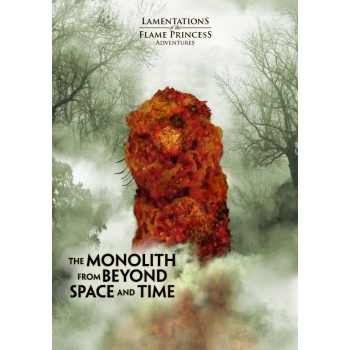
Into this:

They owned that bitch. You know, given the nature of that adventure, it might just be a sign that the PCs have gotten a little too powerful (they're average level 9 now, I think).
Luckily that's totally fine, because I know there's only so many more adventures left in the campaign. And even so, there's still the risk elements caused by the total absence of resurrection magic. In fact, in the session last nights the party nearly got casualties a couple of times, not from anything to do with the Monolith, but from encounters in places they visited with it (a Bronze Golem guarding the Paris Treasure Vault of the Frogmen, and a Bronze Dragon guarding a piece of the Lance of Mithras in the catacombs below the ruins of Corinth).
Anyways, just thought I'd share that little detail. In spite of how easy-peasey the Monolith was, my players are still really enjoying the LotFP game and the Dark Albion campaign alike. They're in 1479, the campaign ends in 1485, so I figure there's maybe only a dozen or so sessions left. Home Stretch.
RPGPundit
Currently Smoking: Lorenzetti half-volcano + Gawith's Balkan Flake
Subscribe to:
Posts (Atom)